Trending

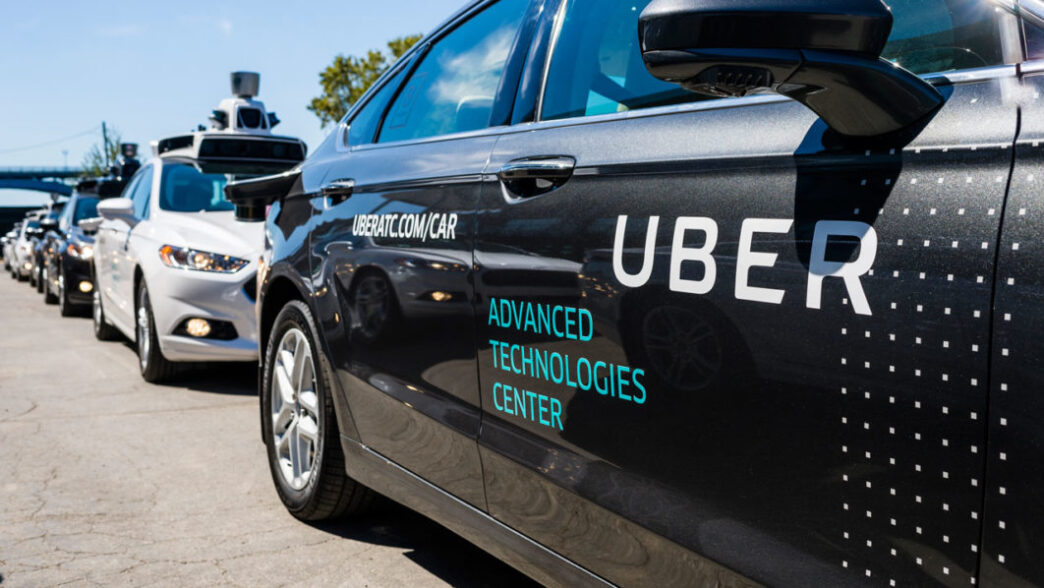
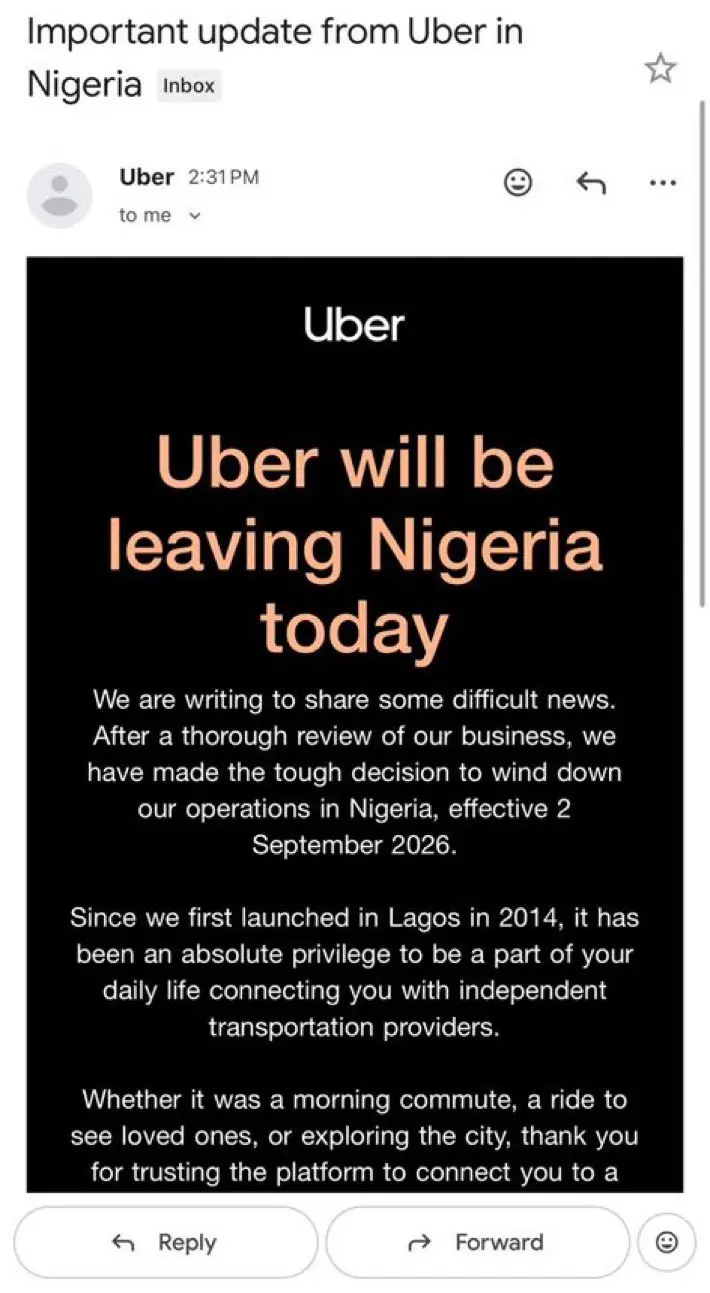
When news broke that Uber was leaving Nigeria, drivers and customers in Nigeria’s capital, Abuja, didn’t all react the same way.
Interviews conducted by the News Agency of Nigeria (NAN) on Thursday revealed a split between those mourning the loss and those ready to move on.
Some described the exit as a genuine setback that will squeeze their income and raise transport costs.
Read More : Makinde Predicts APM Overwhelming Victory
Others saw it differently, framing the departure as a chance for Nigerians to shift their support toward homegrown ride-hailing alternatives.
‘I Have Achieved a Lot From Them’
Friday Ayegba, who has driven for Uber for nearly three years, said the news left him disheartened.
He explained that the platform’s bonus structure and promotional campaigns had meaningfully lowered his operating costs over the years, and that his Uber earnings had become central to how he supports his family.
“Uber is very important to my family because what I earn from Uber is what I use to support my family. I have achieved a lot from them, and leaving Nigeria now will affect us because we don’t have any app that offers us promos and bonuses like Uber,” he said
He credited Uber’s mapping system in particular, calling it consistently accurate no matter the destination, and said the company’s fares generally held up well against competitors.
“Anywhere we are going, once you pick the place, the map is accurate. Their money and fare are also good compared to others. Uber normally gives us driver promos that help us adjust our fuel expenditure, but now that they are going, it is going to affect us much,” he added.
Losing access to the driver bonuses that helped him manage fuel costs, he said, will be a real blow: especially since, in his view, no other app currently on the market offers comparable perks.
‘The Cheapest and Most Affordable’
A customer, Mercy Marcus, shared a similar sense of loss.
She ranked Uber as the most wallet-friendly of the major ride-hailing options ahead of Bolt and InDrive and said she came to rely on the combination of low fares and a comfortable, well-organised service.
“It was comfortable, very organised and cheap transport. I’m really going to miss that about Uber — being the cheapest and most affordable comfort ride I could get,” she said.
With Uber gone, she expects her commuting costs to rise and said she’ll miss the affordability and comfort most.
‘Another Entity Will Take Over’
Not everyone is bracing for disruption.
Another customer, Kasim Abdullah, said he doesn’t expect the exit to meaningfully affect his own travel, since Bolt, InDrive, and other newer platforms are already available as backups.
“I don’t believe that a company will just sell off their business in a location and vacate like that. I always believe that another entity or company will take over,” he said.
Comparing his experience with Uber and Bolt, he noted that Bolt tends to connect riders with drivers more quickly, while Uber has usually been the cheaper option.
Rather than expecting a lasting gap in the market, Abdullah predicted that another company would move in to absorb the demand, saying he doesn’t believe a firm would simply exit a market without something else stepping in to replace it.
He also pointed out that many drivers already run multiple apps simultaneously, which should make the transition away from Uber fairly smooth.
‘I Have Nothing to Miss’
Driver Emmanuel Ogbor was the least sentimental about the news, saying Uber’s business model had already stopped working in his favour.
He put the company’s commission at around 30 percent per ride, a cut he said was hard to justify given that fuel currently costs about ₦1,360.
By comparison, he described InDrive’s commission, which he estimated at roughly 6.1 percent, as a far fairer deal, and encouraged other Nigerians to back local ride-hailing companies going forward.
Because Uber was never more than supplementary income for him, Ogbor said the exit won’t affect his finances much.
He added that any concerns about lost government tax revenue are likely overblown, arguing that the same taxes drivers currently pay will simply carry over to whichever platforms absorb Uber’s former customer base.
“I don’t know how much government is collecting from them, but as an e-hailing service company, the same tax that we drivers are paying is the same tax that we are paying in every other company. So, if they depart, the income and tax will also shift from them to another company,” he said.
Asked directly what he would miss about the service, he answered briefly: nothing.
“I have nothing to miss,” he added.
Ogbor offered one recommendation to policymakers: step in to support the development of local alternatives that can fill the space Uber leaves behind.