Trending


The Lagos State Internal Revenue Service (LIRS) has announced plans to enforce its statutory powers to recover unpaid taxes from defaulting taxpayers through third parties, including banks, employers, tenants, debtors and business partners.
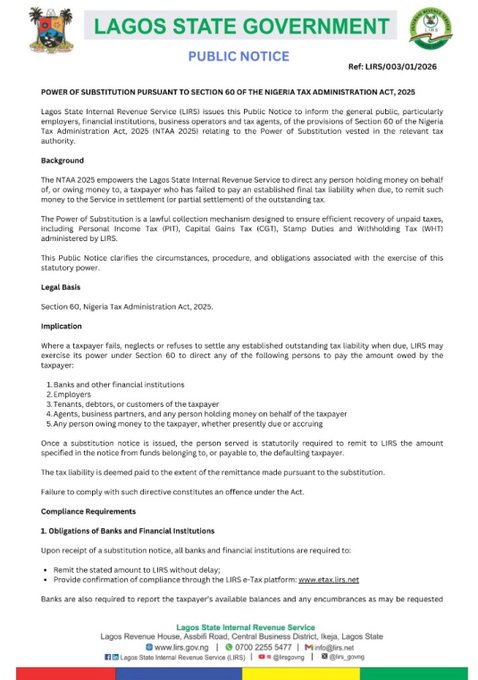
The directive was contained in a public notice dated January 21, 2026, published on the LIRS website and signed by the Service’s Executive Chairman, Ayodele Subair.
According to the notice, LIRS is empowered under Section 60 of the Nigeria Tax Administration Act (NTAA), 2025, to direct any person holding money on behalf of, or owing money to, a taxpayer who has failed to pay a final and established tax liability to remit such funds to the Service.
The agency said the power, known as substitution, applies to unpaid taxes administered by LIRS, including Personal Income Tax, Capital Gains Tax, Stamp Duties and Withholding Tax.
The notice read, “The Lagos State Internal Revenue Service (LIRS) issues this public notice to inform the general public, particularly employers, financial institutions, business operators and tax agents, of the provisions of Section 60 of the Nigeria Tax Administration Act, 2025 (NTAA 2025), relating to the power of substitution vested in the relevant tax authority.
“The NTAA 2025 empowers the Lagos State Internal Revenue Service to direct any person holding money on behalf of, or owing money to, a taxpayer who has failed to pay an established final tax liability when due, to remit such money to the Service in settlement (or partial settlement) of the outstanding tax.
“The power of substitution is a lawful collection mechanism designed to ensure efficient recovery of unpaid taxes, including Personal Income Tax (PIT), Capital Gains Tax (CGT), Stamp Duties and Withholding Tax (WHT) administered by LIRS.”
LIRS explained that the substitution power may be exercised where a taxpayer fails, neglects or refuses to settle an outstanding tax liability when due.

In such cases, banks, financial institutions, employers, tenants, customers, agents, business partners and other persons owing money to the taxpayer may be directed to pay the amount directly to the Service.
“Where a taxpayer fails, neglects or refuses to settle any established outstanding tax liability when due, LIRS may exercise its power under Section 60 to direct any of the following persons to pay the amount owed by the taxpayer,” the notice added.
“Banks and other financial institutions, employers, tenants, debtors, customers, agents, business partners and any person owing money to a defaulting taxpayer may be directed to pay such amounts directly to LIRS.”
On procedure, the notice stated that “once a substitution notice is issued, the person served is statutorily required to remit to LIRS the amount specified in the notice from funds belonging to, or payable to, the defaulting taxpayer.”
The Service warned that failure to comply with a substitution directive constitutes an offence under the Act.
It added that a tax liability is considered settled only to the extent of the amount remitted through the substitution process.
LIRS said banks and financial institutions served with substitution notices must remit the stated amount without delay, confirm compliance through the LIRS e-Tax platform, and provide information on the taxpayer’s available balances where required.
Employers, tenants, agents and other affected parties were similarly directed to withhold the specified sums from payments due to the taxpayer and remit them to LIRS within the period stated in the notice.
The agency noted that any person who does not hold or owe money to the taxpayer must notify LIRS in writing within the stipulated timeframe.
It added that recipients of substitution notices may object in writing within 30 days, in line with the law’s appeal provisions.
While substitution may be used to recover unpaid taxes, LIRS said defaulting taxpayers remain liable for any outstanding balance not recovered and advised them to settle their tax obligations promptly to avoid penalties.
The notice warned that non-compliance with substitution directives could result in liability equal to the specified tax amount, additional penalties and interest, enforcement actions, including distraint, and possible prosecution.