Trending


Myanmar’s deposed leader, Aung San Suu Kyi, has been moved to house arrest after spending nearly five years in detention following the 2021 military coup.
The move was ordered by junta chief-turned-president Min Aung Hlaing on Thursday. According to a statement from his office, Suu Kyi’s remaining sentence, which was handed down on multiple charges, has been commuted, and she is now required to serve her sentence at a designated residence.
However, the statement did not specify where Suu Kyi would be moved, although a senior source within her dissolved National League for Democracy (NLD) party indicated that she is likely to be placed in an undisclosed location within the capital, Naypyidaw.
Read More : Washington Tightens Iran Economic Squeeze
“We do not know where it is exactly,” the source, speaking on condition of anonymity, told AFP. The statement did not clarify how much of Suu Kyi’s original sentence remains, leaving questions unanswered about her long-term future.
Suu Kyi, who was 80 years old when the junta took power, was detained under charges widely regarded by rights groups as fabricated to prevent her from returning to politics. Her arrest sparked a civil war that continues to ravage Myanmar, resulting in thousands of deaths and millions of displacements.
Min Aung Hlaing, who led the coup in February 2021, assumed the title of civilian president this month after a tightly controlled election that excluded Suu Kyi’s NLD party and barred free elections in areas controlled by rebel groups.
Despite a military-backed electoral victory, the international community has widely condemned the process as a thinly veiled attempt to solidify military rule, rather than returning to democratic principles.
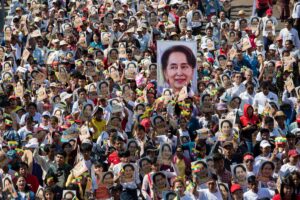
The political manoeuvre has been accompanied by limited concessions, such as the pardon of some prisoners, which critics argue are superficial attempts to improve the junta’s image.
“They’re playing their same usual games as far as I’m concerned,” Suu Kyi’s son, Kim Aris, said in an interview with AFP. “They’re trying to legitimise themselves in the eyes of the international media and governments around the world.”
While Suu Kyi remains a symbol of resistance to the military junta, her family has expressed deep concern over her health, as she remains isolated and largely cut off from communication.
Read More : UNGA: Lavrov Offers Help in Gulf, Slams Europe
Kim Aris expressed hope that if his mother is indeed moved to house arrest, she will be granted the right to communicate with her family and legal team.
“If she has actually been moved to house arrest, then I hope that she will be allowed communication with me and her lawyers, amongst others,” he said. “Nobody has reached out to me.”
Suu Kyi’s ongoing detention, despite her widespread popularity, underscores the continuing power struggle in Myanmar, where the military’s hold over the nation remains firm, despite efforts by various groups to reclaim control.