Trending
Botswana is accelerating efforts to reduce its dependence on diamonds as global demand weakens and synthetic alternatives reshape the market. The country is expanding partnerships, sovereign investment tools, and regional integration strategies to build new sources of growth.
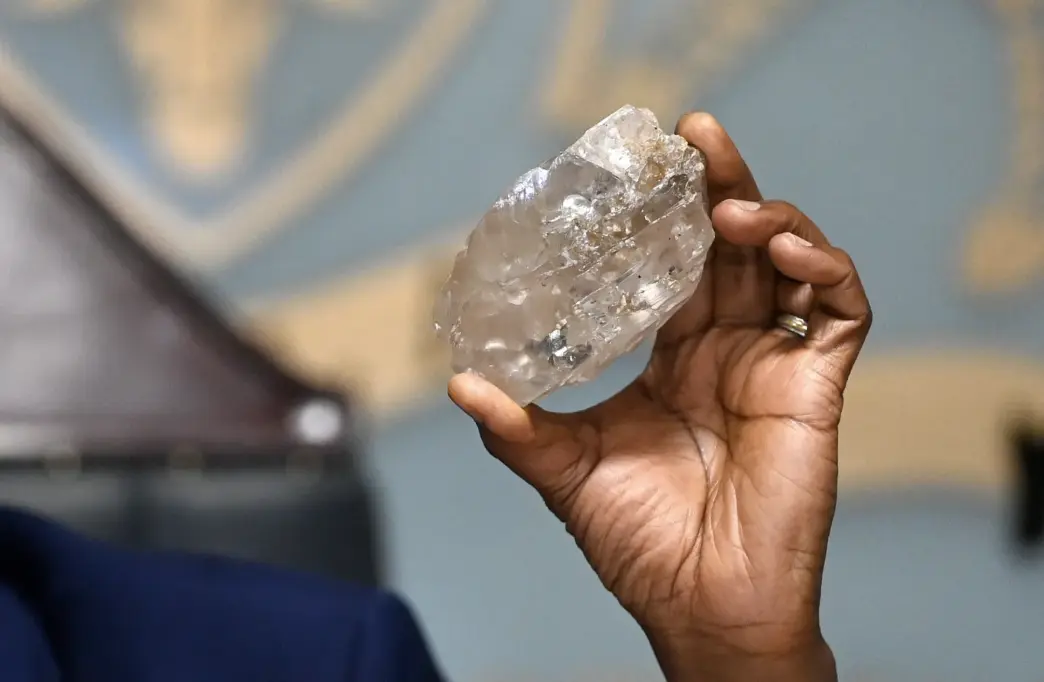
Botswana’s diamonds have long been featured on global stages. From multi-million-dollar jewellery showcased at global events such as the Met Gala to medals embedded with locally sourced stones at sporting showcases such as the Debswana World Athletics Relays in Gaborone, they sit at the intersection of luxury spectacle and state revenue.
That intersection is now under strain as global diamond demand weakens amid rising synthetic supply, shifting consumer preferences, and softer luxury cycles in key markets.
Read More : Surging Ebola Outbreak Overwhelms Congo
“Diversification and investment in different sectors is the way forward. Africa has to learn from Saudi Arabia and not depend on only mineral resources,” according to Herbert Kirumira, a sector analyst.
Botswana’s economy has been plummeting in recent years. S&P Global downgraded the country’s sovereign rating to BBB- in 2025, citing weaker diamond revenues, widening fiscal deficits, and limited diversification buffers.
“The downgrade reflects rising pressure on an economy still heavily anchored in mineral exports,” according to Dickson Waswa, a Nairobi-based economist.
In 2025, diamond production fell by roughly 40%, while revenues dropped by about half, according to government-linked estimates and industry reporting. Diamonds still account for about a quarter of GDP and up to 80% of export earnings, making the contraction structurally significant.
The fiscal impact has been immediate, with the budget deficit widening to nearly 9% of GDP as growth forecasts were repeatedly revised downward.
“The scale of adjustment required is now materially larger than earlier projections,” Waswa said, pointing to weakening export inflows and tightening fiscal space.
Pressure is also accumulating in inventories. By early 2026, diamond stockpiles had reached around 12 million carats, nearly double the government’s comfort level of about 6.5 million carats.
The build-up reflects weak global absorption, softer demand in major markets such as the United States and China, and intensifying competition from lab-grown diamonds. Synthetic stones, now estimated to account for about one-fifth of global diamond demand, have expanded from near marginal levels a decade ago. Analysts project continued growth.
This shift is reshaping Botswana’s external position. Mineral revenues are projected at about 10.3 billion pula in 2025/26, far below historical averages of more than 25 billion pula, underscoring a prolonged erosion in export earnings and fiscal buffers.
The challenge is not unique to Botswana. Across Africa, resource-dependent economies are facing similar exposure. Angola continues to grapple with volatility in oil revenue, Zambia with dependence on the copper cycle, and Namibia with diamond-linked fiscal sensitivity through joint ventures such as Debmarine.
Across these cases, the structural issue is that fiscal systems remain anchored in single commodities before diversified sectors are mature enough to absorb shocks.
In Botswana, the slowdown is already tightening fiscal space and reducing room for public investment. Lower diamond inflows are constraining macroeconomic buffers that have historically underpinned stability through commodity cycles.
“Botswana’s fiscal model is being stress-tested at the exact moment its primary export engine is weakening,” Waswa explained.
Policy response has focused on adjustment rather than rupture. In 2025, Botswana renegotiated its agreement with De Beers, increasing the state’s allocation of Debswana output through the Okavango Diamond Company from about 25% to 30%, with a phased pathway toward as much as 50% over the next decade, according to the joint terms of the deal.

The agreement also extends Debswana’s mining licenses for 25 years, locking in long-term production continuity even as global demand conditions weaken. The deal followed years of tense negotiations over pricing power, sales channels, and Botswana’s desire to capture more downstream value, including through partnerships such as its stake in HB Antwerp.
While officials framed the agreement as a “transformational reset” for Botswana’s role in the diamond value chain, analysts note it also reflects a pragmatic compromise: greater control over supply today in exchange for continued reliance on a structurally weakening market.
“As supply dynamics shift and natural diamonds face sustained pricing pressure, producer states are increasingly negotiating for volume and control rather than just royalty uplift,” Waswa said, pointing to a broader rebalancing of power between governments and traditional trading houses.
Alongside this, the Botswana Economic Transformation Programme has been launched, targeting services-led growth, investment attraction, financial sector expansion, and broader economic diversification.
Diversification is also increasingly external. In 2026, Botswana signed agreements with Oman covering mineral exploration, oil storage infrastructure, and renewable energy cooperation. The country has also been linked to discussions on Angola’s Lobito Corridor, particularly regarding logistics and mineral export infrastructure.
These moves suggest a transition from domestic industrial build-out to regional integration, in which Botswana positions itself within existing value chains rather than building entirely new ones.
At the same time, Botswana is expanding its diversification push into critical minerals. Early-stage exploration partnerships, including work with Tsodilo Resources and the University of Cape Town, are focusing on rare earth elements in Ngamiland.
“Critical minerals could become a second pillar if exploration translates into commercially viable deposits,” according to Waswa.
Alongside resource diversification, Botswana is experimenting with early-stage financial repositioning. Sovereign investment mechanisms and fund-of-funds structures are being developed to channel capital into emerging sectors such as energy, tourism, SMEs, and digital industries.
This is reinforced by the creation of the Botswana Sovereign Wealth Fund Limited in 2025, which is designed to invest domestically and internationally while smoothing income volatility across mining cycles. A governance official described its purpose as “building resilience beyond diamonds through disciplined long-term capital allocation.”
Private capital activity is also emerging, including a reported £50 million (more than US$67 million) in the Botswana Tech Fund, which is focused on technology and venture investment, with ambitions to position the country as a regional fund-domiciliation hub within Southern Africa.
However, these initiatives remain early-stage and institutionally thin compared to established financial centres. The gap between ambition and absorptive capacity remains significant.
IMF researchers expect the economy to expand by 4.7% this year, the second-strongest performance in the region after Zimbabwe’s projected 5%.
Credit: Bonface Orucho, Bird Story Agency