Trending
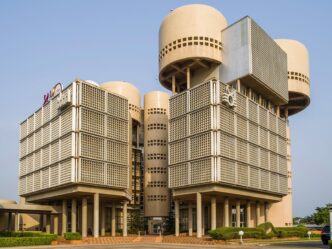
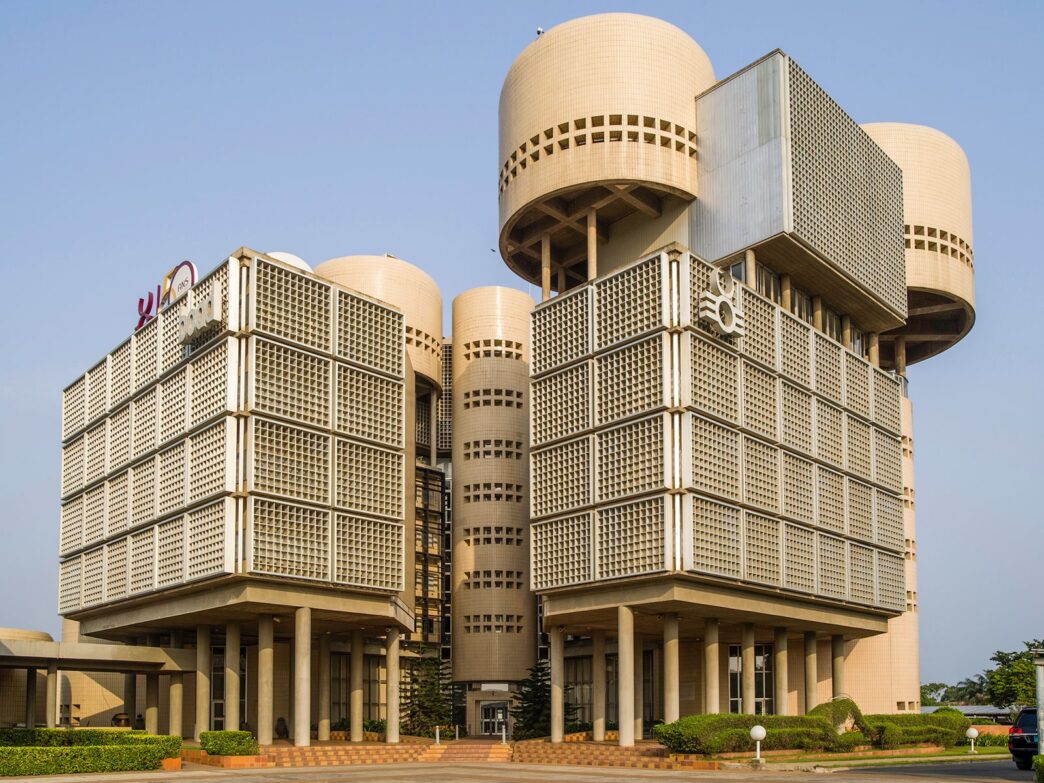
Major cultural institutions are increasingly commissioning documentary films to capture African architectural heritage, integrating moving images directly into exhibition designs and permanent archives.
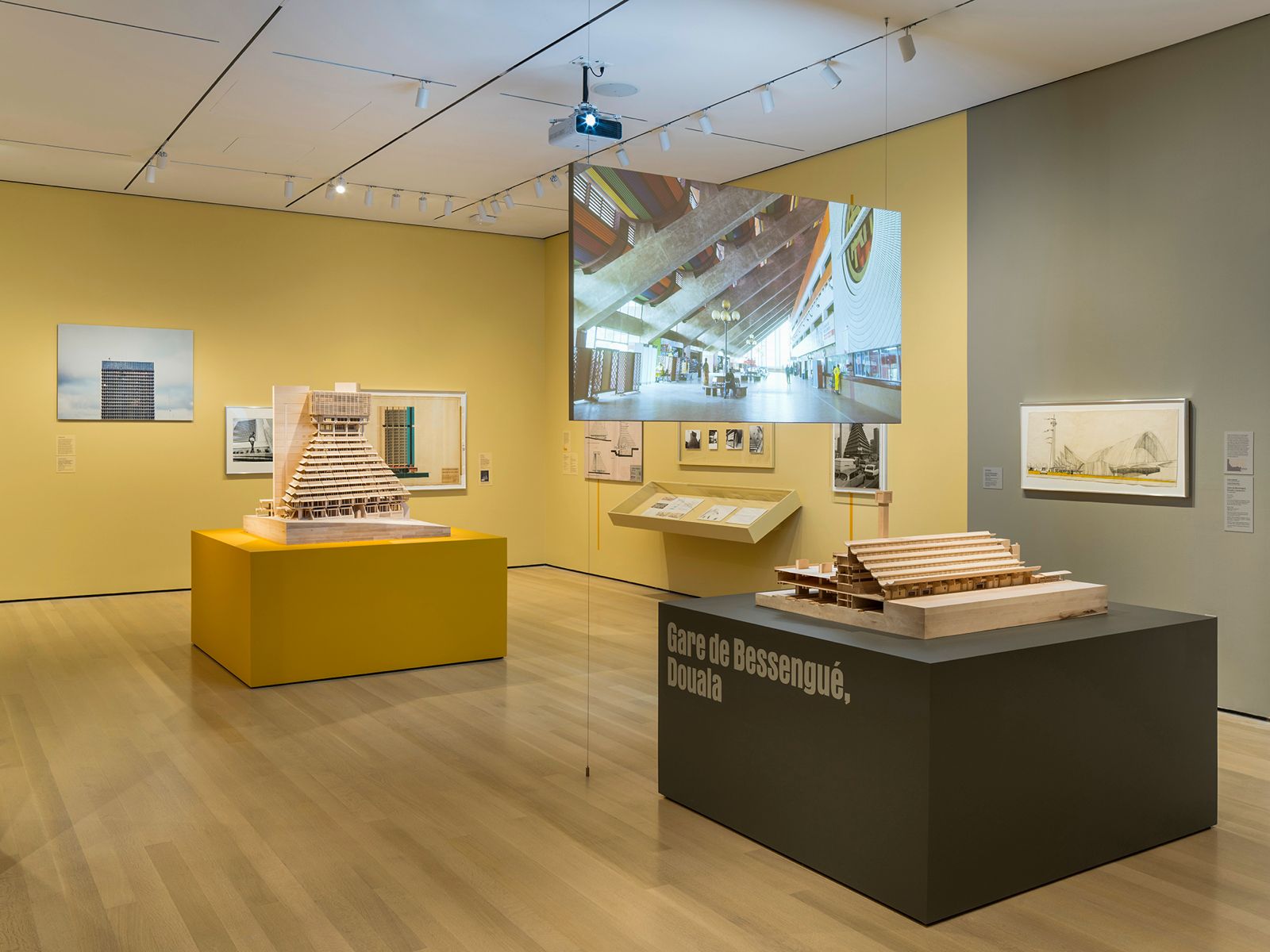
It glides over the dense fabric of Douala before settling on a railway station whose concrete roof rises and falls in sweeping curves. Sunlight catches bands of coloured aluminium slats, while a monumental clock tower anchors the building against the skyline.
The camera moves through the vast concourse, across glass, tile and exposed concrete, revealing a station designed in 1978 to connect Cameroon’s rural regions to its growing cities.
Read More : Mariama Camara Champions African Textiles
The sequence is part of Architects of Liberation: Modernism in Western Africa, the Museum of Modern Art’s major exhibition in New York, which runs until January 2, 2027. Alongside architectural drawings, models and archival photographs, the exhibition includes a suite of newly commissioned documentary films.
Exhibition Design
The exhibition is one of the clearest examples of a broader shift. Museums are commissioning films as part of exhibition design, architectural research and heritage preservation, documenting buildings, landscapes and architectural knowledge as part of their public record.
Architects of Liberation is the first major exhibition to examine West African modern architecture from the late 1950s through the early 1980s in the context of political independence.
Organised by Martino Stierli and Ikem Stanley Okoye, it spans Benin, Cameroon, Côte d’Ivoire, Ghana, Nigeria, Senegal and Togo.
The exhibition brings together around 450 objects from 17 countries after four years of research across the region. It places the work of many overlooked architects alongside films that reconstruct the buildings they designed.
The films follow railway stations, trade fair pavilions, university campuses and experimental homes built during the independence era. They show how architects adapted modernist design to tropical climates, local materials and new national identities.
“In the decades following independence, countries across West Africa used architecture to imagine and build new national identities,” Stierli explains in the exhibition documentary. Modernist buildings became symbols of “progress, self-determination, and Pan-African ambition.”
Futuristic Tower
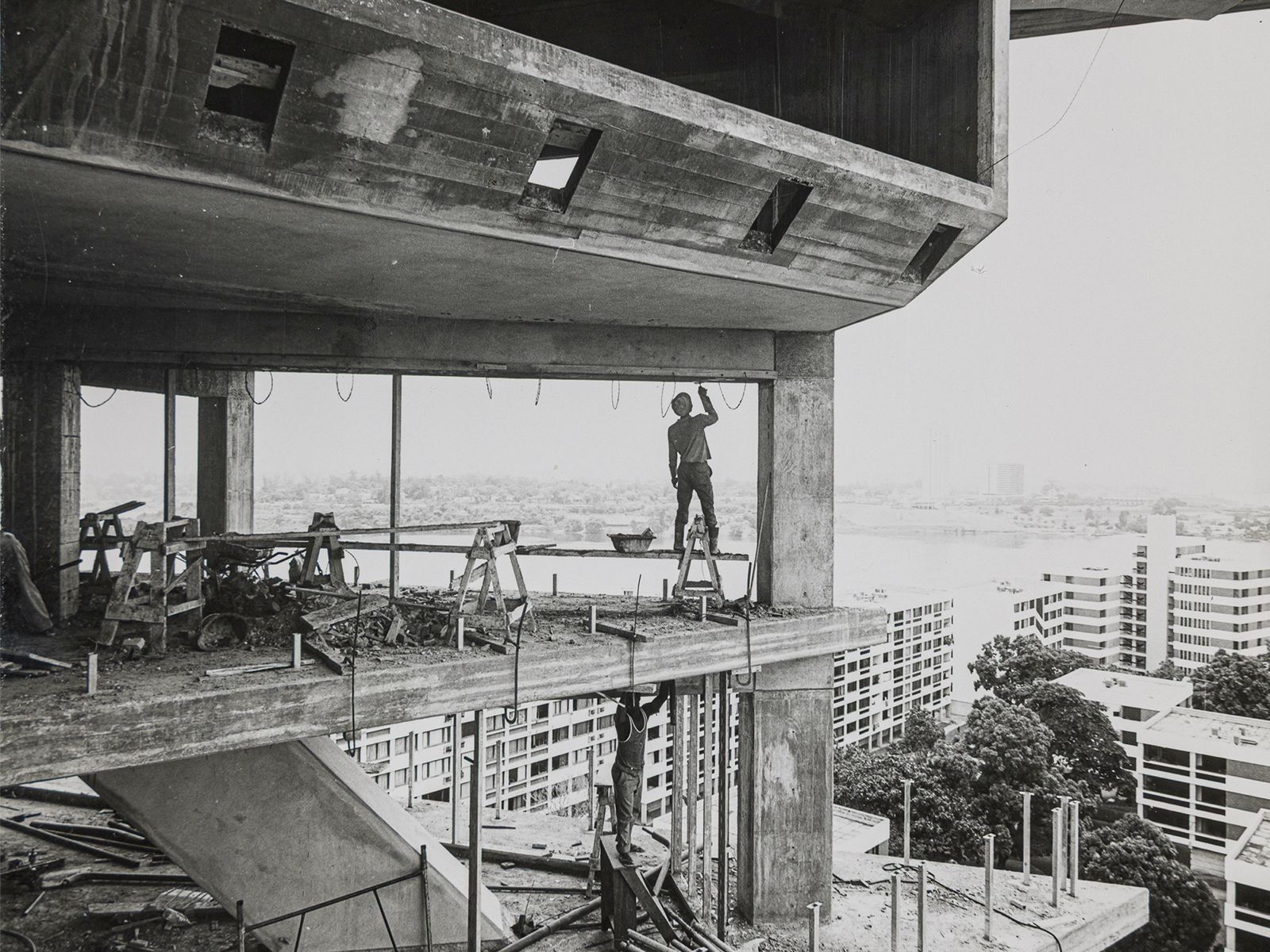
From Cameroon, the film moves to La Pyramide in Abidjan, the futuristic tower built between 1968 and 1973 during Côte d’Ivoire’s economic boom. Its three-storey atrium, tubular staircases and dramatic play of light made it one of the city’s most distinctive buildings.
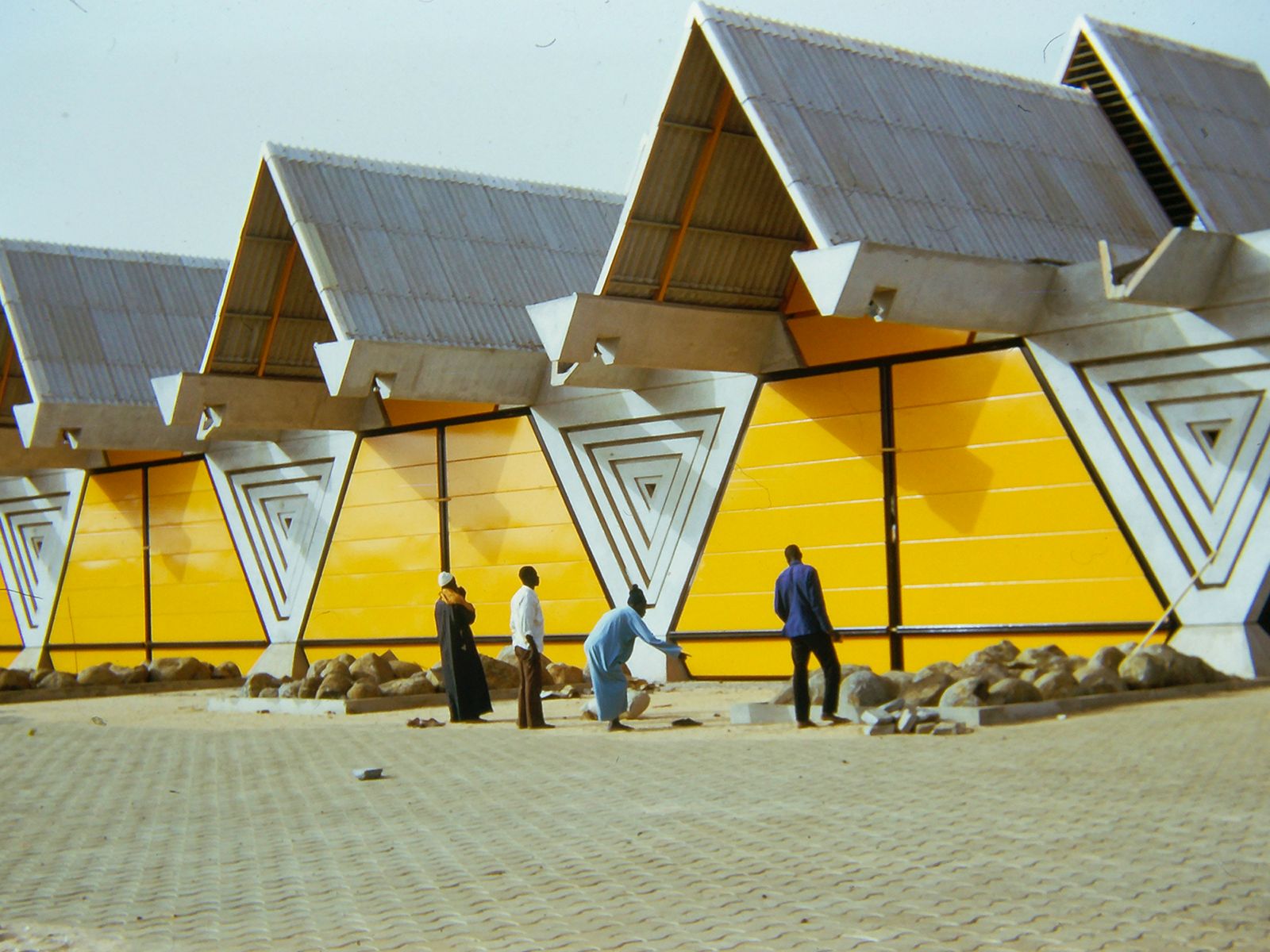
Dakar provides another striking example. The camera moves through the Centre International du Commerce Extérieur du Sénégal (CICES), where triangular rooflines and repeating geometric forms stretch across the trade-fair complex and project Senegal’s post-independence identity.
Accra introduces a different architectural language. The film enters the Scott House, where movable wooden louvres channel airflow through the tropical climate.
Nigeria shifts the focus to education and public infrastructure. The documentary follows the ramps, terraces and shaded walkways of the University of Ife, where climate-responsive design shaped the campus experience.
These films capture movement through courtyards, changing light inside atriums, the rhythm of shaded walkways and the scale of buildings designed for newly independent nations. They record environmental knowledge and spatial experience that architectural drawings and photographs often cannot fully convey.
The shift has become visible across museums and heritage institutions over the past two years.
Documentary Films
The Penn Museum expanded that approach in March with Africa’s Cultural Landmarks, a series of documentary films directed by Ethiopian-American filmmaker Sosena Solomon.
The films take viewers from the rock-hewn churches of Lalibela in Ethiopia and the Kasubi royal tombs in Uganda to the earthworks of Benin City, the sacred grove of Osun-Osogbo in Nigeria and the ruins of Great Zimbabwe.
Produced by the Metropolitan Museum of Art in collaboration with the World Monuments Fund, the series has become part of the permanent display in the museum’s Africa galleries. The films document preservation efforts alongside the communities that maintain and protect these sites.
“Each screening expands the conversation about Africa’s heritage and the communities whose knowledge and stewardship protect these remarkable landmarks,” Solomon said during the Penn Museum programme.
Benin City points to the next phase of this shift. The Museum of West African Art (MOWAA) Institute opened in 2025 as the first completed building in the MOWAA campus and houses research facilities, conservation laboratories, exhibition galleries and public engagement spaces.
Built almost entirely from rammed earth using local laterite, the building is designed around preservation, interpretation and circulation. Its undulating walls, skylights and open public spaces connect architectural heritage, archaeological research and new forms of documentation.
Expanding the Infrastructure
Institutions such as MOWAA are expanding the infrastructure through which African heritage is recorded, interpreted and shared. Film and digital storytelling are becoming part of that archival ecosystem.
Nairobi is emerging as another centre of that ecosystem. The inaugural Pan-African Architecture Biennale, scheduled for September 2026, includes a dedicated short-film platform focused on Africa’s built environment, vernacular knowledge systems and architectural futures.
The biennale brings architects, urban historians, filmmakers and cultural institutions into the same documentary conversation, placing moving-image work alongside architectural research and public engagement.
International heritage institutions are moving in a similar direction. In May 2026, UNESCO announced a partnership with France and Monaco to expand the digitisation and public activation of its audiovisual archives through screenings, research programmes and cultural events.
Heritage Preservation Strategy
The initiative places documentary film, audiovisual collections and public access within the same heritage preservation strategy.
UNESCO has increasingly framed audiovisual archives as resources for research, education and public engagement, linking archives, museums and creative communities more closely.
Read More : Africa Tests New Funding Models for 5G
Nigeria has also become part of that documentary preservation effort. In February 2026, the country became the first African nation to deposit cultural and historical records in the Arctic World Archive in Svalbard, a long-term preservation facility designed to safeguard documentary heritage for future generations. The deposit included records from museums, libraries and cultural organisations.
“One of the key things that has affected Africa is memory,” said Obi Asika, director-general of Nigeria’s National Council for Arts and Culture. “We have not been deliberate about protecting and projecting our narrative.”
Bonface Orucho, Bird Story Agency