Trending
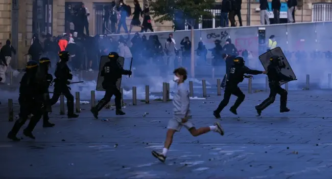
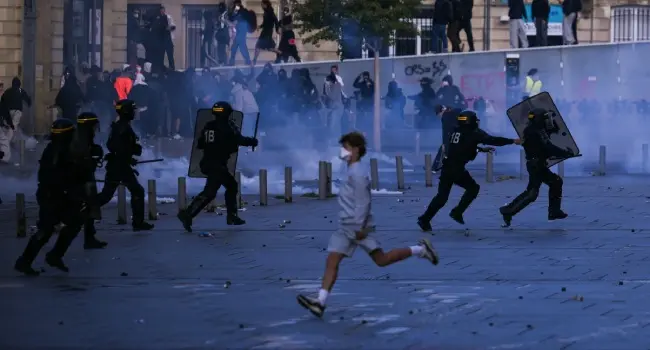
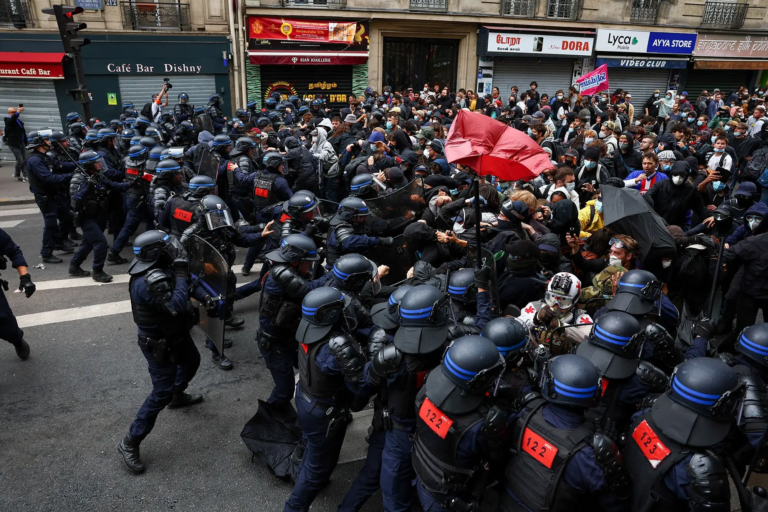
Police clashed with protesters in Paris and several French cities on Saturday as demonstrations against rising living costs turned violent, with fires and tear gas reported at multiple locations.
The protests came as France prepares for elections to replace President Emmanuel Macron, with demonstrators voicing anger over high prices, economic inequality and the government’s handling of social issues.
In Lyon, masked youths set a tourism office ablaze, prompting riot police to deploy tear gas and water cannon to disperse hundreds of demonstrators.
In Marseille, protesters broke into the town hall, overturned a bust and smashed furniture before police forced them out, according to AFP journalists at the scene. The city’s mayor called for additional police reinforcements.
In Lille, demonstrators reportedly forced their way into the mayor’s office and vandalised the premises before leaving.
Thousands march in Paris
In Paris, tens of thousands of people marched through the eastern and northern parts of the city, with some chanting slogans including “Everyone hates the police” and “Macron, resign”.
Agnes, a 50-year-old actor who declined to give her surname, said she joined the demonstration because of the government’s handling of economic and social challenges.
“For years we’ve had climate, economy and equality problems but the government is not doing anything about it,” she said.
High school student Kamil Alahyan, 18, said he was protesting over several issues, including the forthcoming 2027 elections and what he described as dishonesty among politicians and growing wealth among the ultra-rich.
The protests also saw clashes between demonstrators and police in several locations across the capital.
AFP journalists reported that protesters broke windows at the offices of French broadcasters CNews and Europe 1 in western Paris, while several parked cars were set on fire.
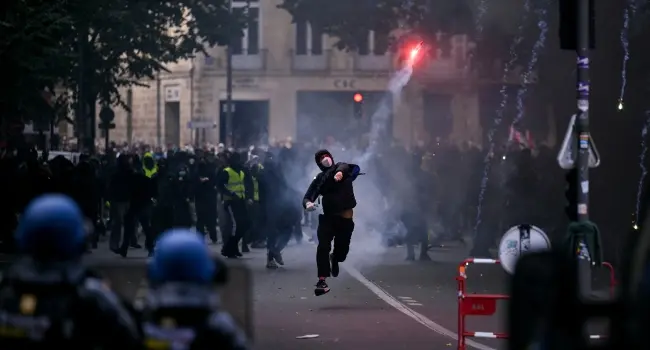
Police used water cannon and tear gas after hundreds of masked protesters, some setting off fireworks, confronted officers at different locations.
Police said more than 130 people were arrested in Paris.
Yellow Vest movement joins demonstrations
The demonstrations were called by France’s Yellow Vest movement, which staged nationwide protests eight years ago against Macron’s government over planned fuel tax increases.
Organisers described the latest mobilisation as “yellow and youth” demonstrations, bringing together groups including former Yellow Vest protesters, secondary school and university students, climate activists and farmers.
A website established by the organisers listed more than 600 planned demonstrations across France.
Authorities in Paris banned protests around government buildings, the Champs-Elysees shopping avenue and train stations.
Many demonstrators blamed inflation for worsening their financial difficulties, with some pointing to rising prices amid the war in the Middle East.
Others protested against what they described as police brutality during student demonstrations that have gripped France over the past four weeks.
The unrest has added to political tensions ahead of the presidential election scheduled for 2027.
Le Pen blames far-left groups
Politicians seeking to succeed Macron have responded to the demonstrations, with disagreements over the causes of the unrest and the conduct of protesters.
Far-right presidential candidate Marine Le Pen, who has expressed support for the police, criticised the violence in a post on X.
“Looting, pillaging, attacking police — rioters have once again sullied the October 17 demonstrations over the cost of living,” she said.
Le Pen claimed that the protesters’ demands had been “hijacked by the far left”.
Her far-left rival, Jean-Luc Melenchon, maintained that most demonstrations across the country had remained peaceful and accused television news outlets of focusing excessively on violent incidents.
Macron had called for “respect for people and property” on Friday.
Some protesters invoked the French Revolution of 1789 during the demonstrations. In Marseille, some shouted, “It’s the Revolution — we’re taking the Bastille!” as demonstrators forced their way into the mayor’s offices.
In La Rochelle, marchers carried a placard reading, “Revolution or death”, while protesters in Montpellier unfurled a giant blue sign bearing the words, “The people will win”.
Ryad Rani, head of the LSU high school student representative body, told journalists in Paris that the government had reason to be concerned about the public anger.
“The government is trembling and it’s right to tremble because when the French people are angry, they never let up,” he said.
Rising prices fuel public anger
The rising cost of living has become a major concern in France, worrying about 45 per cent of the population, according to a survey of 2,000 people published earlier this month.
Franck, a civil servant in his forties who declined to give his surname, said rising prices and stagnant wages had left him struggling financially.
“At the end of the month, I have nothing left. Prices are going up but wages aren’t,” he said while demonstrating in the central town of Gueret, where about 300 people gathered, including high school students.
“We can’t take it anymore, we’re suffocating,” he added.
Read More : India Stampede Kills at Least 19
Purchasing power in France has declined since 2024, while fuel prices have risen amid the US-Iran war, according to the report.
The country, the eurozone’s second-largest economy, is also facing pressure over its public finances, with public debt projected to exceed 120 per cent of gross domestic product next year, twice the European Union’s 60 per cent reference limit.
The demonstrations highlight growing public concern over living costs, economic inequality and government policies as France approaches its next presidential election.