Trending


Ghana will purchase its cocoa using domestic currency and ban the export of raw mineral ores by 2030, President John Mahama announced on the sidelines of the 39th African Union Assembly of Heads of State.
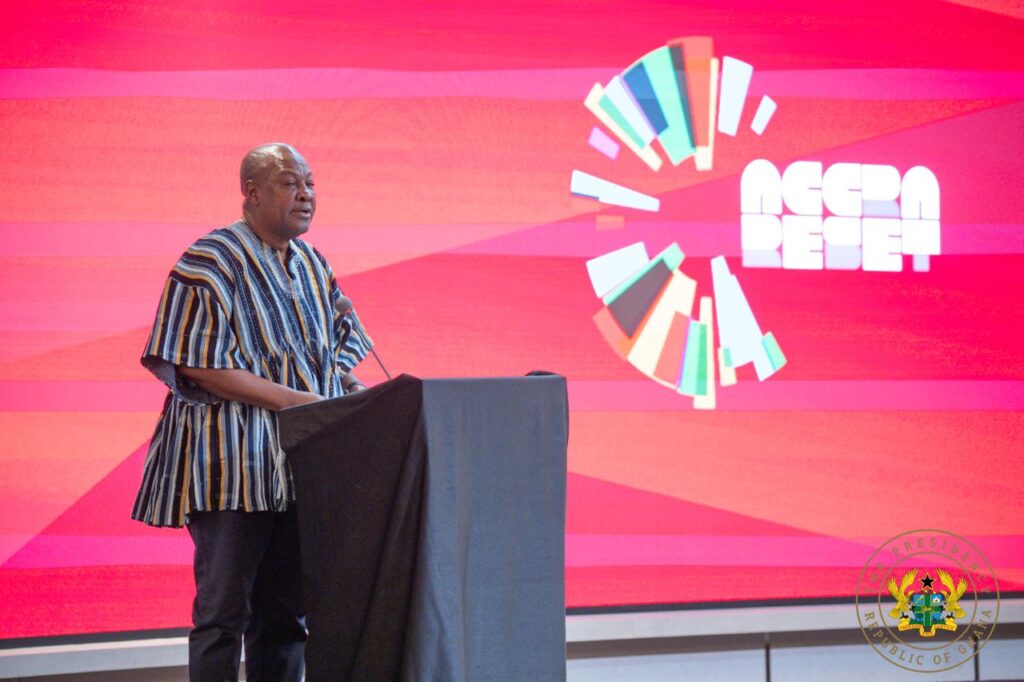
Speaking at the closing of his side event, “Accra Reset’s Addis Reckoning”, Mahama said the reforms aim to reduce dependence on foreign financing and increase local value addition.
“One of the key decisions we’ve made is to stop accepting foreign funding for the purchase of our cocoa. We are going to raise domestic bonds. We have enough Cedis in Ghana to pay for our cocoa,” Mahama announced.
The President explained that prior foreign financing arrangements required Ghana to use cocoa beans as collateral, which restricted local processing.
“You know what the collateral for the funding is? Our own cocoa beans. You collateralise the beans with the financier, buy them, ship them, and they pay you the international market price,” he said.
Under the new plan, Ghana will issue domestic bonds denominated in Cedis to pay cocoa farmers directly, which Mahama said will enable local processors to access 400,000 tonnes of cocoa beans.
“You know the interesting part? We have the capacity to process 400,000 tonnes of those beans in Ghana, but because they are collateralised, we cannot even allocate them to local processors. We must ship all the beans outside.”
Mahama also spoke about mineral exports, announcing that raw ore shipments would cease by 2030.
“I say by 2030, there won’t be any raw mineral ores leaving Ghana. You’re not going to ship raw manganese ore out of Ghana. You’re not going to ship raw bauxite ore out of Ghana. You’re not going to ship raw iron ore out of Ghana. You must process all that locally,” he stated.
The announcements are part of the Accra Reset initiative, which Mahama said is a framework to strengthen African economic sovereignty, increase industrialisation, and create employment.
“That is the only way we can provide opportunities for our young people. Our young people are less patient than our generation. They want to see that progress and prosperity today,” Mahama said.
He added that the reforms also aim to reduce migration pressures on African youth.
“That is why Accra Reset needs that urgency to stop our young people from braving the dangers of the Sahara and the Mediterranean as they try to reach Europe in search of opportunity.”
Mahama urged immediate implementation, saying, “We come with the decisions. We agree. We do the frameworks. What is missing is urgency and implementation. We take time. And we behave like time is waiting for us.
“That is why Accra Reset is a good idea. But let’s implement urgently. If parts of the continent are not ready, let’s form a coalition of the willing to move this as quickly as possible. And let all the others follow and join.”