Trending


The Ghana Revenue Authority (GRA) has announced changes to the country’s Value Added Tax (VAT) system following the passage of the Value Added Tax Act, 2025 (Act 1151), with the reforms slated to take effect on January 1, 2026.
In a public notice to VAT-registered taxpayers, the Authority said the VAT registration threshold for businesses dealing in goods has been increased from GH¢200,000 to GH¢750,000, a move expected to exempt more small businesses from mandatory VAT registration.
GRA also announced the abolition of the COVID-19 Health Recovery Levy and confirmed that the National Health Insurance Levy (NHIL) and Ghana Education Trust Fund (GETFund) levies have been re-coupled to allow taxpayers to claim input tax credits.
Under the new law, both NHIL and GETFund levies will now be treated as input tax deductions. In addition, the VAT rate has been reduced to 20 per cent, which the Authority said is intended to ease the tax burden on households and businesses.
The notice also mentioned the elimination of the VAT Flat Rate Scheme, which opened the door for a single VAT structure meant to increase tax system transparency.

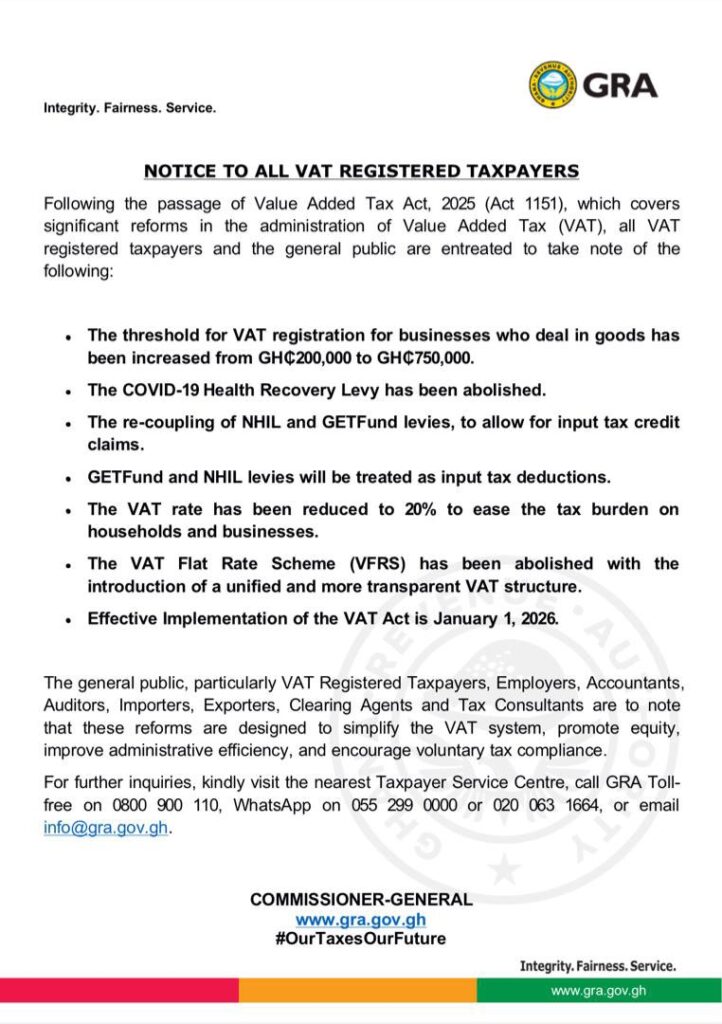
The notice read, “Following the passage of the Value Added Tax Act, 2025 (Act 1151), which covers significant reforms in the administration of Value Added Tax (VAT), all VAT-registered taxpayers and the general public are entreated to take note of the following:
“The threshold for VAT registration for businesses that deal in goods has been increased from GH$200,000 to GH$750,000.
“The COVID-19 Health Recovery Levy has been abolished.
“The re-coupling of NHIL and GETFund levies to allow for input tax credit claims.
“GETFund and NHIL levies will be treated as input tax deductions.
“The VAT rate has been reduced to 20% to ease the tax burden on households and businesses.
“The VAT Flat Rate Scheme (VFRS) has been abolished with the introduction of a unified and more transparent VAT structure.
“Effective Implementation of the VAT Act is January 1, 2026.”
Before the changes are put into effect, the Authority advised VAT-registered taxpayers, employers, accountants, auditors, importers, exporters, clearing agents, and tax consultants to note that these reforms are “designed to simplify the VAT system, promote equity, improve administrative efficiency, and encourage voluntary tax compliance.”