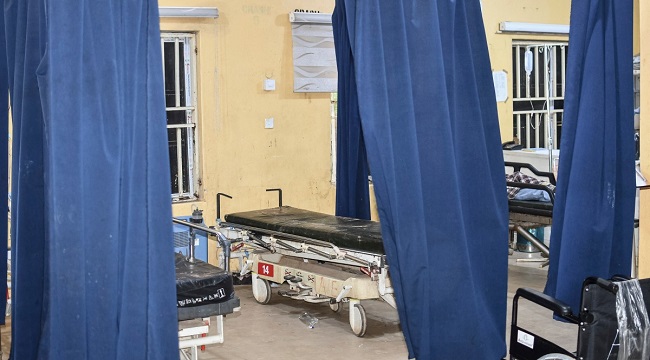
The Joint Health Sector Union (JOHESU) has urged Nigerians to hold the Nigerian Government responsible for the hardship faced by patients and others needing medical care as a result of the ongoing strike by its members.
The union said its sole demand remains the implementation of the report on the adjustment of the Consolidated Health Salary Structure (CONHESS) for health workers.
Speaking on Channels Television’s The Morning Brief on Monday, JOHESU’s National Secretary, Martin Egbanubi, said Nigerians should not blame the union for the disruption to healthcare services. He argued that the government must take responsibility by addressing the issue to prevent similar strikes in the future.

Egbanubi acknowledged the impact of the strike on citizens, particularly those who cannot afford private healthcare, but stressed that JOHESU members have also suffered losses. He disclosed that the union recently lost a member at the University of Uyo Teaching Hospital.
He appealed to well-meaning Nigerians to pressure the Federal Government to meet the union’s demand so that the strike could be suspended, adding that the union derived no satisfaction from the action and faced significant logistical and personal challenges in sustaining it.
The national secretary also expressed disappointment that the government had failed to act despite several engagements, including President Bola Tinubu’s assurance in June 2023 that the relevant ministries and agencies would address the issue. He said the union had since written to the President to remind him of that commitment.
JOHESU declared an indefinite strike in November 2025, insisting it would continue until the adjusted CONHESS was implemented. The National Chairman of the Medical and Health Workers Union, Kabiru Minjibri, warned that the action would disrupt healthcare delivery and academic activities nationwide, citing the government’s failure to honour agreements.
Last week, the Trade Union Congress (TUC) backed the strike and rejected a Federal Ministry of Health and Social Welfare circular enforcing a “No Work, No Pay” policy and the stoppage of salaries through the IPPIS from January 2026. The TUC described the directive as unacceptable, accused the government of intimidation, and said it undermined ongoing negotiations and violated established industrial relations principles.
Author
-
Toyibat is a highly motivated Mass Communication major and results-oriented professional with a robust foundation in media, education, and communication. Leveraging years of hands-on experience in journalism, she has honed her ability to craft compelling narratives, conduct thorough research, and deliver accurate and engaging content that resonates with diverse audiences.
Trending