Macron Criticises US-Israel Strikes on Iran

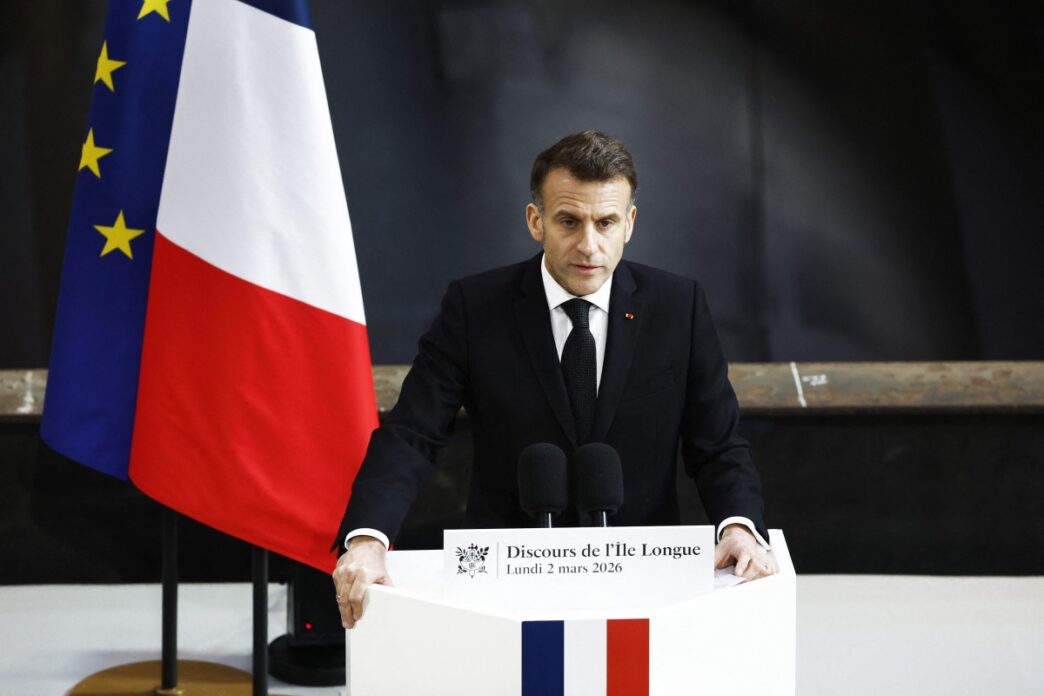
France's President Emmanuel Macron delivers a speech next to nuclear-powered ballistic missile submarine (SSBN) submarine "Le Temeraire" - S617 during his visit to the Nuclear Submarine Navy Base of Ile Longue in Crozon, north-western France on March 2, 2026. High expectations, few certainties: on March 2, 2026, Emmanuel Macron is set to outline how France's nuclear deterrent can help strengthen security in Europe in the face of a increasingly brutal world and an increasingly uncertain US ally. This issue has been brought sharply into focus by the Israeli-US offensive in Iran this weekend, against the backdrop of the Iranian nuclear crisis, which is shaking the entire Middle East and, by extension, the international community. (Photo by Yoan VALAT / POOL / AFP)

French President Emmanuel Macron has sharply criticised the ongoing military campaign by the United States and Israel against Iran, warning that the strikes risk destabilising the region and undermining international law.

Speaking during a state visit to South Korea on Sunday, Macron described the operation as “outside the framework of international law” and cautioned it could “open a Pandora’s box.”

The French president acknowledged that Iran’s leadership remains “a very bad regime,” but insisted that military force alone cannot resolve deep-rooted geopolitical tensions.
Advertisement

                                                                               Macron Criticises US-Israel Strikes on Iran

Drawing on recent history, Macron pointed to interventions in Iraq, Afghanistan, and Libya as cautionary examples where external military action failed to deliver lasting stability. His remarks reflect growing concern in European capitals that escalation in the Middle East could spiral into a broader conflict with global consequences.

Macron also underscored France’s absence from the joint US-Israeli strikes, stressing that such unilateral action sets a dangerous precedent. According to him, bypassing international consensus weakens the principle of national sovereignty and risks normalising regime-change operations without multilateral backing.

As tensions continue to rise, particularly following a renewed ultimatum to Tehran from Donald Trump, Macron is advocating what he described as a diplomatic “third way.”

The proposal centres on building a coalition of global powers to de-escalate hostilities while safeguarding key economic routes, including the strategically vital Strait of Hormuz.

 

Author

  • Tope Oke

    Temitope is a storyteller driven by a passion for the intricate world of geopolitics, the raw beauty of wildlife, and the dynamic spirit of sports. As both a writer and editor, he excels at crafting insightful and impactful narratives that not only inform but also inspire and advocate for positive change. Through his work, he aims to shed light on complex issues, celebrate diverse perspectives, and encourage readers to engage with the world around them in a more meaningful way.

Share the Story
Advertisement

Keep Up to Date with the Most Important News

Weekly roundups. Sharp analysis. Zero noise.
The NewsCentral TV Newsletter delivers the headlines that matter—straight to your inbox, keeping you updated regularly.