Trending

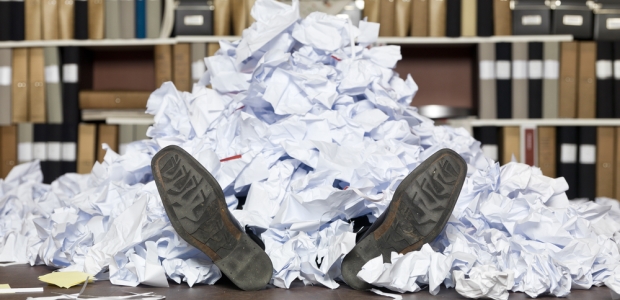
Despite the Nigerian government’s transition to a paperless civil service, the Office of the Head of the Civil Service of the Federation (HCSF) and 10 ministries have proposed to spend a total of N2,463,596,694 on paper and other office consumables in the 2026 fiscal year.
The figure represents an increase of N731,853,324, or 42.3 percent, compared to the N1,731,743,370 spent on stationery in 2025, Guardian Nigeria has reported.
According to The Guardian, the proposed spending comes months after the Head of the Civil Service of the Federation, Didi Esther Walson-Jack, launched the 1Gov Enterprise Content Management System (ECMS), a central part of the Federal Civil Service Strategy and Implementation Plan (FCSSIP 2025), aimed at digitising government operations and reducing paper use.
By December 31, 2025, Walson-Jack announced that all 38 ministries and extra-ministerial departments had gone digital, with physical paper submissions no longer accepted in government registries.
“To consolidate these gains and end the culture of paper-based bureaucracy, the 38 Federal Ministries and Extra-Ministerial Departments will no longer accept paper submissions through their physical registries,” Walson-Jack said.
However, an analysis of the 2026 budget proposal submitted to the National Assembly, as cited by The Guardian, shows that expected savings from the paperless initiative have yet to be realised.
The HCSF, which spearheaded the digital transition, proposed spending N300,875,037 on stationery in 2026. This is N101,104,700, or 84.4 per cent, higher than its 2025 expenditure.
Similarly, the Federal Ministry of Defence increased its stationery budget from N350,572,345 in 2025 to N638,041,668 in 2026, representing an 82 per cent rise.
The Federal Ministry of Justice proposed increasing funding from N125,000,000 in 2025 to N525,000,000 in 2026, a 320 per cent increase.
Other increases were recorded at the Ministry of Budget and Economic Planning, which raised its stationery allocation from N90,000,000 to N117,000,000, and the Ministry of Police Affairs, which increased its budget from N45,450,000 to N60,467,848.
Out of the 10 ministries analysed, only the Ministry of Women Affairs reduced its stationery budget, cutting it from N138,468,547 in 2025 to N40,000,000 in 2026.
Five other ministries – Agriculture and Food Security, Communications and Digital Economy, Foreign Affairs, Education, and Environment – retained the same stationery allocations for 2026 as in 2025, effectively copying previous budget figures.
Spending on stationery across ministries, departments, and agencies (MDAs) has long been identified as a major drain on public funds. Estimates suggest that Nigeria’s public sector spends about N50 billion annually on paper and related materials.
In 2024, 10 ministries spent a combined N969.37 million on stationery. That figure rose to N1.52 billion in 2025, despite ongoing digital reforms.