Trending


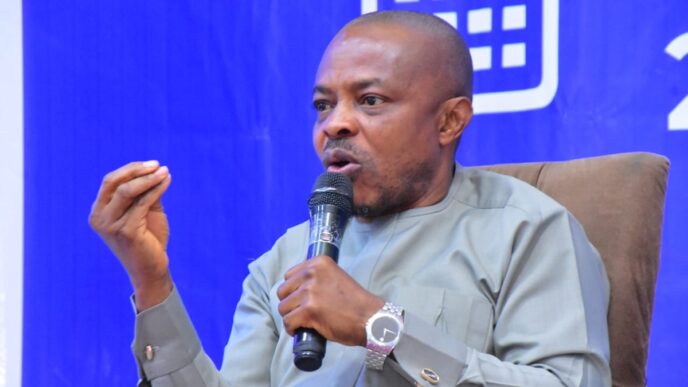
Renowned political economist and public affairs analyst, Professor Pat Utomi, has warned that taxation without transparency, accountability and representation risks deepening public distrust in governance.
Speaking during an interview on News Central TV, Utomi stated that the core problem with Nigeria’s tax debate is the government’s narrow focus on revenue targets rather than transparency and responsible use of public funds.
Utomi stressed that representation is inseparable from taxation, arguing that citizens must be assured their contributions are being used for the collective good.
“Why is representation important? Representation is important because if you take what is mine in order to do something for the collective, the common good, I need to make sure that you use it in the interest of the common good from which I benefit,” he explained.
According to him, accountability should be central to any tax reform conversation, not abstract global benchmarks.
“The more important part of it is accountability, holding the government accountable. But we just say, ah, GDP tax to GDP ratio, the Washington Consensus, nonsense,” he said.

He lamented what he described as the opacity of governance in Nigeria, noting that citizens have little insight into how public funds are spent.
“But how much do Nigerians know of how public officials spend their monies? Very little. Government in Nigeria is opaque. Government officials are profligate in the use of public resources,” he said.
Utomi noted that while government officials often cite international tax-to-GDP ratios to justify higher taxes, such statistics mean little to ordinary Nigerians who see no corresponding improvement in their quality of life.
“What does tax reform really amount to? The base of that conversation is that they say Nigeria does not tax enough.
“They give you statistics that are used around the world for tax to GDP ratio. That’s fine. But what exactly do these mean for people who pay taxes and the benefits of paying taxes?”
Drawing historical parallels, Utomi referenced the Boston Tea Party, which he said laid the foundation for modern taxation principles.
“The way we know taxation in the world today got significant impetus from what was called the Boston Tea Party. It essentially was a revolt based on no taxation without representation.”
He contrasted Nigeria’s governance culture with examples from other African countries, particularly Egypt, where he said public officials demonstrate restraint and strategic leadership.
“Go to Cairo and look at how public officials use public resources. Egypt has twice as much power available as it needs at every point in time. That’s government strategy.”
He added that, unlike Nigeria, Egyptian officials do not display excessive luxury.
“Their government officials don’t go out in 20-car motorcades. They go out in one Toyota Corolla,” he said.
“In Nigeria, they go out in all kinds of fancy cars that cost a fortune, and you say people don’t pay enough taxes. There’s something fundamentally wrong in the thinking about taxes and governance.”
Utomi also criticised the repeated justification of economic hardship using delayed policy impact theories, describing them as recycled excuses.
“So is your life better today than it was three years ago? Ah, well, it’s going to come eventually. Are you kidding me?
“In economics, we talked about the J-curve to justify some of the major policy errors of the Structural Adjustment Program.
“Today, we know that nothing ever curved, and growth never quite took off, because there is something more fundamental, governance.”