Trending
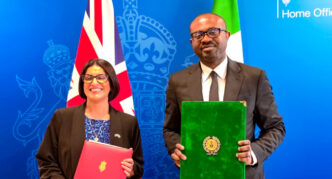
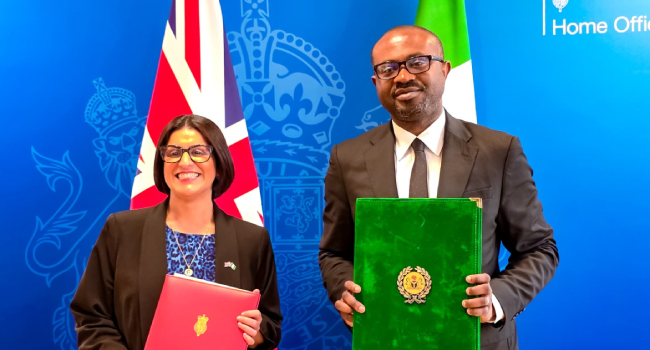
The Nigerian government has clarified details of the recent migration partnership with the United Kingdom.
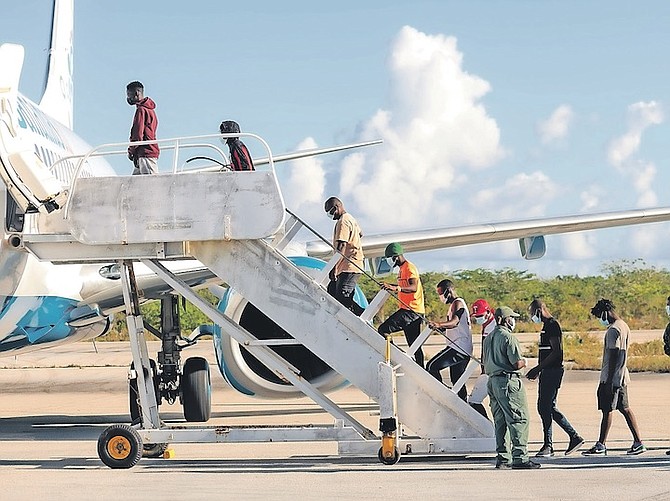
The government noted that all nationals to be repatriated under the agreement will undergo multiple levels of identification and verification to ensure accuracy and safeguard their rights.
Bayo Onanuga, Special Adviser to the President on Information and Strategy, in a statement on Saturday, said, “Nationals to be repatriated must have undergone multiple levels of identification and verification, and, where errors occur, they are returned to the requesting country at the requesting country’s cost.”
He added, “Under the agreement, Nigeria and the United Kingdom will work together to secure the dignified return of their nationals who do not, or no longer, have the right to enter or remain in the territory of the other country.”
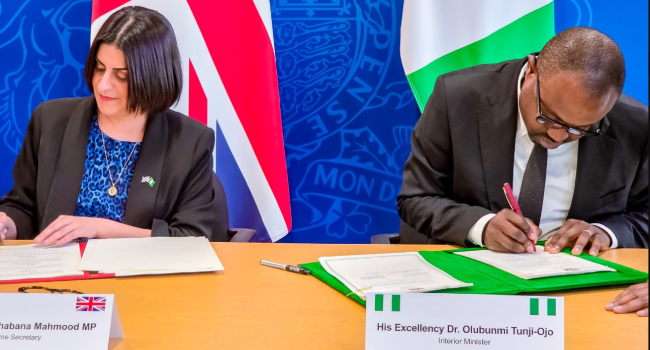
The clarification comes amid widespread misinformation following the signing of the Memorandum of Understanding (MoU) on immigration cooperation between Nigeria and the UK during President Bola Tinubu’s historic state visit to London.
The MoU aims to strengthen bilateral cooperation on migration management while ensuring compliance with domestic immigration and citizenship laws and relevant international treaties, conventions, and protocols.
Onanuga noted that nowhere in the 12-page memorandum is Nigeria required to accept foreign nationals other than Nigerians.
He also stated that “a clear condition in the MoU is that the returnees concerned are bona fide nationals of the country and are treated with dignity and respect, with due regard to their human rights and fundamental freedoms.”
Under the MoU, returnees are entitled to carry their legally acquired personal belongings, a departure from past practices where migrants were often returned without their property.
Onanuga pointed out Article 12, which states that “Every returnee will be given ample opportunity to make adequate arrangements for the transfer or disposal of his property in the territory of the requesting party, under the supervision of the mission of the requested party.”
He added; “Another provision is that where a return is being considered, and the person has made a claim under relevant domestic or international human rights legislation, that claim will be considered in line with the provisions under the party’s respective domestic legislation.
“The appeal may relate to circumstances in which the foreign nationals have been lawfully resident in the territory of the requesting party for most of their lives and socially and culturally integrated in the territory of the requesting party.
“Another ground of appeal may be where the nationals would face significant obstacles to their integration into the country to which they are to be deported.”
Article 9 of the MoU sets out the conditions for the migrant’s return.
Article 9 requires that “before departure, identification checks will be carried out by the officers of the requested party in the territory of the requesting party and on arrival by the competent authorities of the requested party. The requesting party will coordinate all returns with the officers of the requested party.
“A return may be conducted by means of a scheduled aircraft or an aircraft chartered specifically for this purpose by the authorities of the parties; the requesting party will provide the flight details and particulars of each returnee five (5) working days before the date of return.
“A return will be conducted using an original, valid passport, or, if the requesting party can biometrically match a returnee to a visa application made in the territory of the requested party, then an expedited process will be permissible, via which the requesting party will facilitate the return or repatriation using a UK Letter (UKL).
“If a returnee cannot be biometrically matched to a visa application by the requesting party, but there is otherwise strong evidence to confirm nationality, including a copy of a passport, a passport number or a national identity card, then an expedited process will again be permissible via which the requesting party will facilitate return or repatriation using a UK Letter (UKL).
“Should the requested party not be satisfied with a returnee’s identity within five (5) working days of submission of the UK Letter (UKL) to Nigerian authorities, detailed reasons should be presented to the requesting party why the identity cannot be satisfied. In these circumstances, removal will be deferred.
“If subsequent evidence shows that a returnee who has been returned is not a national of the requested party, the requesting party will take the person back to its territory at the requesting party’s cost and by the most efficient means possible. The request for the return of the person referred to in Article X will be made within ten (10) working days following the return exercise and carried out within fourteen (14) working days after acceptance of the request.”
Article 9, subsection 3, shows that Nigeria has not ceded to the UK the right to document the repatriated person.
The section says, ‘It shall be the sole responsibility of the Nigeria Immigration Service (NIS) to issue and handle, as is necessary under Nigerian domestic legislation, any Nigerian documentation (including the digital acknowledgement of receipt of a UK Letter) ahead of the notified date of return as stated in the UK Letter. This shall be distinct from the UK Letter process and remains the sole right and responsibility of Nigerian authorities, including the handling of the travel document and any onward transmission required from the issuing office to enable entry.
Article 11 deals with returnee reintegration assistance. It states that every returnee will be able to access basic on-arrival and reintegration assistance in the territory of the requested party.
“Short-term assistance may include airport reception, accommodation, onward transportation, care and provision packs and small cash assistance. Medium-term assistance can include support to find and reunite with family; support in obtaining the in-country documentation required, signposting to local services, and the potential provision of mental well-being and counselling services (if required).
“Longer-term assistance may allow access to a Returnee Education and Entrepreneurship Fund to enable sustainable reintegration. Support may include accessing the local job market, setting up a business, accessing vocational training or further education, and assistance with legal migration opportunities.
“Should the parties’ domestic legislation regarding the provision of reintegration support to all or certain categories of returnees change, or should the overarching non-legally mandated package of reintegration support change, the parties will inform each other as soon as is practicable.”
STATEHOUSE PRESS STATEMENT
CLARIFYING THE NIGERIA-UK MIGRATION PARTNERSHIP
Read More : Niger Cash Handout Stampede Kills Three
It has become necessary to debunk the raft of misinformation assailing the migration partnership between Nigeria and the United Kingdom, as contained in the Memorandum of Understanding signed by the… pic.twitter.com/yDOCZsYYe6
— Bayo Onanuga, OON, CON (@aonanuga1956) March 21, 2026