Trending


The Nigerian Government has banned the collection of cash taxes and the use of roadblocks for revenue enforcement as part of new regulations to implement the country’s tax laws nationwide.
The announcement was made on Tuesday in Abuja by Olusegun Adesokan, Executive Secretary of the Joint Revenue Board, during the signing of the Presumptive Tax Regulations and Guidelines at the Federal Ministry of Finance.
Adesokan said the new regulation aims to end informal, coercive, and fragmented tax practices, particularly at the subnational level.
“It bans all forms of cash collection by tax authorities. It also bans the mounting of roadblocks for the collection of taxes,” he said.
The reforms, according to him, would promote transparency and equity in tax administration, especially in commerce and the informal sector.
“These regulations are another demonstration of his commitment to taxing prosperity and not poverty,” he added.
Under the new regime, nano- and small businesses with an annual turnover of N12 million or less are exempt from tax, Adesokan noted.
He added that other informal businesses will pay a one per cent tax on turnover, with technology-driven payment systems encouraged.
The framework also provides a uniform structure for states to tax the commerce sector and integrate operators into the formal economy through a Tax Identification platform.

Finance Minister Wale Edun said the signing marks the transition from legislative approval to operational enforcement of the 2025 and early 2026 tax reforms.
“With these regulations, we are transitioning from regulation to structured implementation,” Edun said, noting that the reforms ensure fairness, consistency, and economic inclusion without raising tax rates.
He added, “Our aim is to ensure consistency, prevent arbitrary assessments… and to protect small businesses while ensuring the continuous growth of the Nigerian economy,” the minister said.
“We’ll expand the tax base, not raising taxes, but expanding so that each bears his rightful contribution to the common cause.
“Our role is to ensure that tax administrations are coordinated, not fragmented, and deliver results and impact to all Nigerians.
“We’re looking at, in the immediate term, to try to get to seven per cent GDP growth on our way to Mr President’s clear-stated target… by 2030, the $1tn economy.”
Joseph Tegbe, Chairman of the National Tax Policy Implementation Committee, said the signing marked a transition from policy intention to practical execution.
He noted that the informal sector employs over 80 per cent of Nigeria’s workforce but has historically contributed little to structured public revenue due to systemic challenges.
Read More : Aisha Yesufu Backs Osun Script for 2027 Election
“It’s not about imposing new volumes but restoring order where there has been fragmentation and replacing arbitrariness with transparency,” he said.
“The informal sector… employs more than 80 per cent of the workforce… yet its contribution to structured public revenue has been disproportionately low, not because they are unwilling to pay but because our framework was either too complex or did not reflect operational realities.”
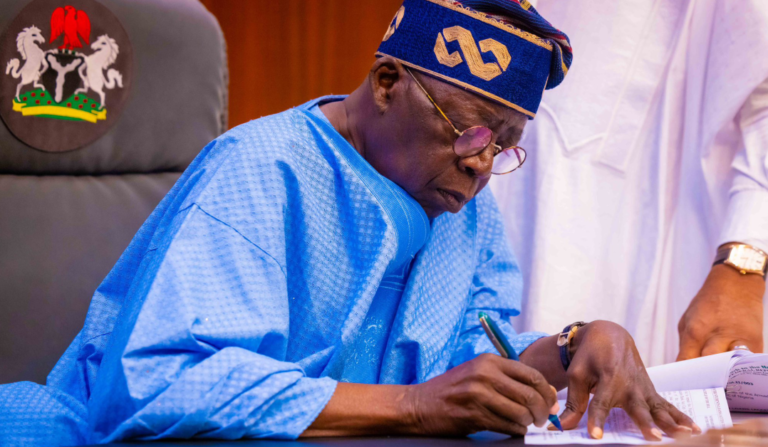
The regulations follow the signing of four major tax reform bills by President Bola Tinubu in June 2025, which modernised Nigeria’s tax system and overhauled decades-old statutes.