Trending
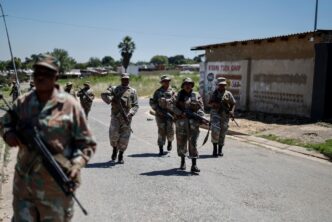

Soldiers have moved into gang-violence hotspots in Johannesburg as authorities intensify efforts to address South Africa’s escalating crime crisis, a situation President Cyril Ramaphosa has described as one of the country’s most pressing threats.
On Wednesday, around a dozen armed military vehicles rolled into several suburbs west of Johannesburg, including Riverlea and Westbury, marking the start of a large-scale security deployment first announced by Ramaphosa last month. The operation brings soldiers onto the streets alongside police officers, with the goal of stabilising communities frequently affected by gang-related violence.
During the operation, uniformed troops supported police in conducting house-to-house searches. Armed soldiers were seen lifting mattresses, opening cupboards and questioning residents about the presence of illegal drugs and weapons. Authorities say such searches are intended to disrupt criminal networks and recover illegal firearms that fuel violence in these neighbourhoods.
Read More : 43 Dead in South Africa Political Hits: Report
Riverlea and Westbury have long struggled with shootings and murders linked to rival gangs battling for territory, particularly in the drug trade and illegal mining activities. South Africa records an average of roughly 60 murders per day, with many incidents tied to organised criminal groups.
While some residents appeared relieved to see security forces in their communities, others expressed scepticism about whether the intervention would bring lasting change.

A resident who identified himself only as Ali told AFP that he doubted the deployment would make a meaningful difference. “Nothing is going to change,” he said. “They are going to be here for a few days, and then everything will go back to normal.” Another resident shouted at a passing army convoy in Riverlea, asking, “Is this the real deal?” while pointing to a recent killing in a nearby apartment block.
Ramaphosa has framed the crackdown as essential to restoring stability. In his recent state of the nation address, he warned that “organised crime is now the most immediate threat to our democracy, our society and our economic development.”
The deployment is scheduled to run for one year and extend across five of South Africa’s nine provinces, including the Western Cape, home to the tourist city of Cape Town. However, critics, including security experts and opposition figures, argue that soldiers are not trained for civilian policing and may struggle to address the deeper causes of gang violence.