Trending
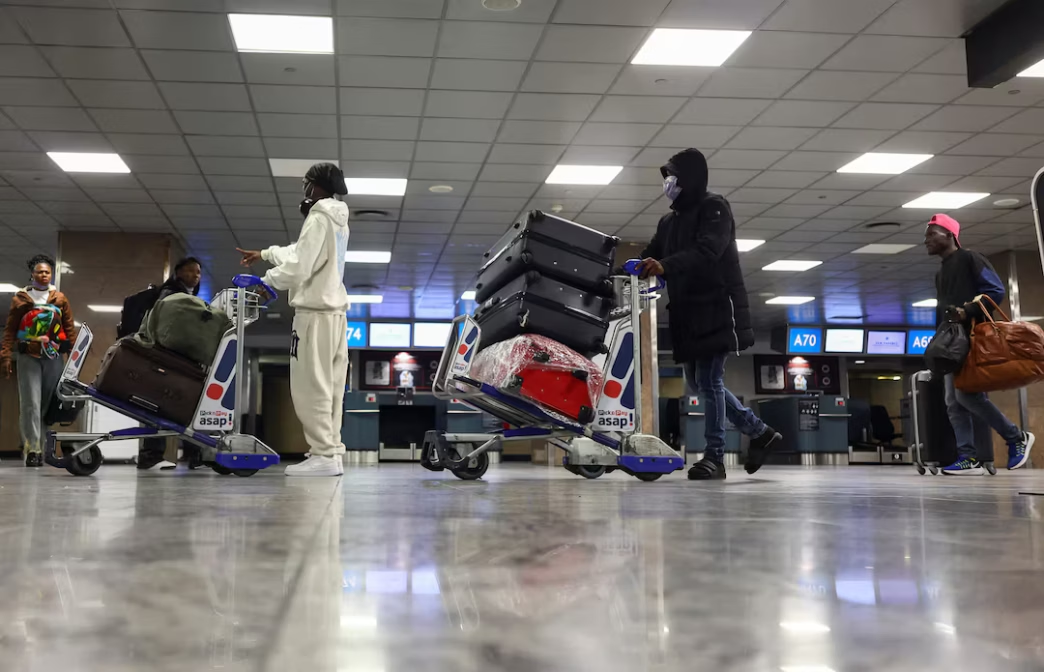
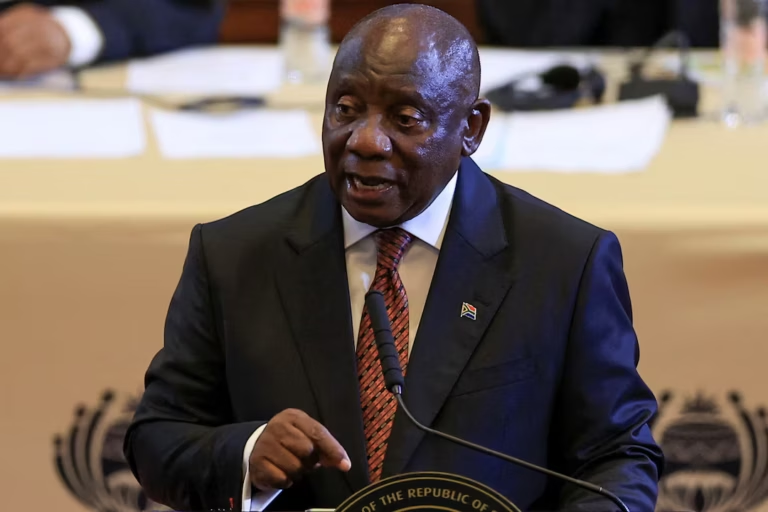
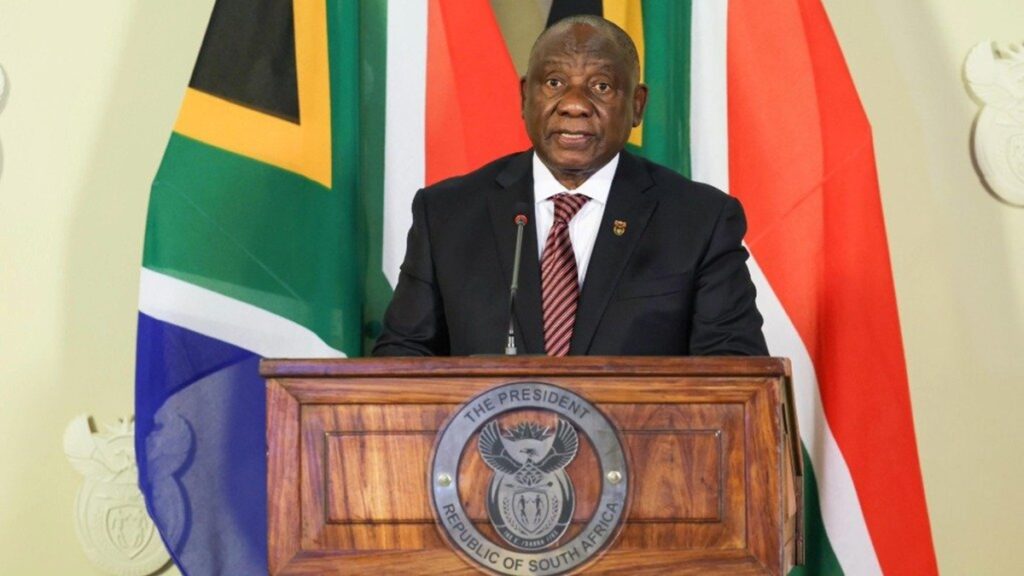
President Cyril Ramaphosa on Sunday addressed South Africans on the growing concerns over migration and illegal immigration, outlining the government’s plan to tackle the challenge while urging citizens to reject xenophobia.
“Fellow South Africans, I wish to address you this evening on a matter that concerns many South Africans,” Ramaphosa said.
“Over recent months, South Africans from every walk of life have raised concerns about migration and illegal immigration. These concerns are being expressed in our communities, our workplaces, our schools, our clinics and across social media platforms.”
Read More : Gunmen Kill Six in Plateau
He acknowledged that many South Africans are asking difficult but legitimate questions about whether borders are secure, about jobs, pressure on public services, and safety and security.
“These concerns are real. They deserve to be heard. They deserve to be addressed,” the president said.
“Tonight, I want to address these concerns. I want to explain what government is doing to address them. And I want to outline the principles that must guide us as we confront this challenge together. We must be honest about the context in which these concerns arise.”
The address from the Union Buildings in Tshwane came amid rising anti-foreigner sentiment in several communities, with complaints about foreign nationals dominating informal trading and spaza shops.
Here are ten key measures and messages from his national address:
1. Illegal immigration not the cause of economic woes
Ramaphosa acknowledged that South Africans face persistently high levels of unemployment, especially among young people, with many families struggling to make ends meet.
“Yet we must recognise that illegal immigration is not the cause of all our economic challenges,” Ramaphosa said, noting that there are other causes.
He stated that the solution lies in faster economic growth, greater investment, industrial expansion, infrastructure development and the creation of millions of new jobs.
The president noted that frustration can easily be directed at those perceived to be competitors for jobs and resources but urged South Africans to look beyond scapegoats.
“The answer must be faster economic growth, greater investment, industrial expansion, infrastructure development and the creation of millions of new jobs,” Ramaphosa said.
“These are precisely the issues that our government is working on.”
2. Crackdown on employers who hire undocumented workers
The president announced intensified inspections targeting companies that employ undocumented foreign nationals.
The Department of Employment and Labour has launched the phased recruitment of 10,000 inspectors for this financial year as part of rebuilding labour enforcement capacity.
“We are going to increase the penalties, including imprisonment, for employers who violate the Immigration Act,” Ramaphosa said.
“We cannot have a situation where employers who, after being charged and found guilty of violating our laws, merely pay a fine and continue employing undocumented foreign nationals whom they exploit. To address violations of immigration and labour laws in the transport sector, we are implementing a plan that has been developed with the logistics and freight industry and labour organisations.”
He added that employers who exploit undocumented migrants by paying below minimum wage and forcing longer hours are “breaking the law.”
“We have uncovered a number of workplaces where undocumented migrants are made to labour under very bad conditions,” the president revealed.
He warned that such conduct “will attract far stronger penalties and far stricter enforcement.”
3. Dedicated courts and deportation of undocumented migrants
Ramaphosa said the Department of Home Affairs, Border Management Authority and South African Police Service will intensify the process of identifying and deporting undocumented foreign nationals residing illegally in South Africa.
“We will set up dedicated courts to deal with immigration to speedily support the deportation of undocumented migrants,” he said.
In the past year alone, the Border Management Authority intercepted and stopped over 450,000 people attempting to enter South Africa illegally.
The president emphasised that the responsibility for enforcing immigration laws “rests with the state and the state alone.”
He added that no other person is allowed to confront someone in the street to demand proof of nationality.
4. Securing borders and relocating refugee centres
The president announced further measures to secure South Africa’s borders, including investment in modern technology, infrastructure and personnel.
“Secure borders are not a sign of hostility towards other countries. They are a fundamental requirement of a sovereign and well-governed state,” Ramaphosa said.
He announced a phased relocation of refugee reception centres to border posts, starting with the Tshwane centre this year.
“Many other countries have refugee reception centres close to the place where refugees enter the country seeking asylum or refuge,” he noted.
The relocation aims to process asylum applications more efficiently, securely and fairly, allowing government to determine protection needs at the point of entry.
5. Crackdown on corruption and end of green ID books
Ramaphosa said officials who sell documents, facilitate unlawful entry or abuse public office “betray the trust of the South African people.”
“We must recognise that illegal immigration is often enabled by corruption,” he said.
“Those responsible are facing dismissal, criminal prosecution and the full consequences of the law,” he warned.
The government is establishing an Intelligent Population Register containing biometric data for every person in the country, laying the foundation for a Digital ID.
At the same time, authorities will progressively discontinue the green ID books, which the president said “have enabled identity theft by undocumented immigrants and criminal syndicates.”
The Department of Home Affairs will set a date after which the green ID books will not be recognised.
Ramaphosa also announced plans to end the abuse of the Traffic Registration Number, which foreign nationals require to register or buy vehicles but which is being used as a form of identification.
“The Department of Transport will issue new regulations to align with the identification laws of our country within the next three months,” Ramaphosa said.
Managing Migration Together: President @CyrilRamaphosa addresses the nation https://t.co/GIG3rPCP3s
— The Presidency 🇿🇦 (@PresidencyZA) June 7, 2026
6. Government acknowledges weaknesses in migration management
The president admitted that there have been weaknesses in the way migration has been managed, including lapses in rigorous enforcement and instances of corruption.
“South Africans are entitled to expect better,” Ramaphosa said.
“We accept that responsibility and we are taking decisive action to correct these shortcomings.”
He stated that South Africans have a right to expect a state that is effective, professional and capable of enforcing its own laws.
7. Warning against xenophobia
Throughout his address, Ramaphosa urged South Africans not to turn against foreign nationals.
“We know that South Africans are not xenophobic, as there is no space for xenophobia, racism, sexism, Afrophobia or any other forms of intolerance in South Africa,” he said.
He warned that authorities would act against groups exploiting concerns about illegal immigration “to further their own political, personal or criminal agendas.”
“We will not be fooled or influenced by social media campaigns that spread misinformation, fake news and lies about foreign nationals,” Ramaphosa added.
He expressed concern that anti-foreigner sentiment is at times accompanied by tribal and ethnic slurs, insults or attacks aimed at other South Africans.
“We expect foreign nationals to respect our laws. We therefore need to respect them ourselves,” the president said.
8. New laws to close immigration loopholes
Ramaphosa acknowledged that laws regulating immigration in South Africa are fragmented and often contradictory.
“They allow legal loopholes that are exploited by undocumented migrants,” he said.
He announced that the government has finalised the National Labour Migration Policy, which proposes maximum quotas for the employment of documented foreign nationals.
The Employment Services Amendment Bill has been approved by Cabinet for introduction to Parliament.
“This empowers the Minister to set quotas in respect of the employment of foreign nationals in any economic sector or occupational category,” Ramaphosa said.
9. Support for South African spaza shops
The president addressed community anger about the number of foreign nationals running spaza shops and informal outlets.
“Many South Africans feel excluded from opportunities within their own communities,” he acknowledged.
He announced that the Department of Small Business Development, working with the South African Local Government Association, will complete the process of ensuring small and informal businesses are properly registered.
The department will also provide support for South African informal businesses through the Spaza Shop Fund.
10. Diplomatic envoys to African countries
Ramaphosa announced that he will send envoys to a number of sister African countries to outline the measures government is taking.
“South Africa cannot address migration challenges alone,” he said.
“Migration is a continental and global phenomenon.”
He said South Africa will continue working with other countries through the Southern African Development Community and the African Union to find sustainable solutions.
Call for unity
Ramaphosa called on all South Africans to work with government and reject any calls for violence or lawlessness.
“Let us build a South Africa that is secure, lawful, compassionate and prosperous,” he said.
“We can protect our borders while protecting human dignity. We can enforce our laws while upholding our Constitution.”