Trending

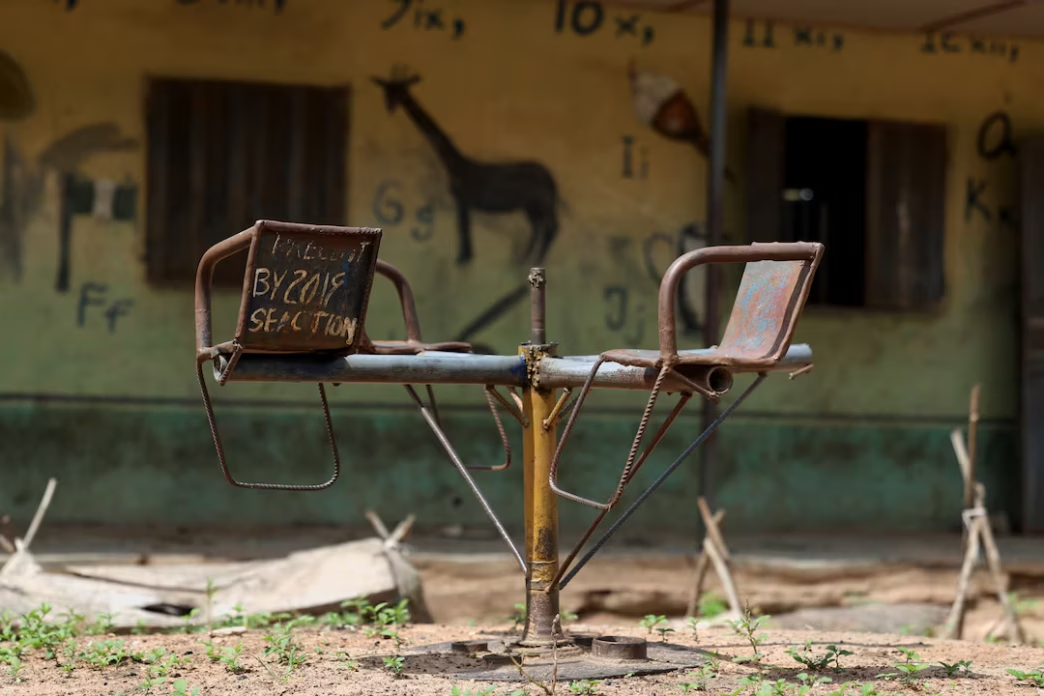
The fundamental promise of education in Nigeria is fading. Nigerian schools, once regarded as havens of education and catalysts for social advancement, are now dangerous places where children are hunted like prey.
The recent horrific attack in Oyo State’s Orire Local Government Area, where terrorists violently broke into three schools, kidnapped 46 pupils and teachers, and beheaded a teacher, dispelled any notion that school kidnappings are still a regional, northern problem.
This business has been nationalised by criminal organisations.
Read More : Niger Governor Demands Mining Ban In Some Areas
Mass kidnappings will irrevocably undermine the future of the country if the government does not take immediate action.
The figures paint a dismal picture of a country retreating from literacy.
International Centre for Investigative Reporting
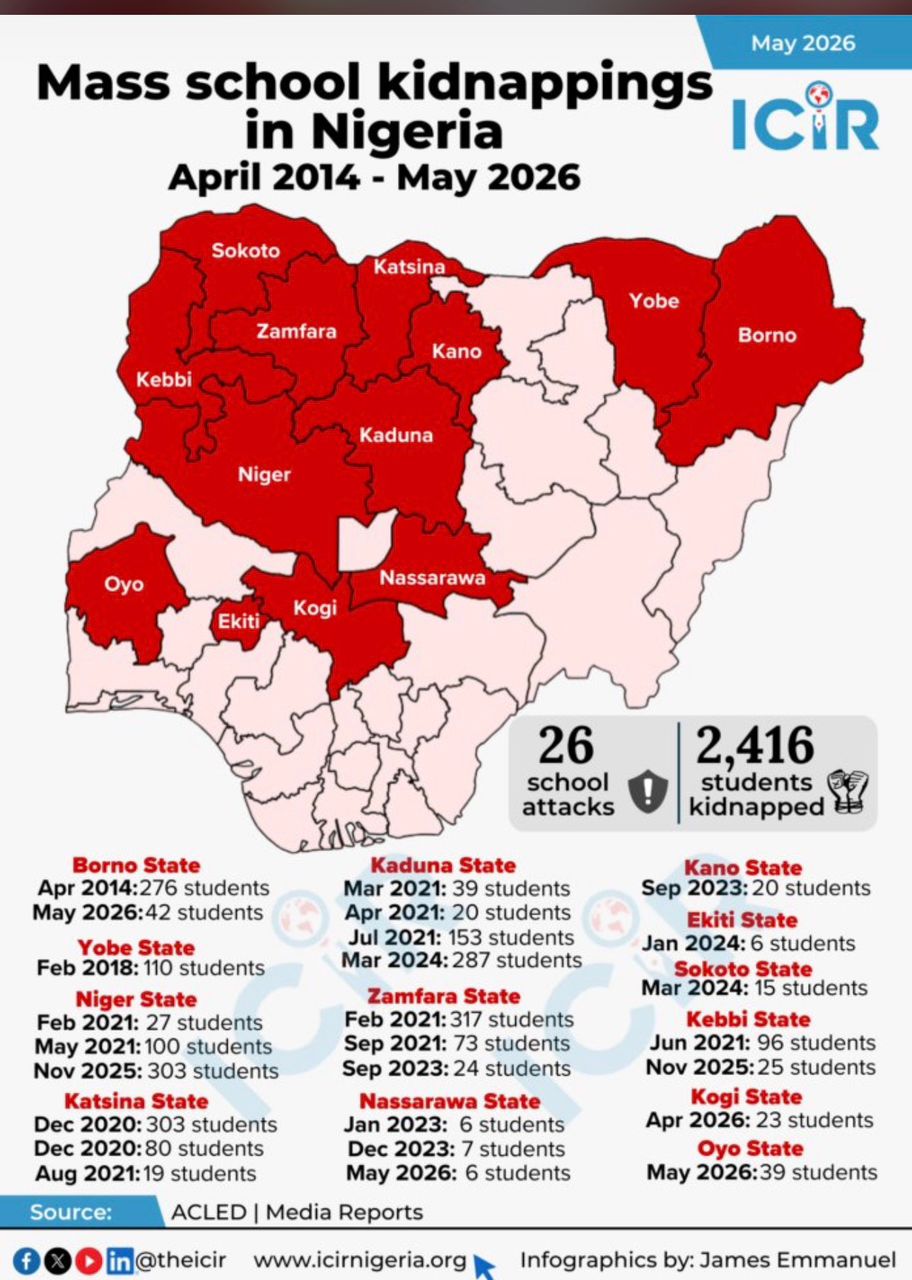
According to data released by the International Centre for Investigative Reporting (ICIR), 2,416 students were abducted in 26 major school attacks that occurred in Nigeria between April 2014 and May 2026.
The vulnerability of young students in many states, including Borno, Yobe, Niger, Katsina, Kaduna, Zamfara, Nassarawa, Kano, Ekiti, Sokoto, Kebbi, Kogi, and Oyo, has been weaponised during the past 10 years by armed bandits and terror groups.
2021 witnessed huge, well-planned school raids, including the kidnapping of 317 children in Zamfara in February, 100 students in Niger State in May, and 153 students in Kaduna in July, which brought the problem to an unparalleled fever pitch.
This predatory tendency has persisted rather than diminished to the present day.
Kogi State Kidnappings
The kidnappings of 23 students in Kogi State in April 2026, 39 students in Oyo State in May 2026, and an additional 42 students in Borno State in the same month are all depicted in infographics that follow a relentless timetable of violence that continues throughout mid-2026.
No schoolchild in Nigeria is genuinely protected since criminal syndicates increasingly take advantage of lax state borders and unpoliced rural passageways down south.
Beyond the initial shock of incarceration, this epidemic has a deadly impact. It actively contributes to Nigeria’s startlingly high number of out-of-school children, more than 20 million, which is among the highest in the world. Terror paralyses the entire town when a school is attacked.
Boys are compelled into early labour as families flee unstable rural communities, while parents withdraw their daughters to shield them from sexual abuse.
Scorched-Earth Approach
Terrorists are effectively carrying out a scorched-earth approach against the development of human capital in the most populous country in Africa by focusing on classrooms.
Although state executives should be commended for trying to find answers, their existing approaches are inadequate.
To protect schools, Ogun State Governor Dapo Abiodun has announced a comprehensive multi-agency network that includes the Amotekun Corps, the So-Safe Corps, hunters, and local vigilantes.
This community-focused mobilisation acknowledges a harsh reality: the centralised Nigerian Police Force lacks the personnel and local-terrain knowledge necessary to simultaneously secure thousands of rural campuses. Nevertheless, static defences are insufficient.
The use of simple single-shot rifles by vigilantes to combat sophisticated groups armed with military-grade weapons is really a stopgap measure.
The Nigerian government must assume full responsibility for this disaster by shifting from reactive, fear-driven responses to proactive, intelligence-driven prevention.

First, to keep an eye on the dense woodland reserves that kidnappers utilise as logistical strongholds, the military must use sophisticated overhead surveillance, including drones.
Safe Schools Initiative
Second, the Safe Schools Initiative, which includes installing solar-powered security cameras, constructing safe perimeter fencing, and setting up rapid-response warning systems directly connected to neighbouring military bases, needs to be vigorously funded and implemented by the administration.
Lastly, to destroy the culture of impunity that supports this profitable enterprise, the state must actively arrest, convict, and publicly punish kidnappers and their financial enablers.
Read More : Shettima To Lead Nigeria’s UNGA Delegation
When Nigeria’s future leaders are constantly in danger of being kidnapped or killed for just learning to read, the country cannot have a thriving, technologically advanced economy.
The conflict in our schools must be treated as a serious national security emergency.
To restore the security of our schools, find the predators, and ensure that no Nigerian child ever has to choose between survival and education, the government must use every resource at its disposal.