Trending
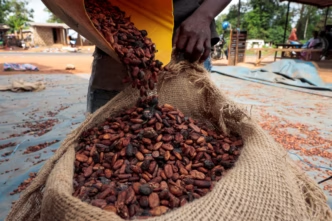
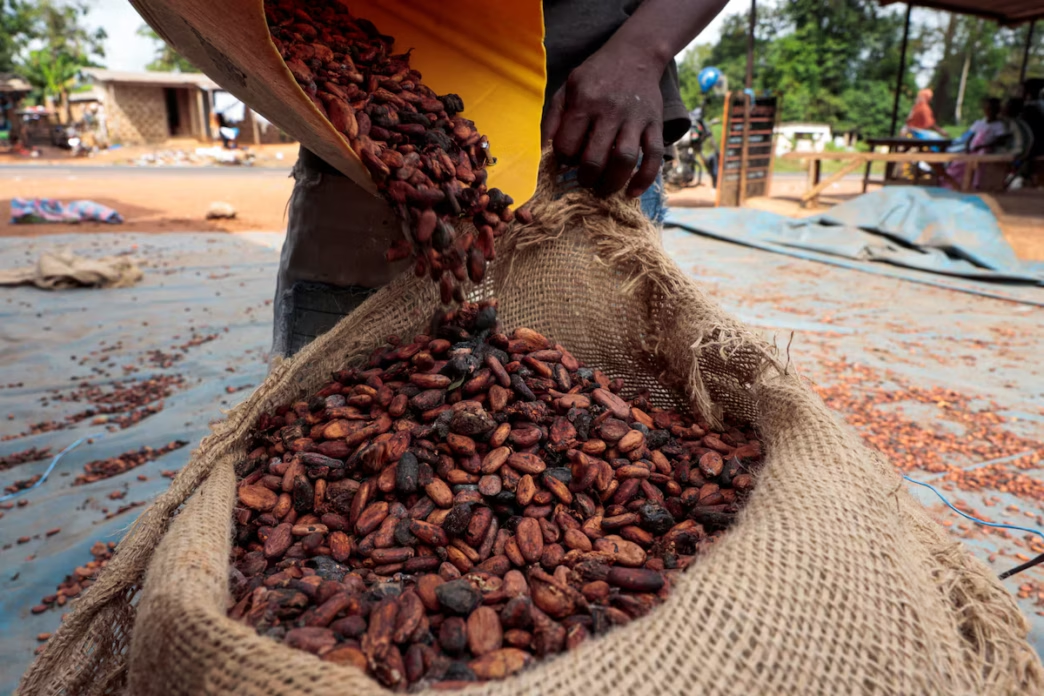
The Ministry of Agriculture and Food Security has dismissed reports suggesting a planned ban on raw cocoa bean exports, clarifying that the focus is on value addition rather than export restrictions.
Minister of Agriculture and Food Security, Senator Abubakar Kyari, said in a statement on Friday that the objective is to build a globally competitive cocoa industry by encouraging local processing while maintaining Nigeria’s position as a reliable exporter of cocoa.
“Our objective is value addition, not an export ban,” Kyari said.
The clarification follows public discussions suggesting authorities intended to stop raw cocoa exports, a position he said does not reflect government policy.
“Raw cocoa exports will continue to play an important role as we expand domestic processing capacity. Our goal is to create an enabling environment that encourages more investment in processing, increases farmers’ incomes, creates jobs, and enables Nigeria to earn more from every tonne of cocoa produced,” Kyari said.

The policy aligns with President Bola Tinubu’s Renewed Hope Agenda, which aims to strengthen Nigeria’s agricultural exports through improved traceability and compliance with international standards.
The clarification comes three days after President Tinubu, represented by Minister Kyari, declared at the Cocoa Value Addition Summit 2026 in Abuja that Nigeria would no longer export raw cocoa beans while importing finished chocolate products.
“Nigeria will no longer export raw beans while importing finished value. We will grind our beans at home, we will press our butter at home, we will make our chocolate at home, brand it at home, and sell it to the world on our own terms,” Tinubu said through his representative.
“And let no one mistake this for rhetoric. The proof is already rising out of the ground. At Sagamu, Nigerian investors are building a 70,000-ton processing facility, the largest this nation has ever seen.
“Our national grinding capacity has crossed 120,000 tonnes a year, and it’s growing. The Bank of Industry stands ready as a co-convener of this summit, with capital prepared for deployment into bankable projects.”
The president noted that although Africa produces about 70 per cent of the world’s cocoa, it earns only a tiny fraction of the global chocolate industry, now valued at over $130 billion, because most processing, branding and manufacturing take place overseas.
At the summit, Nigeria, Ghana, Côte d’Ivoire and Cameroon signed the Abuja Declaration, forming a strategic alliance to end raw cocoa exports and jointly negotiate with international buyers as a unified bloc controlling about 75 per cent of global cocoa production.
“The message is clear: the federal government is not banning raw cocoa exports. We are promoting value addition so that Nigeria captures more value from its cocoa while remaining competitive in the global market,” Kyari said.
STATEMENT BY THE HONOURABLE MINISTER OF AGRICULTURE AND FOOD SECURITY, SENATOR ABUBAKAR KYARI, CON, ON COCOA VALUE ADDITION
The Federal Ministry of Agriculture and Food Security has noted public discussions suggesting that the Federal Government intends to ban the export of raw… pic.twitter.com/9sZquoIUiH
— Sen. Abubakar Kyari, CON (@SenatorAKyari) July 17, 2026