Trending
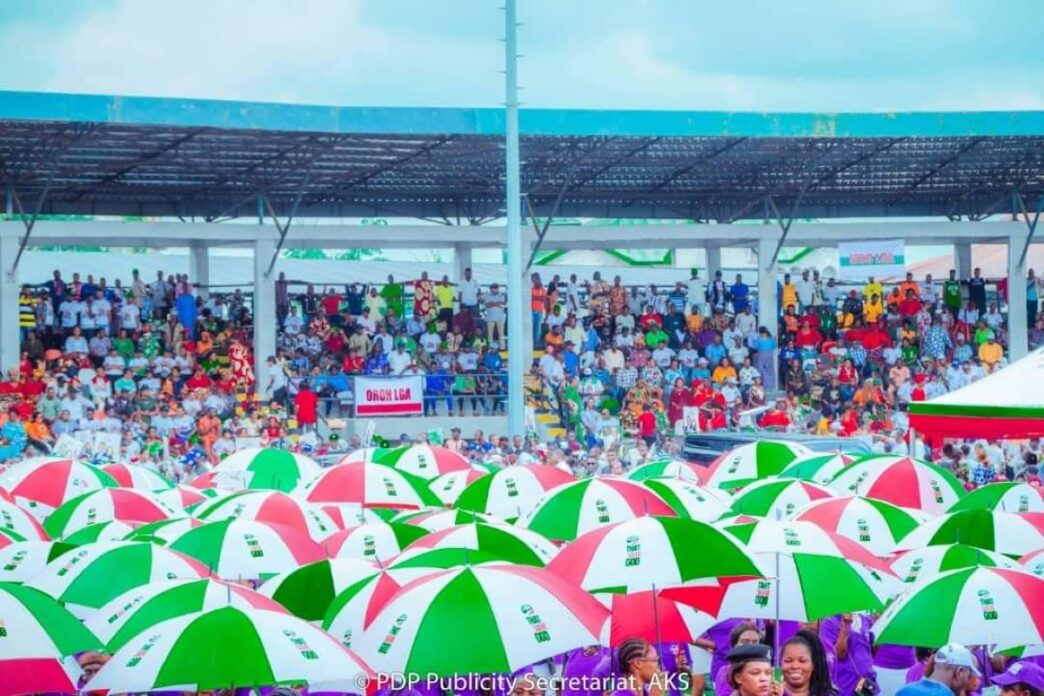
In the unforgiving theatre of Nigerian politics, death rarely arrives with a bang. It comes as a slow bleed, with governors vanishing overnight, senators switching jerseys mid-season, state assemblies hoisting new flags before the ink dries on old ones, and so it is with the People’s Democratic Party (PDP), once Africa’s largest and most feared political machine.
The umbrella that sheltered Nigeria’s Fourth Republic from 1999 is now folded, frayed, and six feet under. Its pallbearers? The very heavyweights who once swore eternal loyalty and the one man who never did: President Bola Ahmed Tinubu.
For nearly two decades after Nigeria’s return to civilian rule in 1999, the People’s Democratic Party towered over the nation’s political landscape like an immovable colossus. It controlled the presidency, dominated the National Assembly, and governed the overwhelming majority of states under its iconic umbrella symbol.
Under the commanding shadow of General Olusegun Obasanjo, soldier, former prisoner, born-again democrat, the PDP planted its umbrella over virtually every corner of Nigeria’s federal architecture and dared anyone to stand in the rain. In December 2008, its then National Chairman, Vincent Ogbulafor, declared the obvious: the PDP would rule Nigeria for 60 years. “I don’t care if Nigeria becomes a one-party state,” he thundered. Obasanjo smiled. The machine looked immortal.
Twenty-six years later, that umbrella is in tatters, and one man holds the scissors.

The Last Man Standing in Opposition
Through the PDP’s years of unchallenged supremacy, most of Nigeria’s political elite calculated that proximity to power meant proximity to the party. Governors, senators, ministers, and traditional power brokers all sheltered under the umbrella. All, that is, except one conspicuous holdout.
While others defected to the PDP, Tinubu entrenched himself against it, cultivating Lagos as his personal political estate and building the Action Congress network into something the PDP grudgingly respected but could never fully absorb. His alliance with the North, his patience across two decades, and his relentless transactional genius eventually produced what many thought impossible: a presidential victory in 2023.
While the party still retained deep structural strength after Muhammadu Buhari defeated Goodluck Jonathan in 2015 with surgical precision and then largely governed on autopilot, the decisive turning point came with the ascent of Bola Ahmed Tinubu to the presidency following the 2023 Nigerian presidential election.
Tinubu, long regarded as one of the most strategic political operators in the country, arrived in office with a deep understanding of Nigeria’s elite power networks. Where earlier opposition leaders had simply competed with the PDP, Tinubu pursued something more existential: the systematic dismantling of the party’s remaining power base.
The Defection Avalanche
The numbers tell a brutal story.
Since Tinubu assumed the presidency in May 2023, the PDP’s gubernatorial stronghold has been systematically gutted. One by one, then in clusters, governors who campaigned under the red umbrella have folded their tents and marched some to the ruling All Progressives Congress, others to freshly minted vehicles more amenable to Abuja’s orbit.
Sheriff Oborevwori (Delta) went first in April 2025. Umo Eno (Akwa Ibom) followed in June. Peter Mbah (Enugu) and Douye Diri (Bayelsa) defected in October and November. Agbu Kefas (Taraba) and then Siminalayi Fubara (Rivers).
Plateau Governor, Caleb Muftwang, jumped ship at the turn of the new year before Ahmadu Fintiri (Adamawa) defected a month after, pledging 85% of his state’s votes to Tinubu in 2027. Dauda Lawal (Zamfara) crossed over in March 2026, handing APC its 31st governor and reducing PDP to just two: Bala Mohammed (Bauchi) and Seyi Makinde (Oyo), and even that meagre remnant is crumbling.
Bala Mohammed, the PDP Governors’ Forum chairman, has reportedly concluded talks with Tinubu. Senate ticket on offer, same “allowances” extended to earlier defectors, but no control of Bauchi APC structure and no right to anoint his successor. Barring last-minute cold feet, the umbrella will be down to a single governor by the weekend.
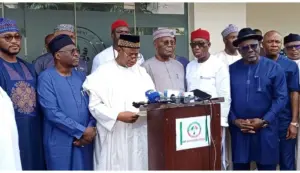
The governors are merely the headline act. Senators, House members, state legislators, and the PDP’s entire middle management defected in droves. The party’s National Working Committee is a theatre of the absurd: two rival factions (Damagum and the expelled Wike bloc) still fighting in court after the November 2025 convention that INEC refused to recognise. Expulsions, counter-expulsions, and legitimacy battles have left the secretariat a haunted house. The autopsy is brutal but simple. The PDP died of hubris compounded by internal haemorrhage.
The G-5 revolt of 2022-2023; Wike and Makinde’s war against Atiku opened the veins. Governors who treated the party as their personal property refused to subordinate to structures. When Tinubu offered federal protection and 2027 cover, they sprinted. The same patronage politics the PDP perfected in its glory days were now weaponised against it.
In effect, the PDP succumbed to the classic fate of long-ruling parties: complacency in power and disarray in opposition. The political architecture that once ensured its supremacy proved ill-suited for life outside power.
Tinubu’s Personal Mission
Tinubu’s mission was never secret. The man the PDP once dismissed as a regional godfather spent 24 years in opposition learning the game. He returned the favour with interest.
Where the PDP used federal might clumsily, Tinubu has been surgical: carrots for the ambitious, silence for the compromised, and cold shoulders for the defiant. Makinde remains the last man standing for now, insisting he isn’t bothered, but history suggests he should be.
Those close to the president make little effort to disguise the strategic intent. The decapitation of the PDP is understood in Abuja’s corridors not as collateral damage but as deliberate architecture. Tinubu has consistently worked to construct a counterweight to the PDP’s once-monolithic control. Today, that project is complete.
What Remains And What Comes Next?
What is buried today is not just a party but an era. The PDP was Nigeria’s default power setting. Its collapse leaves APC with 31 governors, a rubber-stamp legislature, and a clear runway to 2027.
Democracy without credible opposition is democracy on life support. The funeral is quiet. No grand requiem, no state procession. Just governors quietly changing flags, lawmakers updating WhatsApp statuses, and the umbrella, once a symbol of national shelter, now a footnote in the history books, swept away in piercing irony by the APC’s broom.
Asiwaju has had his revenge. The PDP, that erstwhile powerhouse, is dead. The umbrella was always just a symbol. What kept the rain off was power, and power has moved, and in Nigerian politics, when the power moves, the symbol folds quietly, efficiently, and without ceremony.
The PDP’s 60-year dream lasted 26. The burial, it turns out, needs no announcement. Just an attendance sheet and the names that are no longer on it.