Trending
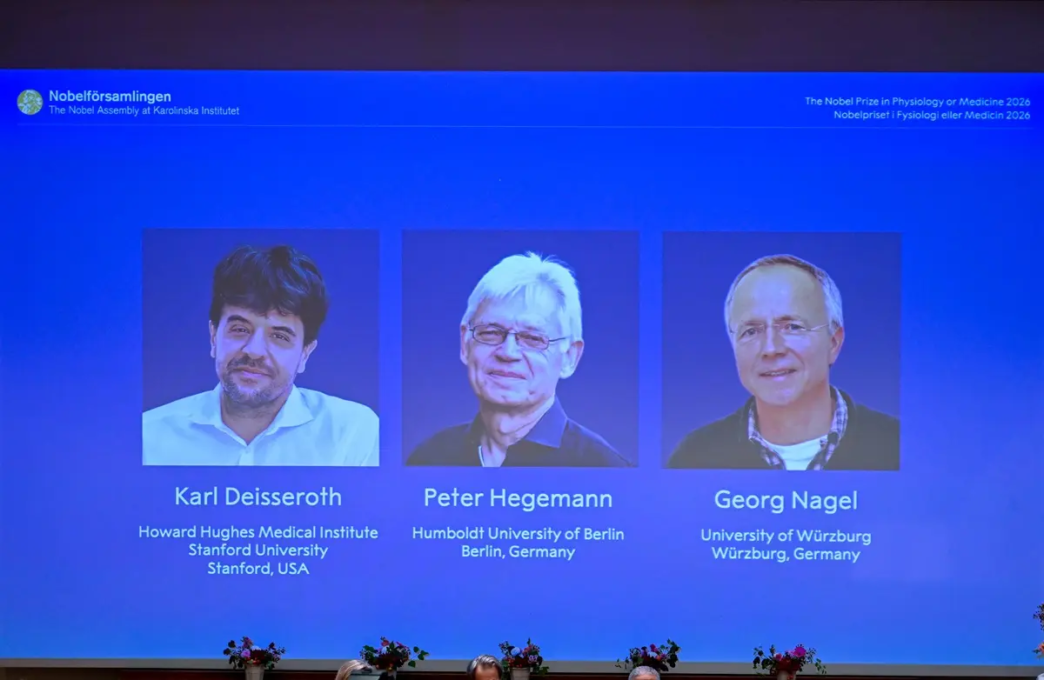
The Nobel Prize in Medicine has been awarded to three scientists whose research into light-controlled proteins gave science a tool for switching individual nerve cells on and off.
Karl Deisseroth, 54, Peter Hegemann, 71, and Georg Nagel, 73, share the prize for work on light-gated ion channels and optogenetics, the Nobel Assembly announced on Monday.
Deisseroth is based at Stanford University in California, while Hegemann works at Humboldt University in Berlin and Nagel at the University of Würzburg in Germany.
The field began with Hegemann’s study of how a single-celled green alga moves toward light. He and Nagel identified a protein that opens a channel to create an electrical impulse when exposed to blue light, making cells that carry it light-sensitive.
Deisseroth later used the gene controlling that protein to build a light-operated switch for nerve cells in living mice.
The Nobel Assembly said the method “is now being used in laboratories around the world to reveal the brain’s mysteries,” describing it as opening a new era in neuroscience.
Read More : Unknown Virus Leaks From Russian Lab
The award was announced at the Karolinska Institute in Stockholm, marking the start of this year’s Nobel week.
Thomas Perlmann, secretary of the medicine committee, said he reached all three laureates by phone on Monday.
The prize carries 12 million Swedish kronor (about $1.2 million). The physics prize follows on Tuesday, chemistry on Wednesday and literature on Thursday, with the peace prize on Friday and the economics prize on October 12.