Trending

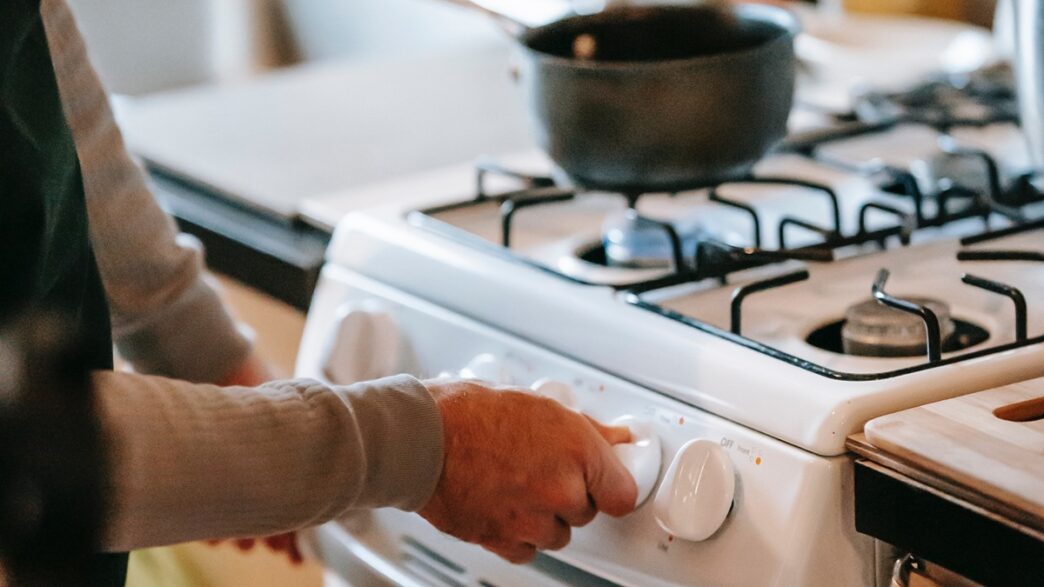
A pot of jollof rice has become the most honest ledger of global inequality. Follow the money from a Middle Eastern Strait to a Lagos stove.
When U.S. and Israeli forces struck Iran on February 28, 2026, the first thing that changed in the world’s financial capitals was the price of Brent crude. Within weeks, oil had climbed from the low $70s past $120 a barrel — a shock that rippled through shipping lanes, commodity desks, and freight markets worldwide.
The last thing anyone in those capitals was thinking about was jollof rice.
Read More : Kenyan Women Take Soapstone Craft Global
They should have been.
Five Thousand Kilometres, One Month
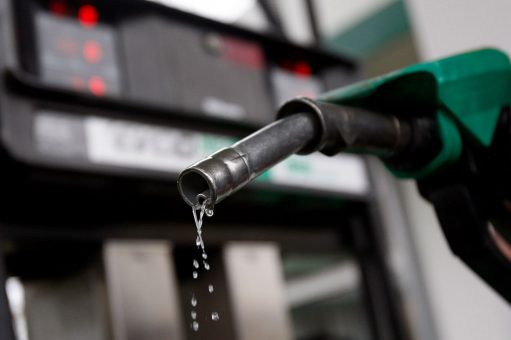
By mid-March, petrol in Lagos had nearly doubled to ₦1,325 a litre. Abuja stations were posting ₦1,367. Diesel, the lifeblood of every refrigerated truck, cold room, and long-haul lorry in the country, surged past ₦1,500. The cost of moving a tonne of grain from Kano to Lagos jumped 56 per cent almost overnight, from ₦45,000 to ₦70,000.
The Strait of Hormuz is 5,000 kilometres from Lagos. In March 2026, it might as well have been at the end of the street.
Nigeria is a crude oil exporter that imports nearly all of its refined fuel, a structural absurdity that means every global oil shock passes through the pump price into the price of tomatoes, rice, and transport fares with almost no lag. When Brent moves, Nigerian kitchens feel it before Nigerian finance ministers do.
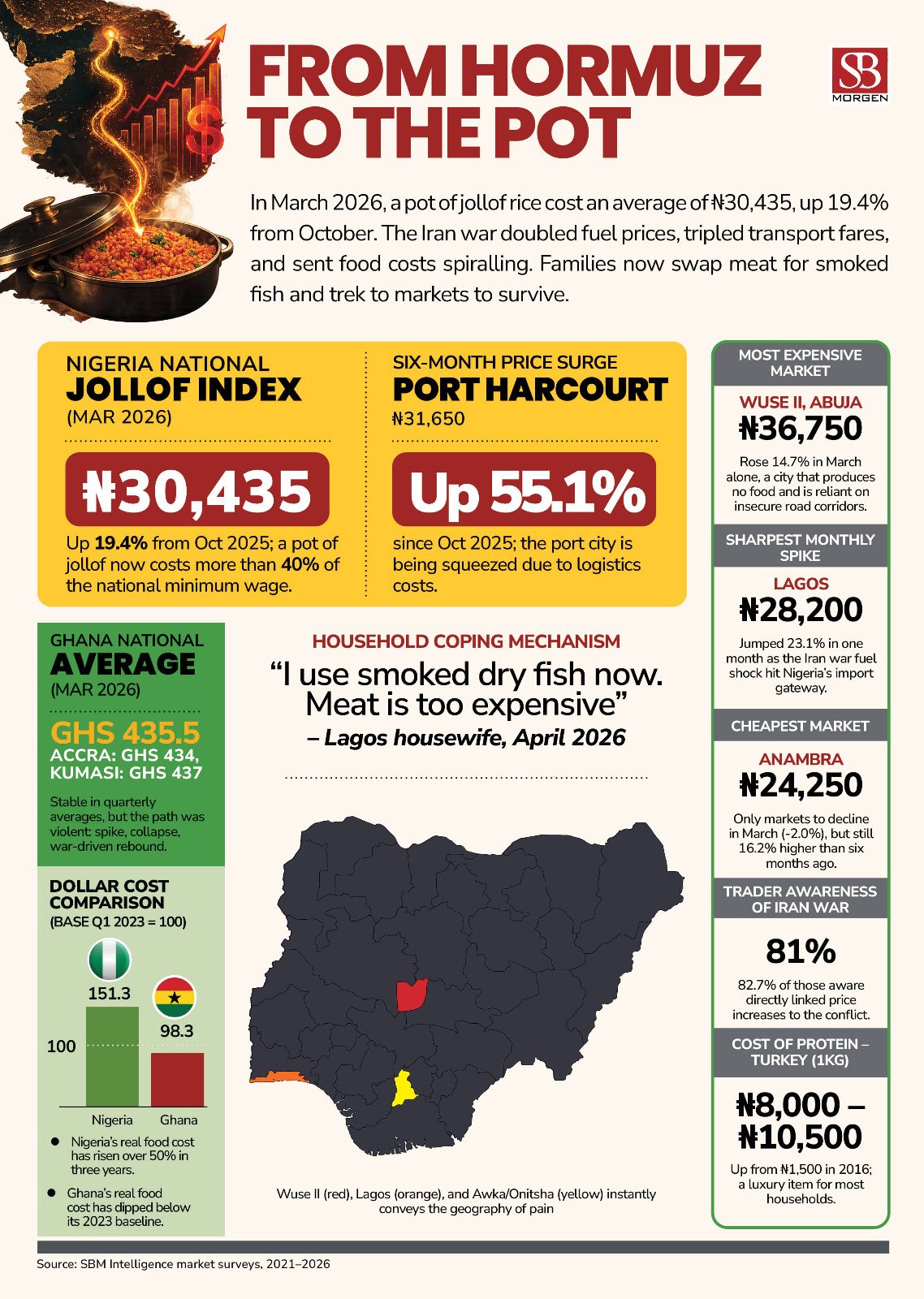
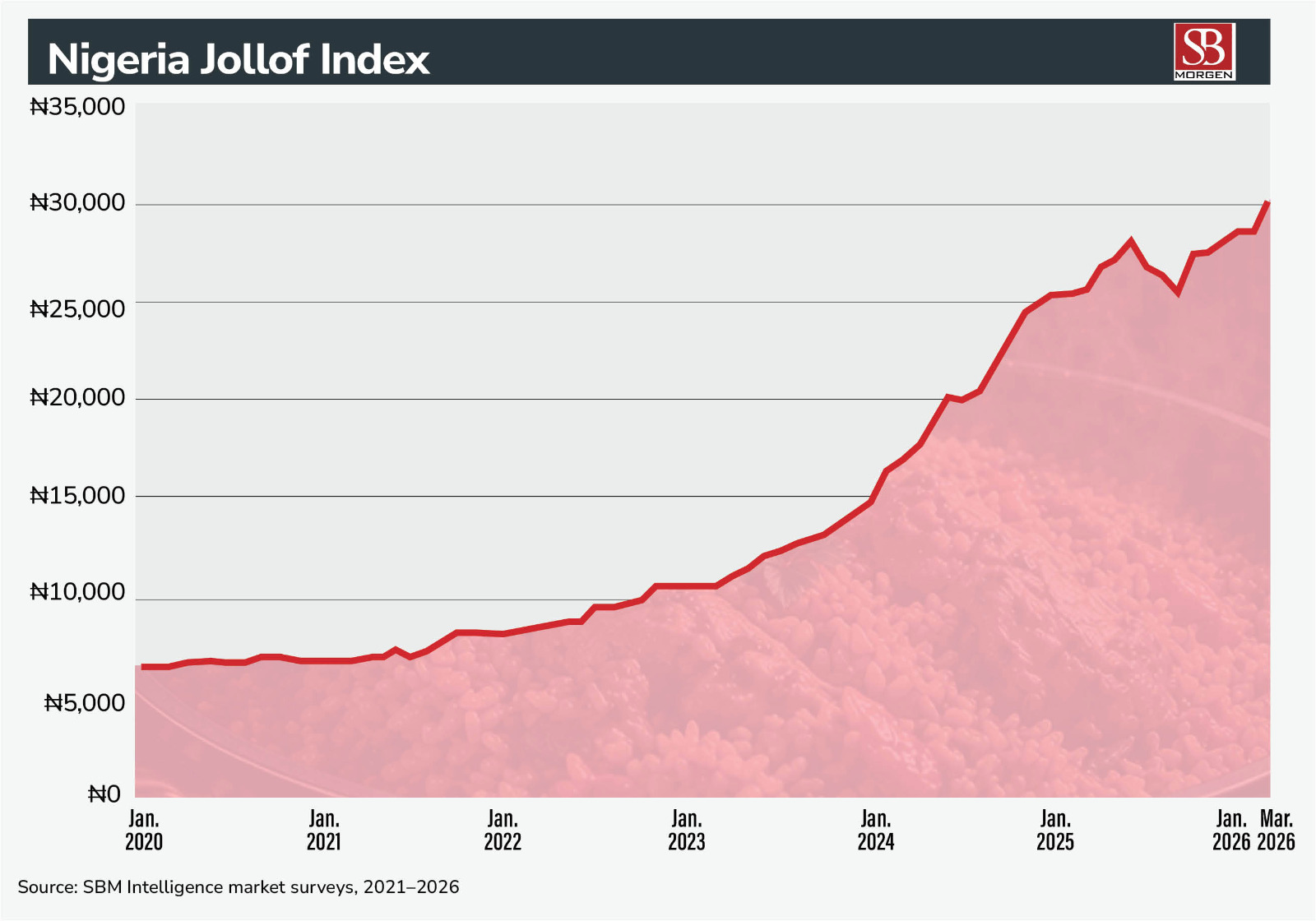
SBM Intelligence, a Lagos-based research firm that has tracked the cost of cooking a pot of jollof rice for a family of five since 2016, captured the damage in cold numbers. The national average cost of that pot rose 19.4 per cent in six months, from ₦25,486 in October 2025 to ₦30,435 in March 2026. A single meal for a family now costs more than 40 per cent of Nigeria’s monthly minimum wage.
The Geography of Pain
The aggregate figure conceals extremes that tell starker stories.
Port Harcourt, a port city supposedly blessed with coastal access, recorded the steepest six-month surge of any market in the country: up 55.1 per cent since October. The paradox is brutal. The city’s diesel-dependent cold storage, its notorious internal road network, and its high last-mile logistics costs all meant that even modest fuel increases translated into disproportionate price hikes at the retail level. Port Harcourt’s households are, in effect, paying inland prices for coastal geography.
Lagos markets recorded the sharpest single-month acceleration, 23.1 per cent, in March alone. This is Nigeria’s commercial gateway, the port through which imported rice, vegetable oil, and most consumer goods enter the country. When global shipping costs surge, Lagos absorbs the first blow and passes it down the supply chain.
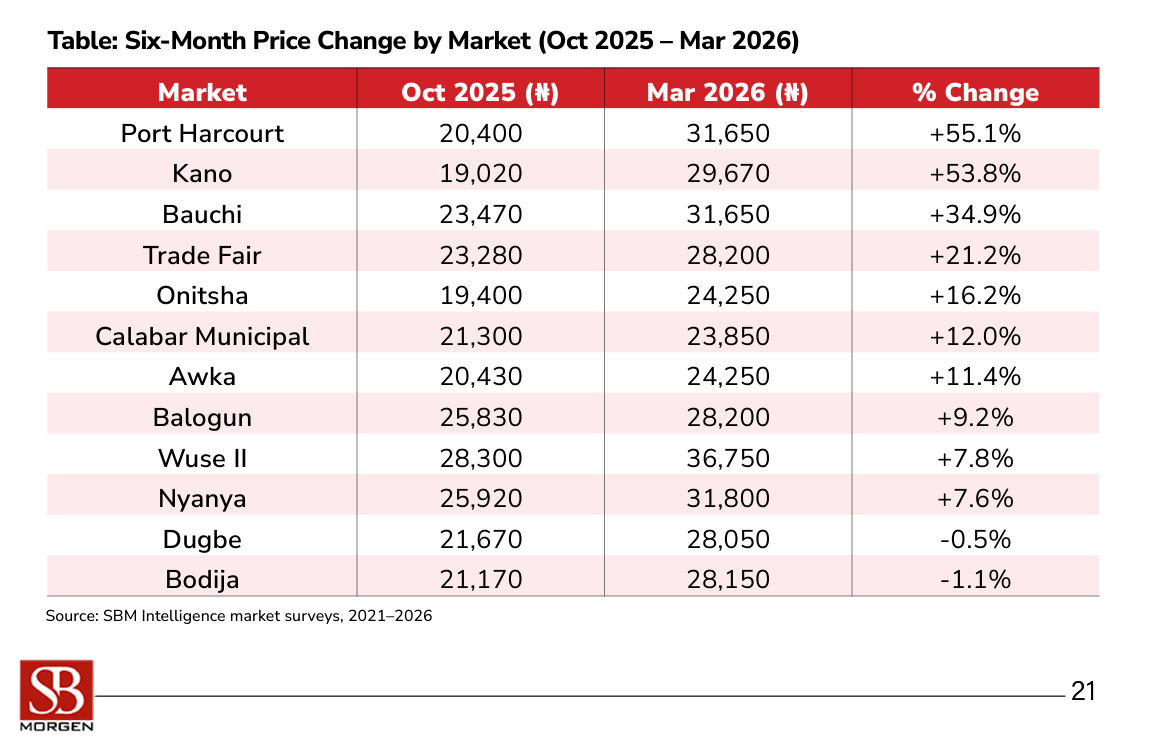
Abuja’s Wuse II market, the country’s most expensive, hit ₦36,750 per pot, a 14.7 per cent jump from February. The Federal Capital Territory produces almost none of its own food. Every naira added to diesel is a naira added to the price of tomatoes, rice, and turkey.
Even Kano, where prices barely moved in March, tells a grim story. The flat line is not stable. It is exhaustion. Traders reported that customers could not absorb more. A cosmetics seller told SBM researchers that her customers had abandoned beauty products entirely — to afford food. When jollof rice prices hit this level, the entire consumption basket contracts. The market doesn’t correct downward; it goes quiet.
What Households Are Actually Doing
Economists have a clinical term for what happens next: demand destruction. West African families have a more vivid vocabulary.
Meat is gone. “The protein I use now is smoked dry fish,” one Lagos housewife told researchers. “Chicken, turkey, even basic beef highly expensive.” Across the country, households are swapping protein sources: beef is being replaced by crayfish, chicken by eggs and ponmo (cow skin), and turkey, once the festive centrepiece, is now a luxury item at ₦8,000 to ₦10,500 per kilogram, up from ₦1,500 a decade ago.
Cooking gas is gone too, for many. One woman switched her family’s main meals to a charcoal pot.
“I use gas only for smaller meals or to warm food,” she explained. Charcoal is slower and messier. It is also cheaper. That calculation, messier but survivable, is being made in millions of Nigerian homes right now.
Monthly grocery runs have vanished. Too expensive to transport the goods. Instead: atomised purchasing, buying only what is needed for one or two meals, from a neighbourhood shop within walking distance. Bulk buying — the traditional strategy of working-class households to counter inflation has disappeared because there is no money to buy in bulk.
A wholesale food trader in Onitsha put the logic of collapse plainly: “I am selling what I have. When it finishes, I will close the shop for a while. There is no point buying at today’s prices because nobody will buy from me at tomorrow’s prices.”
This is not merely hardship. It is a market restructuring itself around scarcity — one pot, one meal, one day at a time.
A Tale of Two Countries
Across the border in Ghana, the picture is different, though not as different as it looks.
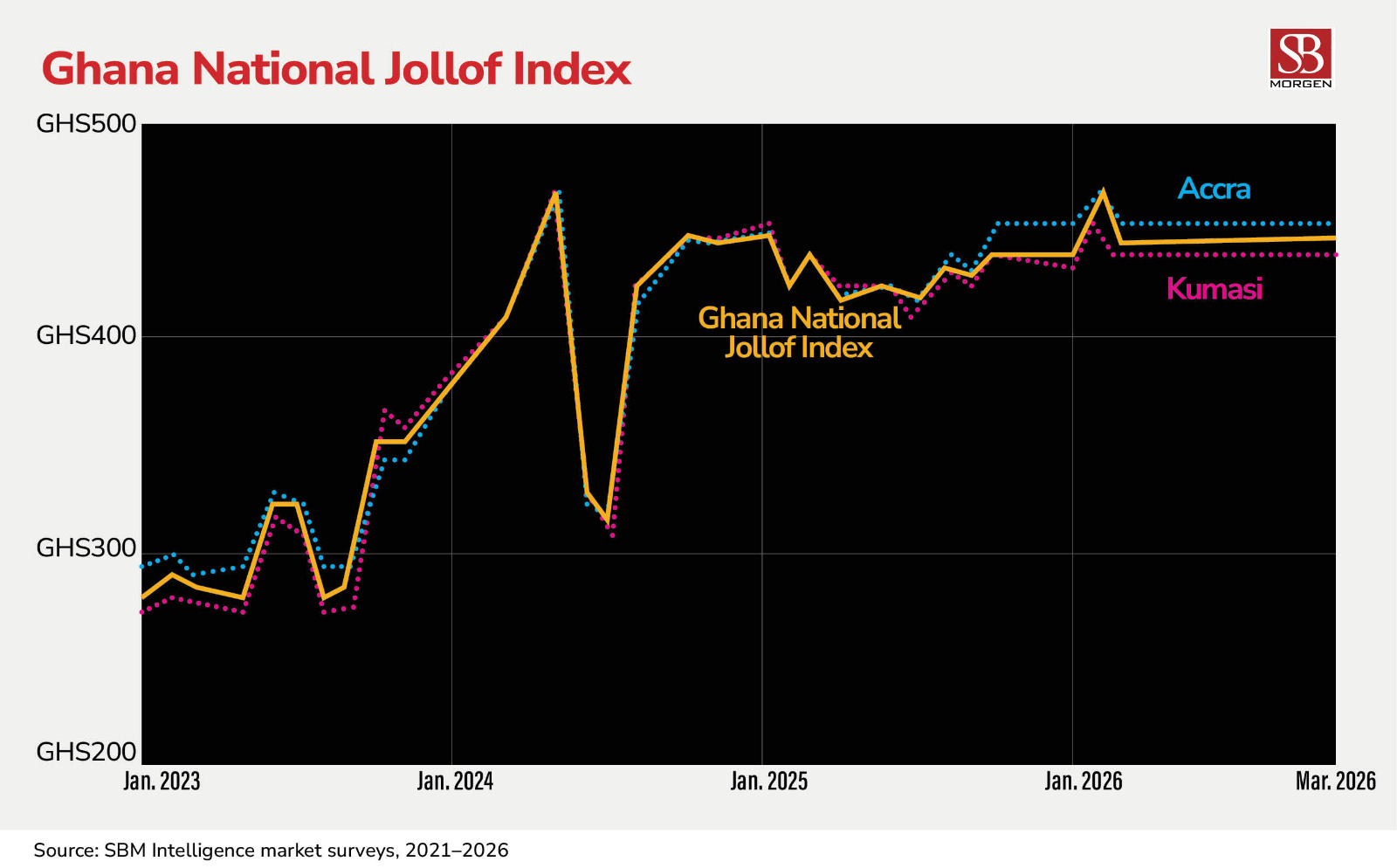
Ghana’s Jollof Index in March 2026 stood at GHS435.50, barely changed from six months earlier. But the path there was violent: a spike to GHS447.50 in January, a collapse to GHS418.50 in February, then a rebound when the Iran war delivered its jolt. The surface calm conceals a food system still at the mercy of global oil prices and import dependency.
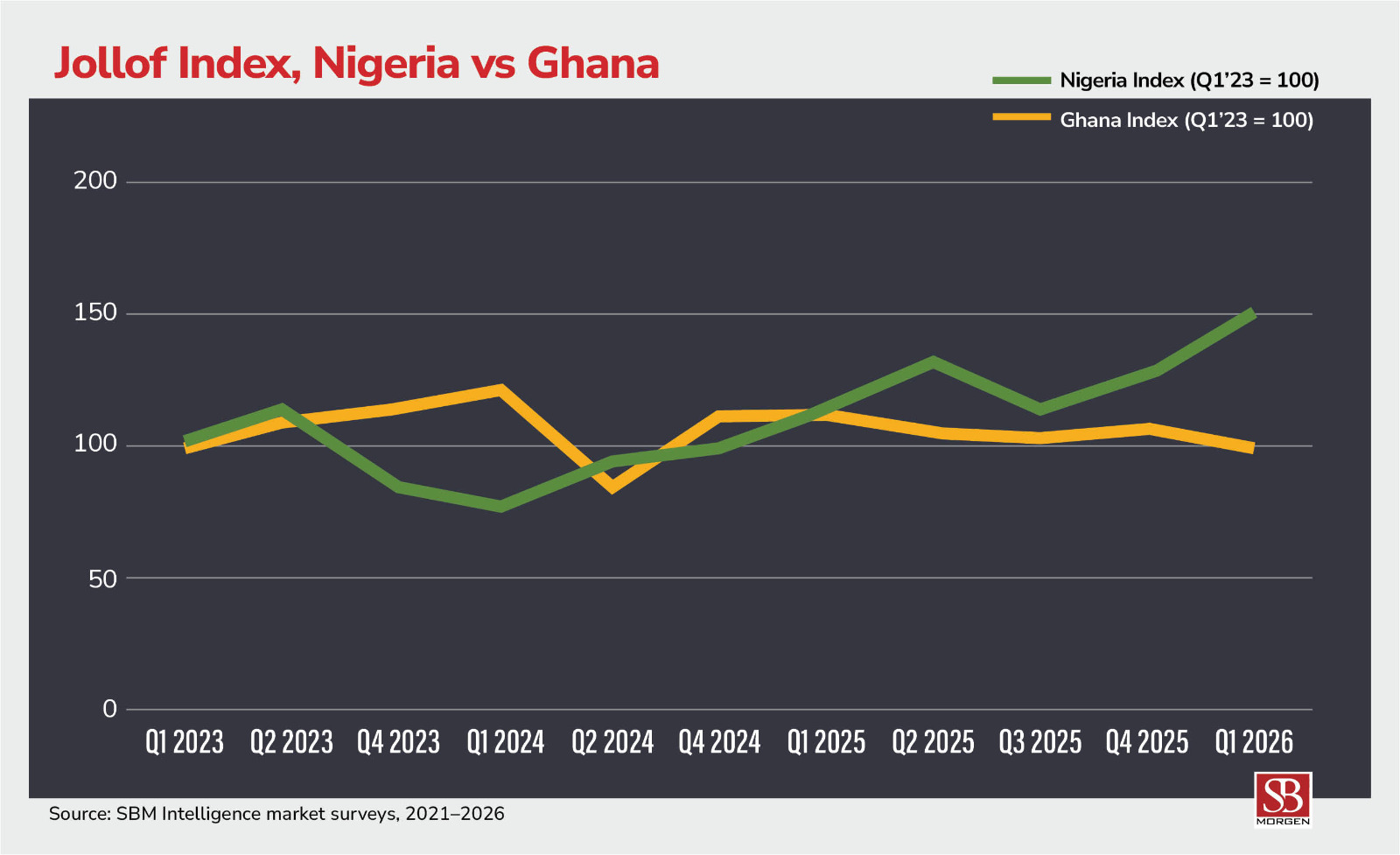
The divergence becomes starker when both countries are measured in dollars. SBM Intelligence set Q1 2023 as a baseline of 100 for both. Nigeria’s dollar-cost index now sits at 151.3 — its highest level ever recorded. Ghana’s has dipped to 98.3, just below the 2023 baseline. In three years, the real cost of feeding a Nigerian family jollof has risen more than 50 per cent. For a Ghanaian family, it has actually fallen slightly.
The difference comes down to currency. The cedi has depreciated, but it has avoided the catastrophic collapses the naira has suffered. Ghana’s relatively more diversified import routes and slightly more stable exchange rate have brought its households a fragile reprieve. For now, the pressure there has stopped mounting. For Nigerian families in Lagos, Abuja, and Kano, it has only intensified.
The Trigger Was Not the Cause
The Iran war did not create Nigeria’s food crisis. It merely ripped off a bandage that had been covering a wound for a decade.
Nigeria has no strategic fuel reserve to cushion oil shocks. Its domestic refining capacity, even where it exists, is priced to global benchmarks — offering no insulation to consumers. Its food-producing regions, the Middle Belt, Benue, and Niger State, remain theatres of conflict and climate stress, forcing ever-longer and ever-more-expensive supply chains to reach urban markets. Its road network functions as a hidden tax on every grain of rice that moves from farm to fork.
These are not secrets. They have been the subject of policy speeches, reform manifestos, and donor reports for years. What the Iran war did was collapse the margin for delay. In a single month, a global energy shock exposed the full cost of a decade of structural neglect.
Policy responses have been, at best, reactive. Nigeria’s authorities held monetary policy tight and offered no targeted transport subsidies or food-price stabilisation mechanisms, letting households absorb the full shock. Ghana’s Ministry of Trade halted a planned increase in sachet water prices on April 6, a useful gesture that changed nothing structural.
What is required is not emergency charity. It is infrastructure: rail freight to decouple food logistics from diesel prices; strategic grain and fuel reserves to buffer global shocks; cold-chain investment to prevent the post-harvest losses that inflate prices before food even reaches a market; and a monetary framework that stops sacrificing food affordability for exchange-rate optics.
One Pot, One Question
There is a detail in the SBM report that is easy to overlook amid the indices and percentages. A housewife in Lagos, when asked what she wants from her government, gave this answer:
“I want the government to reduce the price of foodstuff in Nigeria, especially Lagos. To make a full pot of jollof rice totally affordable.”
Not a stimulus package. Not a macroeconomic reform agenda. A pot of rice.
This is the arithmetic of dignity that sits beneath every inflation report and every commodity price chart: somewhere along the supply chain that runs from an Iranian waterway to a Lagos market, the distance between what a working family earns and what a family meal costs has become, for millions of people, unbridgeable.
The Strait of Hormuz is 5,000 kilometres away. The jollof pot is on the stove.
The two have never been closer.