Trending
For four decades, Africa’s role in the global drug trade was largely passive, a corridor through which cocaine and heroin moved from Latin America toward the lucrative markets of Europe and the Middle East. That era is over, and what is unfolding today across West and Southern Africa is something far more alarming: a deliberate, structured takeover by Mexican drug cartels, not just of Africa’s transit routes, but of its soil.
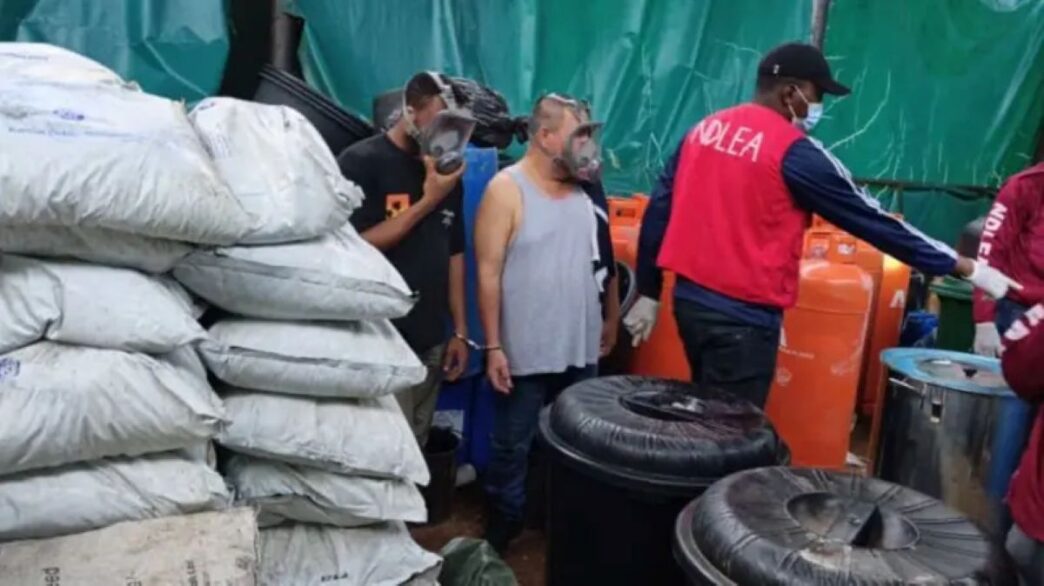
The evidence has been accumulating with grim regularity. In May 2026, Nigerian authorities raided an industrial-scale methamphetamine laboratory hidden deep in Ogun State’s Abidagba forest, arresting three Mexican nationals and six others and seizing chemicals and drugs worth $363 million.
Days earlier, South African police uncovered a large meth lab on a remote farm in Swartruggens, North West province, arresting five Mexicans among 11 suspects and seizing over 481 kilograms of crystal methamphetamine worth an estimated $60 million. These were not isolated incidents; they were the latest chapters in a story that has been writing itself since at least 2016, when industrial meth labs in Nigeria first emerged with alleged cartel involvement.
Read More : From Ojuelegba Bridge to the Ballot Box
A Calculated Retreat, Not a Desperate Advance
To understand what Mexican cartels are doing in Africa, it helps to understand why they are doing it. With North and Central America cracking down on transnational crime, cartels are shifting operations across borders and markets. The U.S.-led counter-narcotics campaign in Latin America has made traditional production and smuggling operations increasingly costly and dangerous. The growing presence of Latin American cartels in Africa is likely a direct effect of the increasing constraints on Latin American production sites and smuggling routes.
Africa, by contrast, presents conditions almost perfectly engineered for criminal exploitation. The Africa Organised Crime Index reported in 2025 that 92.5 per cent of African countries showed low resilience to organised crime, citing corruption, weak institutions, and limited oversight and surveillance capabilities. The cartels did not stumble onto this continent; they studied it and moved methodically.
The strategic logic is also economic. Methamphetamine’s precursor chemicals are relatively inexpensive and difficult to regulate. Manufacturing locally, closer to end-users, slashes logistical costs and eliminates exposure to maritime interdiction. The cartels have simply applied the same cost-benefit calculus that drives any multinational enterprise, except the product is crystal meth and the franchise model runs on violence and corruption.
The Franchise Model
Organised crime researcher Julian Rademeyer of the Global Initiative against Transnational Organised Crime has described what the cartels are doing as “franchising.” Mexican nationals are moving closer to their users by setting up industrial-scale facilities on remote farms and in rural communities. A modus operandi they first followed in Nigeria, then in Kenya, and now in South Africa.
This franchising does not mean the cartels are handing off operations and walking away. In all cases, Mexican laboratory technicians, chemists often referred to as “cooks,” and logistical experts were arrested at facilities disguised as provincial farms or factories, where they advised local actors on acquiring chemicals, assembling and disassembling temporary box lab facilities, moving operations between locations, and smuggling drugs to prime consumption markets.
The two most prominent operators are well-known names. The Sinaloa Cartel is known to operate in West Africa, Kenya and South Africa, while the Jalisco New Generation Cartel (CJNG) is also active on the continent. Their presence is no longer tentative; it is structural.

The Geography of Expansion
The cartel footprint now spans the continent from west to south and is pushing east. Researchers trace early activity back to Nigeria, where local groups were producing meth with Mexican involvement by around 2016. From there, the networks spread through East Africa, then south through Mozambique and Botswana, before reaching South Africa more recently.
The Abidagba forest laboratory was located near Lagos, Nigeria’s commercial capital and one of West Africa’s busiest port cities. The discovery is not peculiar to Nigeria, as similar patterns have been observed across the Gulf of Guinea and along routes into South Africa, where drug trafficking networks originating from South America and Mexico have increasingly exploited vulnerable transit corridors.
The trans-Atlantic supply chain runs like a corporate logistics network. Cartels pay local terrorist groups, armed factions and criminal gangs a tax to allow free movement of drugs northward into North Africa before the product reaches Europe and the Middle East.
Why Rural Africa?
The operational playbook is deliberate. Cartels often operate in rural, heavily forested areas to avoid drones and other aerial surveillance and to help contain the heavy odour associated with meth production. South Africa’s sprawling farming interior has proven especially attractive. The cartels can make significant profits because conditions in South Africa enable undetected, protected operations.
Corruption enables all of it. A separate South African commission of inquiry into law enforcement heard testimony alleging deep corruption within policing structures, including missing drug consignments and suspected insider involvement in major cases. Without institutional integrity, even successful raids become temporary interruptions rather than strategic defeats.
A Continent Paying the Price
The human cost of this expansion is landing hardest on the communities least equipped to absorb it. South Africa has become one of the world’s largest consumer markets for crystal meth, and disputes over drug territory are already fuelling gang warfare in Gauteng and Western Cape provinces. Meth use has risen in Kenya since 2020, and in Nigeria, increased meth use has been linked to homicides and other violent crimes, particularly in smaller communities where it is produced.
The social disintegration that follows is not incidental; it is a by-product that the cartels have long understood and, in some cases, weaponised. It’s a chain reaction that destabilises these communities. Unemployed youth, porous borders and weak security architectures are not just vulnerabilities cartels exploit; they are conditions the drug trade actively deepens.
The Road Ahead
The warning signs have now accumulated beyond the point of ambiguity. What was once a transit problem for Africa is now a production problem. The shift from corridor to factory represents a qualitative escalation in cartel ambition, and African governments are confronting it with institutions that, by the cartels’ own calculation, are not built to stop them.
Without deeper institutional reform, analysts warn, the pattern is likely to continue: new farms, new labs, new chemists arriving quietly in rural provinces. The question for Nigeria, South Africa, Kenya and their neighbours is no longer whether Mexican cartels have arrived. It is whether Africa has the political will and institutional muscle to make staying here cost more than it is worth.