The Nigerian Government has defended its decision to revoke the mining licences of Basin Mining Limited, insisting the action was based solely on the company’s failure to meet its statutory obligations and not on any preference for Chinese investors, as alleged in recent media reports.
The Minister of Solid Minerals Development, Dele Alake, stated this in a statement issued by his spokesperson, Kehinde Bamigbetan, in Abuja on Sunday.
Alake also dismissed allegations that he was handing Nigeria’s mineral wealth to Chinese interests, describing the claims as false, misleading and part of a campaign to discredit ongoing reforms in the mining sector.
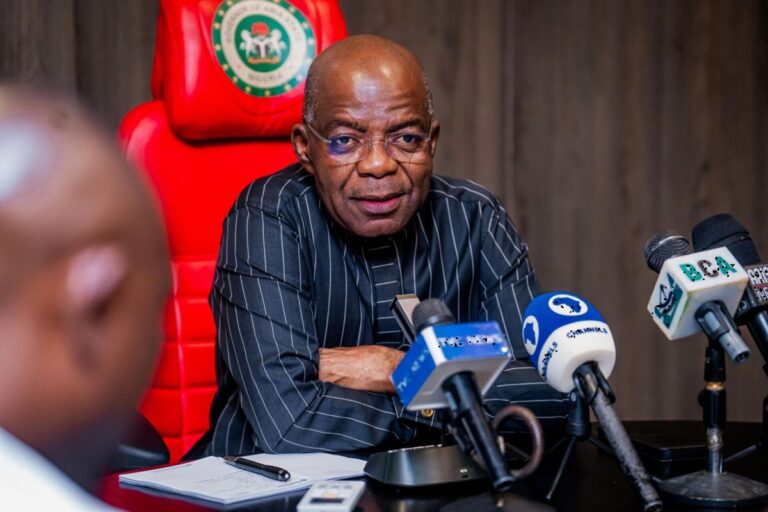
Nigeria’s Minister of Solid Minerals, Dele Alake. Credit; The Guardian
According to Bamigbetan, Basin Mining Limited’s mineral titles were revoked after the company failed to pay statutory annual service fees amounting to ₦1.223 billion in 2024.
He said the outstanding debt later rose to about ₦2.494 billion before the licences were eventually cancelled.
“The revocation was carried out in accordance with Nigerian mining laws and had nothing to do with the nationality of any investor,” Bamigbetan said.
He further stated that although British-Australian firm Jupiter was not the holder of the revoked licences, it instituted arbitration proceedings against the Nigerian Government, claiming a violation of the Nigeria-United Kingdom Bilateral Investment Treaty.
Bamigbetan also alleged that the company had resorted to media campaigns and cyberattacks against Alake in an attempt to pressure the government into reversing the revocation.
Responding to allegations that the minister favours Chinese investors, Bamigbetan said Alake had visited China only twice in the past three years—first as part of President Bola Tinubu’s delegation on a state visit and later at the invitation of the Chinese government for China Mining Week 2025.
He said the minister had attended more investment conferences in Western countries than in China, including three editions each of the London Mines and Money Conference and Mining Indaba in South Africa, as well as two official visits to Australia to promote investment opportunities in Nigeria’s mining sector.
According to Bamigbetan, Nigeria’s policy of opening the mining industry to foreign investment predates the current administration, tracing it to the Nigerian Investment Promotion Commission Act and the Foreign Exchange (Monitoring and Miscellaneous Provisions) Act of 1995, which liberalised investment across most sectors of the economy.
He added that Alake’s reforms have focused on enforcing compliance with mining regulations and promoting local value addition by requiring investors to process minerals within Nigeria before export.
Bamigbetan said several Chinese firms had responded by establishing mineral processing plants in the country, while some licence holders failed to develop their mining assets despite having the opportunity to do so.
He also highlighted the long-standing cooperation between Nigeria and China in the mining sector, including geological mapping, mineral exploration and technical partnerships dating back to 2011.
According to him, President Tinubu’s 2024 state visit to China, during which more than 20 bilateral agreements were signed, further strengthened investment ties between the two countries.
“Contrary to claims that Western investors are being sidelined, more than 300 companies from Europe, North America, Canada and Australia are actively operating in Nigeria’s solid minerals sector,” Bamigbetan said.
He added that the Nigerian Geological Survey Agency continues to partner with French and German institutions on geological data development, while the World Bank supported the development of the new Solid Minerals Sector Roadmap.
According to Bamigbetan, “The reforms introduced by Dr Dele Alake, including the establishment of the Nigeria Solid Minerals Company, the deployment of Mining Marshals, stricter enforcement of mining laws and the commissioning of mineral processing plants, are already yielding measurable results.”
He maintained that the Nigerian Government would not reverse the revocation of mining licences belonging to companies that failed to comply with Nigerian laws, regardless of media campaigns mounted against the minister.
Toyibat is a highly motivated Mass Communication major and results-oriented professional with a robust foundation in media, education, and communication. Leveraging years of hands-on experience in journalism, she has honed her ability to craft compelling narratives, conduct thorough research, and deliver accurate and engaging content that resonates with diverse audiences.
Weekly roundups. Sharp analysis. Zero noise. The NewsCentral TV Newsletter delivers the headlines that matter—straight to your inbox, keeping you updated regularly.
 Trending