Trending
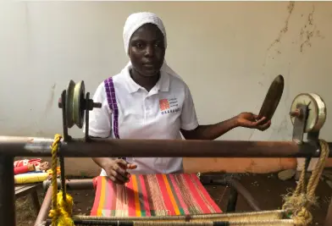
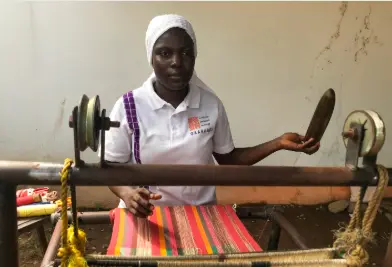
A new training centre in Garoua has equipped young women with weaving skills while promoting local cotton processing.
The Gaaraadji Training Centre in Poumpoumré, northern Cameroon, trains young women to turn locally produced cotton thread into finished fabric.
Twenty-year-old Solantine Maifrigi is among 10 trainees retained from an initial group of 20.
After losing her grandmother, whom she had cared for, Maifrigi returned home without an income or business.
She initially planned to become a seamstress but later chose weaving after her younger sister became interested in the craft.
“During my free one-year training at the centre, I learned how to weave, dye and embroider clothing. I was asked to stay after completing the course,” she said.
Her monthly stipend helps her cover food, clothing and rent and also enabled her to buy a sewing machine.
Eighteen-year-old Nafisatou, a single mother, has also learned weaving at the centre and now has a better means of supporting herself and her child.
The centre teaches trainees to work with gaaraadji, the Fulfulde word for thread, made from cotton grown in Cameroon’s northern regions.
Cameroon produces about 320,000 tonnes of seed cotton annually, making it Africa’s fifth-largest producer, but only about five per cent is processed locally.
The suspension of cotton-processing operations by the Cotton Industrial Company of Cameroon, CICAM, in Garoua has further limited local production.
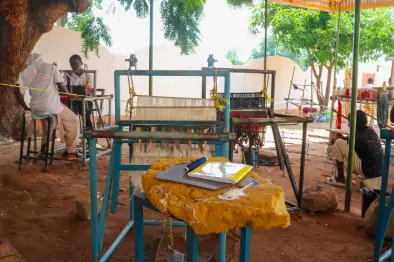
Gaaraadji is seeking to fill part of that gap by turning locally sourced cotton thread into handmade textiles.
The centre, founded by chemist and fashion enthusiast Sonia Hayatou, currently uses just over 100kg of cotton thread monthly.
“We produce fabric every two days. Demand is high, especially for weddings,” Hayatou said.
She said the centre personalises designs and focuses on quality, allowing customers to buy locally made fabrics without travelling to other West African countries.
Hayatou hopes to increase production and eventually handle larger orders, including uniforms.
The centre was selected from 600 enterprises at the 2026 Cameroon International Handicrafts Fair, SIARC, organised by the Ministry of Small and Medium-sized Enterprises, Social Economy and Handicrafts.
It has also received technical and financial support through the ministry’s decentralised services.
Adama Habiya, a ministry representative at Garoua II Council, said the centre stood out for its originality, cultural value, and use of locally produced cotton.
“We encourage the centre to persevere, innovate, establish itself in national and international markets,” Habiya said.
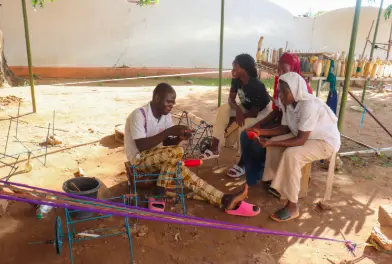
Gaaraadji also demonstrated its work during the World Trade Organization’s 14th Ministerial Conference in Yaoundé from March 26 to 29, 2026.
“We demonstrated the journey from cotton to thread using a spinning wheel, and then from weaving to finished fabric,” Hayatou said.
Ousmanou Garba, director of the Garoua Crafts Village, said the centre could support women’s empowerment and Cameroon’s push for locally made products.
“We firmly believe that this centre will contribute to women’s empowerment through weaving, something we are already witnessing first-hand,” Garba said.
Gaaraadji plans to begin formal vocational courses in October 2026 after receiving authorisation from the Ministry of Employment and Vocational Training.
The centre will continue training women from disadvantaged backgrounds while promoting locally produced cotton clothing.
Its fabrics currently cost between FCFA 2,500 ($4.45) and FCFA 40,000 ($71), depending on the design and material.
Hayatou hopes Cameroon will follow countries such as Burkina Faso and Mali in expanding domestic cotton processing.
“Although we are still at an early stage, we are part of this movement,” she said.
Credit: Leocadia Bongben by Bird Story Agency.