Trending
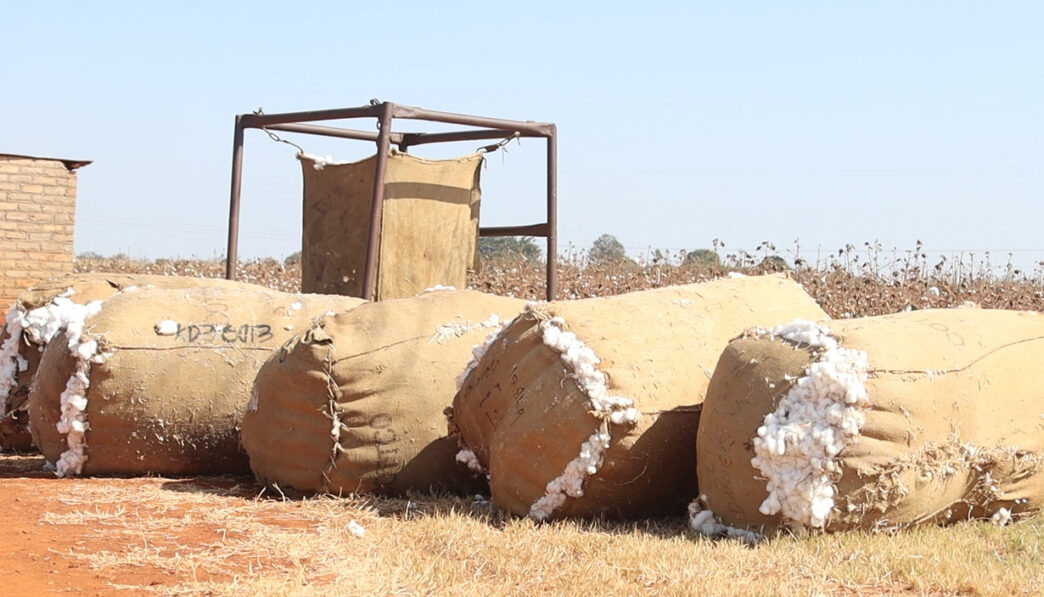
Africa has been one of the world’s major cotton producers for decades. Yet, the labels stitched into shirts, jeans and sportswear sold across global retail chains have rarely carried the continent’s industrial signature.
Cotton grown in African fields has routinely travelled thousands of kilometres to factories in Asia, only to return as finished garments commanding far higher prices than the raw product that left the continent in the first place.
It is an economic paradox that business leaders, policymakers, investors and sourcing specialists increasingly believe can no longer be justified.
Read More : Nigeria’s North Trapped in Ransom Economy
That conviction framed the Cotton to Clothing: Building Integrated African Textile and Apparel Value Chains for Jobs, Trade and Industrial Transformation discussion hosted by the International Trade and Research Centre, where speakers argued that Africa is no longer short of raw materials, market demand or demographic strength.
Instead, they said, the continent’s greatest challenge lies in transforming fragmented production into an integrated industrial ecosystem capable of competing on the global stage.
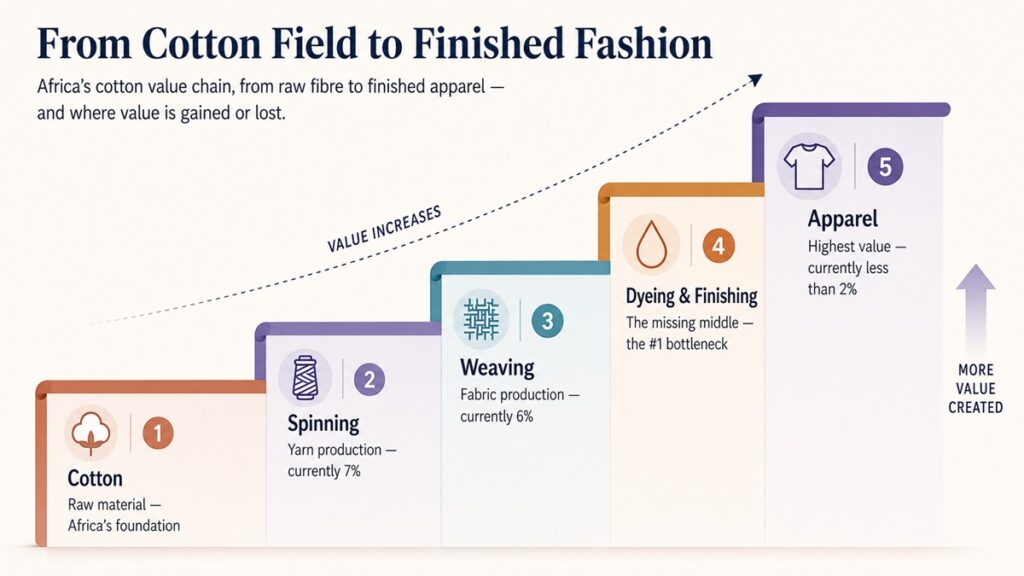
“We only capture 2% of the value because we export raw materials which Asia then processes into manufactured goods and brands,” Zimbabwean agro-industrialist and value chain strategist Tararama Gutu told participants.
“We are stuck in an exporter’s trap where Africa just basically exports raw cotton and brings in finished products,” said Gutu.
“There is a cost to this, which is a US$23 billion cost of being an exporter of raw materials. There is another cost, which is a US$20 billion cost to regional trade between ourselves because of non-tariff barriers, added to the billions that we import back (in goods) from overseas,” Gutu added.
There is an opportunity in this challenge: speakers noted that the cotton-to-clothing value chain is one of Africa’s clearest industrial opportunities at a time when multinational manufacturers are diversifying supply chains, sustainability has become a purchasing requirement rather than a marketing slogan and the African Continental Free Trade Area (AfCFTA) promises lower trade barriers.
According to Gutu, the upside is substantial: “We are staring at a 600% potential increase in textile exports, which is achievable, which would again create almost 5.8 million jobs across the value chain.”
The challenge, however, is not simply growing more cotton.
“There are five steps in the ladder from cotton to apparel,” he explained. “We grow the cotton, but in between the processes of growing cotton and getting apparels, we have got spinning and weaving, then dyeing. The missing middle is dyeing and finishing. It’s the number one bottleneck.”
Africa Fashion and Sustainability Ambassador, Textile Sourcing Expert and Chairwoman of the Ethiopian Buyers Club, Nursema Cil said the issue extends well beyond individual factories.
“We have ginning strong, as well as export strong. But then when you look exactly in between spinning, weaving, dyeing, finishing, trims, even at some point also garment manufacturing, it’s all constrained.
“The missing middle,” she continued, “is not a small gap in the process, it’s almost the entire process. Every stage we skip, someone outside Africa fills it and keeps the margin.”
Without those capabilities, yarn cannot become high-quality fabric at scale, leaving African producers trapped near the bottom of the value ladder while manufacturers elsewhere capture the higher margins associated with finished textiles and apparel.
Asian manufacturing powerhouses built their competitiveness over decades through deliberate industrial policy, heavy infrastructure investment and sustained public-private coordination.
“How our competitors did it, is that they basically built their powerhouses through government policies which were very efficient,” Gutu observed, citing tax holidays, export subsidies, duty-free machinery imports, industrial parks equipped with reliable utilities, workforce development and policies encouraging vertically integrated manufacturing.
Those investments helped countries such as China establish dominant textile industries before production gradually expanded into India, Bangladesh and Vietnam as labour costs evolved.
This is not so on the continent: Infrastructure constraints remain pervasive, with unreliable electricity, congested transport corridors and weak logistics increasing production costs. Skills shortages are particularly acute in technical disciplines such as dyeing, finishing and industrial maintenance. Financial markets often favour short-term lending over patient industrial capital, while fragmented regulations continue to limit cross-border production.
Perhaps most revealing is the contrast in regional integration. Gutu noted that Africa trades far less within its own borders than other regions. Intra-African trade accounts for about 15% of the continent’s total trade, compared with approximately 61% in Asia and 67% in Europe, according to UNCTAD. This is despite Africa’s abundant raw materials and expanding consumer market.
That fragmentation, participants argued, weakens the continent’s attractiveness to international buyers.
International apparel brands no longer seek isolated factories capable of fulfilling occasional orders. They increasingly source from complete industrial ecosystems offering reliability, traceability, compliance, technical expertise and sufficient production capacity to support long-term commercial relationships.
Cil illustrated that imbalance by comparing Bangladesh’s more than 4 000 garment factories and roughly 500 spinning mills with West and Central Africa’s estimated 300 to 700 factories and 40 to 80 spinning mills combined.
“So, we do not have really a full amount that triggers buyers to shift from the established markets to a new market that gives a full scale of sourcing opportunities,” she said.
Equally important, buyers increasingly evaluate future capability rather than present capacity alone.
“We do not just ask what I can buy today. We also ask what you can do tomorrow for us,” she explained. “Nobody moves on a snapshot. We move on credible, long-term plans that is actually happening on the ground.”
That demand for predictability extends into financing. Rather than relying on grants, which speakers argued have become increasingly scarce, Gutu proposed a commercial model centred on long-term purchase commitments.
“What we need is patient capital, which is fully de-risked,” he said.
“The first step in raising pre-orders is to approach global brands… and then you try to get them to sign five to ten-year off-take agreements.”
Such contracts, he argued, create guaranteed demand that banks and investors can finance against while encouraging brands to provide technical assistance and quality oversight.
Africa’s population is projected to exceed 1.8 billion by 2035, according to the Institute for Security Studies. Through the African Continental Free Trade Area, the continent already represents an integrated market of more than 1.4 billion people with a combined GDP of approximately US$3.4 trillion, according to the UN Economic Commission for Africa.
More importantly for manufacturers, AfCFTA offers the possibility of integrated production networks in which cotton grown in one country can be spun in another, dyed elsewhere and assembled into garments in yet another before reaching consumers across the continent and beyond.
For Cil, a regional approach is not optional but essential. While the continent’s advantages already exist, she cautioned against expecting individual countries to build complete textile ecosystems within their own borders.
“Building a full ecosystem inside one border takes decades and capital most countries don’t have,” she said.
Instead, she argued for complementary specialisation across countries: “One integrated regional supply chain from cotton to finished garment, instead of 54 separate, scattered efforts. That’s the actual task in front of us.”
That sentiment was echoed by International Trade and Research Centre Content and Publications Lead Arisekola Muritala, who argued that buyers increasingly procure from integrated production systems rather than isolated businesses.
“Global buyers are sourcing from ecosystems,” he said.
“The competitive advantage of Africa’s cotton textile and apparel sector will be achieved through integrated regional value chains, where countries are not doing everything alone, but collaborating, focusing on areas of specialisation, and then growing together.”
Read More : African Insurers Expand Into Banking
The continent still faces formidable obstacles, including financing gaps, infrastructure deficits, weak logistics and inconsistent regulation. Recent initiatives -including a US$5-billion textile investment plan, new industrial platforms and AfCFTA trade-facilitation mechanisms – suggest that capital and policy are beginning to respond. The test, however, is whether these commitments translate into operating factories, connected regional supply chains and sustained employment.
As Gutu concluded: “Africa already produces the cotton, but the world needs clothing. The only missing piece is the decision to build the factories in between…. We must move from competing for cotton to collaborating on clothing.”
By Muchemwa Mugadzaweta, Bird Story Agency.