Trending
Every Lagos motorist knows the tax no law imposes. As 2027 approaches, the men who collect it may be readying for a bigger job.
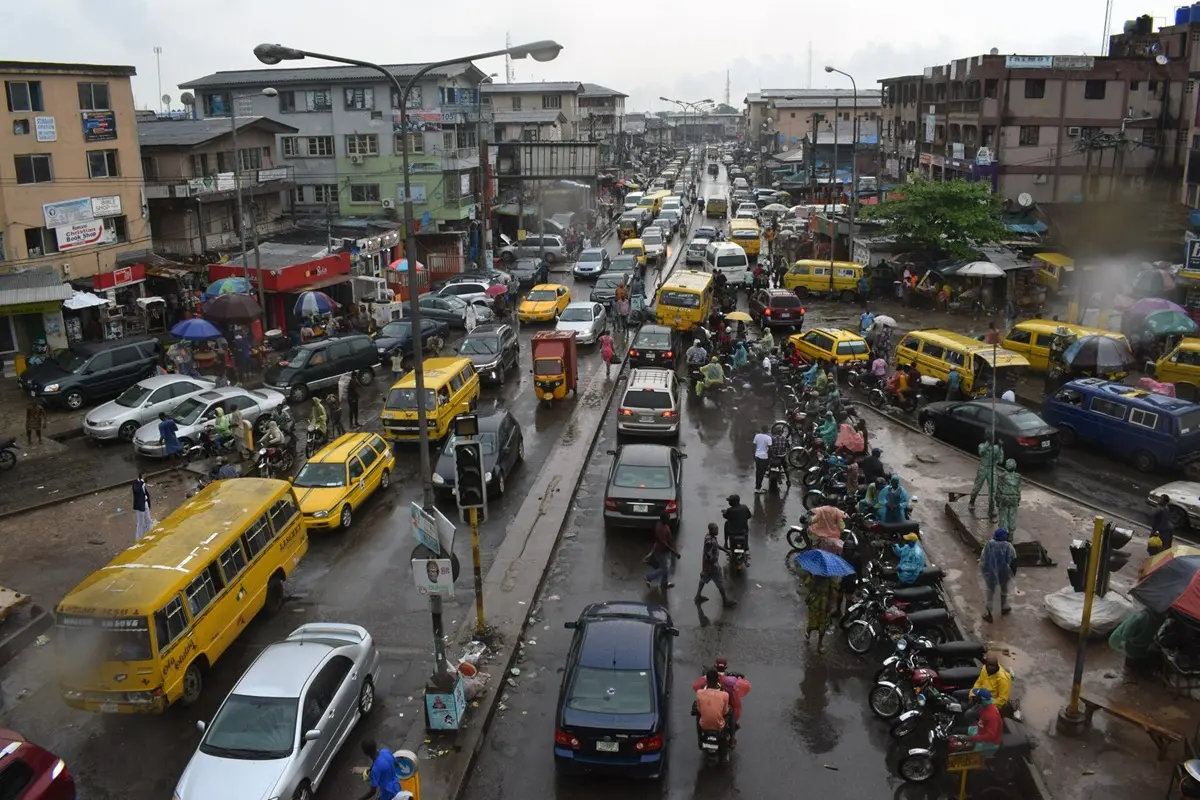
The flood on Herbert Macaulay Road had risen to the windows. I had just picked up my son from the University of Lagos International School, and there was no other way home. We pushed through the water in my Toyota Corolla, and the engine held until we began the climb up the Ojuelegba bridge. Then it knocked and died, and we were stranded halfway up one of the busiest crossings in Lagos.
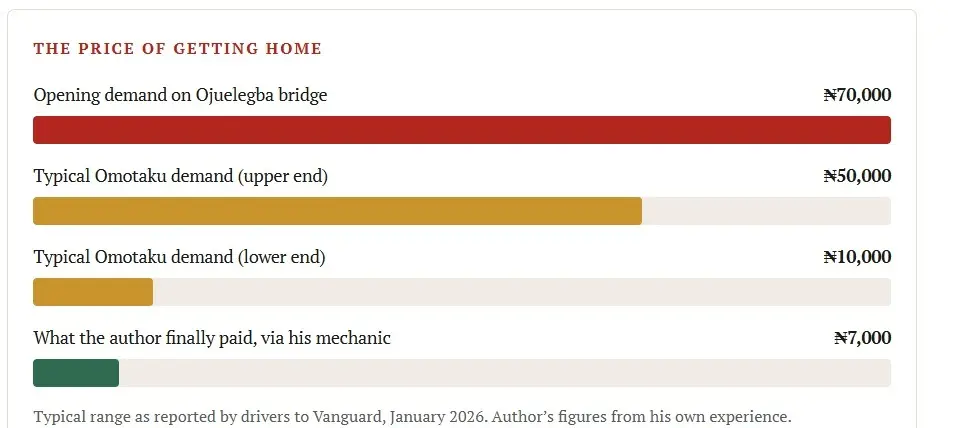
Within minutes, we were surrounded. They came from nowhere, as they always do: a swarm of young men pressed around the car. Their spokesman named the price for pushing us off the bridge to the roadside: ₦70,000. They were not offering a service. They were announcing a toll, and the alternative was left unspoken.
Read More : Kukah Warns Votes Could Decide Survival In 2027
I did not negotiate. I could not. I do not speak Yoruba, and in that moment language was the difference between being a customer and being prey. I called my mechanic. Then I called a friend, a soldier stationed at Abalti Barracks, the headquarters of the Nigerian Army Ordnance Corps, barely a stone’s throw from where we sat. His advice was simple: negotiate with them.
The young men had already told us what they thought of that option. They owned Lagos, they boasted, and no military force could do anything to them. Soldiers were a few hundred metres away, and one of them was advising me to pay.
“They owned Lagos, they boasted, and no military force could do anything to them.”
— What the hoodlums told the author on the Ojuelegba bridge
When my mechanic arrived, he did what I could not. He spoke their language, literally and otherwise. He got me on the phone with a man I never saw, whom the boys deferred to as their leader, and we settled at ₦7,000.
It did not end quietly. The boys charged at me in feigned rage, closing in on the car as if the bargain had insulted them. I did not flinch. They smashed bottles on the asphalt around us. I said nothing. It was theatre, and we all knew it, but on a stalled car halfway up a bridge, theatre is enough.
The scene beside the barracks
It was not my first encounter with them. Some time earlier, driving along the same Ojuelegba stretch beside Abalti Barracks, I watched a group of these men climb onto a container-laden trailer. They told the driver he would pay a “toll” or they would cut his brake cables.
The driver screamed for help. Nobody came. What struck me most was that nobody even raised a phone to film it. Lagosians film everything: fights, fires, accidents, a goat on a danfo roof. That afternoon, no one dared. We sat in our cars, and we were all helpless together.
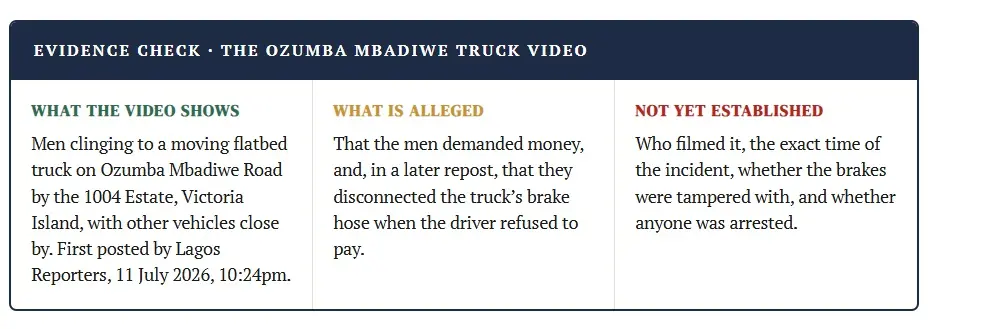
What I saw beside Abalti Barracks has not gone away. On the night of Saturday, 11 July 2026, the Lagos news platform Lagos Reporters posted a clip filmed on Ozumba Mbadiwe Road, Victoria Island, by the 1004 Estate. It shows young men clinging to the sides of a moving flatbed truck as it rolls along a wet road, with a car alongside. The platform reported that the driver almost crashed into other vehicles as the men insisted on collecting money from him.
The video has since been shared thousands of times. In one widely circulated repost, the uploader alleged that the men had disconnected the truck’s brake hose after the driver refused to pay their “levy”. That claim has not been independently confirmed, and the footage alone does not show it. What the footage does show is enough: a heavy goods vehicle in motion on one of the city’s busiest corridors, with men on board demanding payment, and no sign of police, Lagos State Traffic Management Authority, LASTMA or the Taskforce.
These are not isolated stories. They are the visible edge of a system that runs from the roadside to the riot to the polling unit. With the 2027 elections months away, Lagosians are entitled to ask whether that system is being oiled for another outing.
The anatomy of a shakedown
The men who surrounded my car now have a name in the Lagos press: Omotaku. The Yoruba word roughly means taking by force, at all costs. Through 2026 they have become a fixture of news reports, and their method rarely varies.
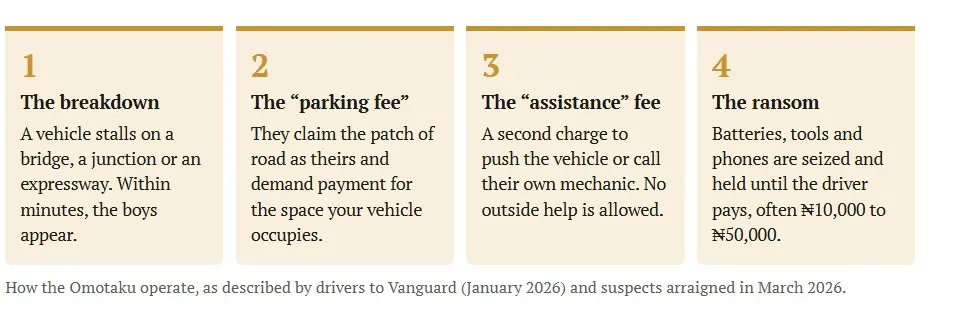
A Vanguard investigation in January described a two-stage extortion. First comes a “parking fee” for the patch of road where your vehicle has broken down, which the boys claim as their own. Then comes a charge for “assistance”: pushing the vehicle aside, or summoning a mechanic from their own network. No outside mechanic may touch the car until they are paid. Drivers told the paper that demands typically run from ₦10,000 to ₦50,000. Batteries, tools and phones are seized and held for ransom in nearby shanties.
Truck drivers are favoured targets. Five suspects arraigned in March 2026 on the Abule-Egba axis admitted posing as roadside mechanics. They approached stranded drivers and then threatened to remove their batteries until they paid. Others in the group blocked drivers from their vehicles or pulled off side mirrors to create panic.
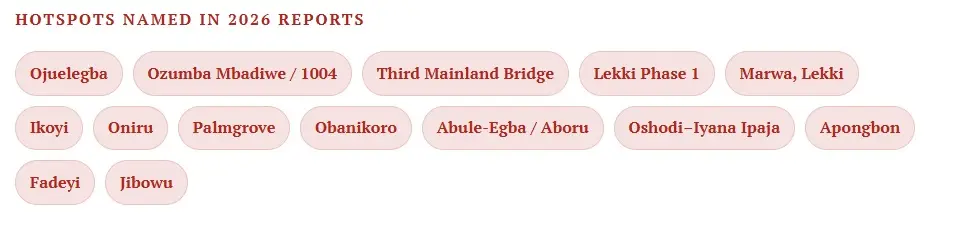
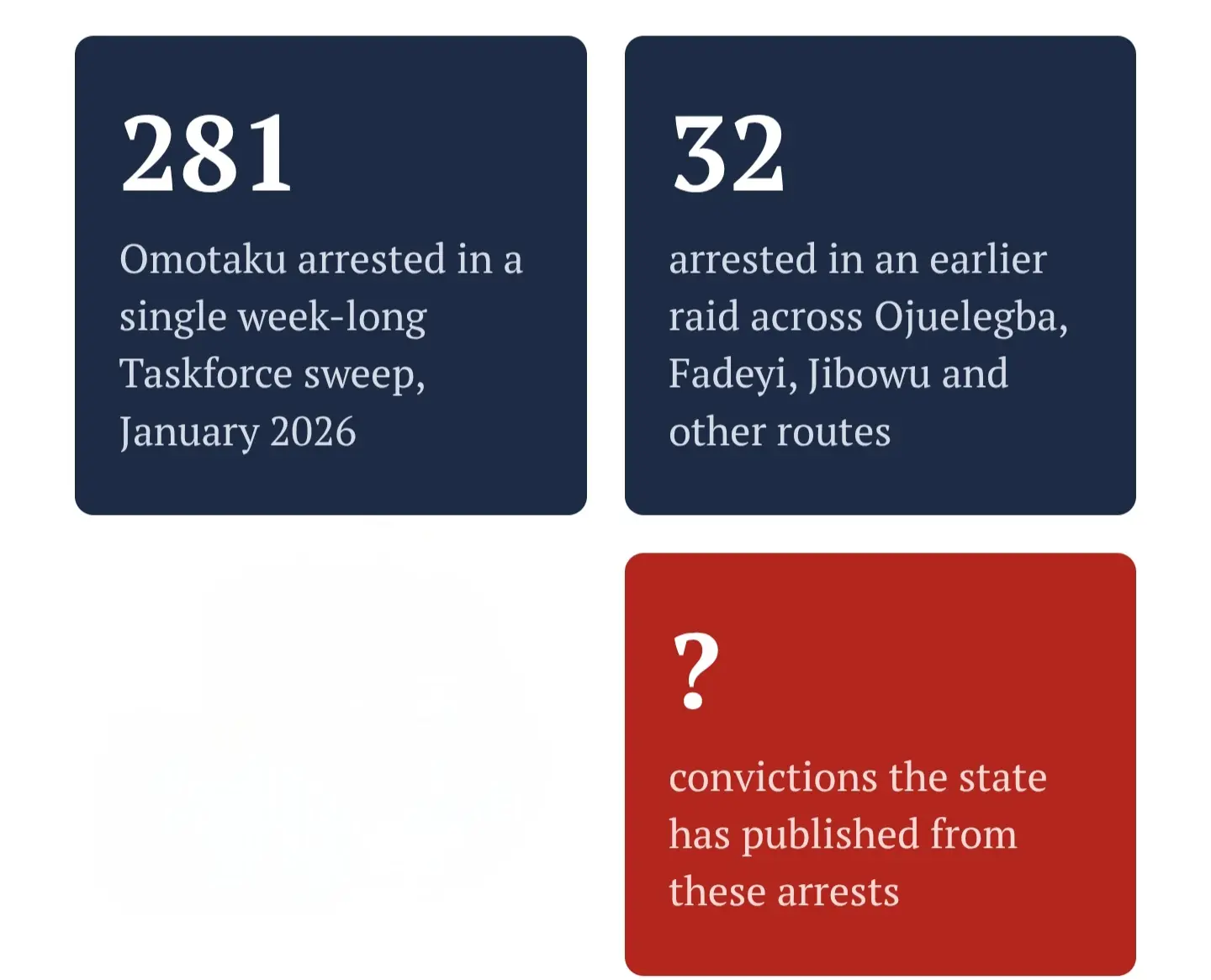
The state has not been idle. In January, the Lagos State Environmental and Special Offences Enforcement Unit announced 281 arrests in a single week-long sweep. The sweep was concentrated on the Lekki, Ikoyi and Ojuelegba axis; Ojuelegba again. In April, the Commissioner for the Environment, Tokunbo Wahab, announced fresh arrests at Palmgrove, Oniru and the Marwa bus stop in Lekki. At Marwa, a truck driver whose vehicle had broken down was threatened by men demanding his phone and money.
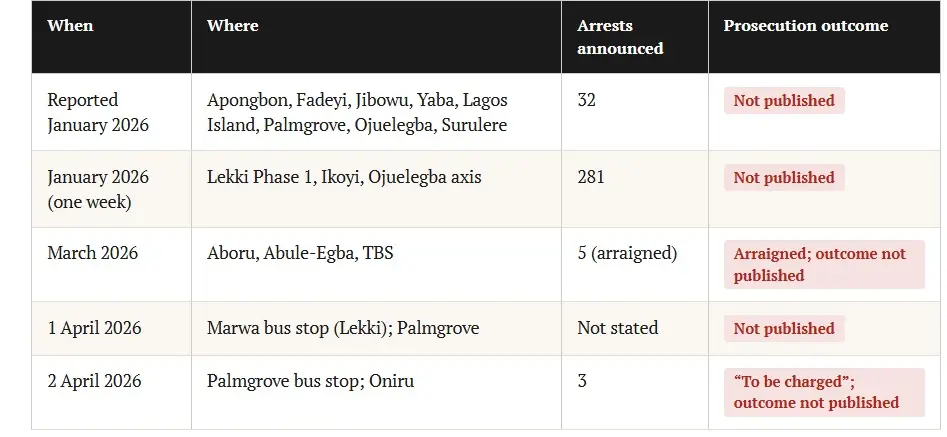
Arrests are announced with fanfare. Convictions are harder to find.
Until those figures are published, the suspicion remains that the crackdowns are a revolving door. The boys are paraded, released, and back on the bridge by the next rainstorm.
From the roadside to the riot
In October 2020, the whole world saw what these young men could do when the city’s restraints slipped.
The #EndSARS protests began as a peaceful, youth-led demand for an end to police brutality. After the shooting at the Lekki Toll Gate on 20 October, Lagos burned. The arsonists and looters captured on live television were not the protesters who had marched in orderly lines for two weeks. They were men who knew the streets and knew which targets to hit.

They torched 80 newly acquired BRT buses, valued at ₦3.9 billion. They burned the Igbosere High Court. They attacked TVC, The Nation, police stations, the Nigerian Ports Authority headquarters, shopping malls and the family home of Governor Babajide Sanwo-Olu in Surulere. They invaded the palace of the Oba of Lagos. The monarch later said $2 million and ₦17 million were stolen from it.
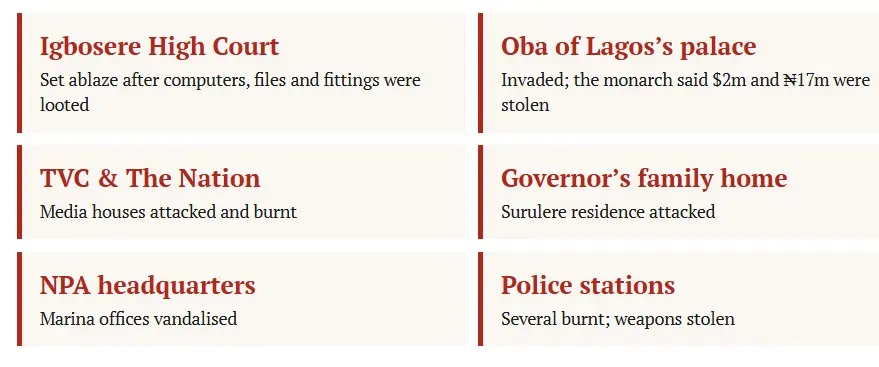
The then Commissioner of Police said 520 suspects were arrested and conceded that they were not the peaceful protesters. Governor Sanwo-Olu estimated that rebuilding what was destroyed would cost more than ₦1 trillion. The #EndSARS protesters carried the blame in much of the official narrative. The men who did the burning went back to the parks and the junctions.
The union and the state
To understand why these men seem untouchable, look at who they work for.
Many of the agberos who collect “tickets” at bus stops and junctions operate under the umbrella of the National Union of Road Transport Workers. In Lagos, the NURTW has been one of the most powerful political machines of the past two decades. Control of the city’s motor parks means control of a vast daily cash flow, and the men who control that cash flow are closely tied to the ruling All Progressives Congress.
That relationship has been studied. A 2025 study of electoral violence in Nigeria, drawing on research across four states, found that in Lagos much of the election violence is linked to the NURTW, whose touts act on behalf of the ruling party. In return, they keep their grip on the lucrative transport sector.
The state’s leadership has been candid about where it stands. In September 2020, weeks before #EndSARS, Deputy Governor Obafemi Hamzat was asked why the government would not simply ban the touts. He said the NURTW was a union recognised by law, no less legitimate than the Nigerian Medical Association. The government could not arbitrarily ban it, he argued, because its members were “our brothers and cousins.”
“They are our brothers and cousins.”
— Deputy Governor Obafemi Hamzat on NURTW members, September 2020. He is now the APC’s 2027 governorship candidate in Lagos.
Mr Hamzat is now the APC’s candidate for governor of Lagos in 2027.
The career of Musiliu Akinsanya, better known as MC Oluomo, tells the same story from the other end. He rose from the motor parks of Oshodi to chair the Lagos State Parks Management Committee, and now leads the NURTW nationally. Few men better embody the fusion of street power and party power in Lagos.
The ballot box
That fusion is at its most dangerous on election day.
In 2019, according to the International Crisis Group, pro-APC thugs attacked polling stations to chase voters away in opposition strongholds with large Igbo populations, such as Ijesha and Okota.
In 2023 it was worse. Two days before the governorship election, a video circulated of MC Oluomo addressing a gathering. “Iya Chukwudi,” he said, naming a stock Igbo figure, “if you don’t want to vote for us, stay at home.” He later said he had been joking with a neighbour. A spokesman for the Nigeria Police Force publicly advised Nigerians to take it as a joke.
“Iya Chukwudi, if you don’t want to vote for us, stay at home.”
— MC Oluomo, March 2023. He later said he was joking.
On 18 March, it did not look like a joke. The European Union Election Observation Mission reported that polling was disrupted by multiple incidents of thuggery and intimidation of voters, polling officials, observers and journalists. It named Lagos among the worst-affected states. In Oke-Afa, Ejigbo, armed thugs wearing APC identity tags stormed a polling unit, destroyed ballot papers and tried to seize the BVAS machine. Residents resisted until soldiers arrived. At Ijegun, a voter told Vanguard he had a bottle smashed on his head after trying to stop thugs disrupting his unit.
Nearly four years on, no one of consequence has been held to account.
2027: the signs
The question I asked at the start is not rhetorical. The signs are already on the road.
In October 2025, a video surfaced of Mustapha Adekunle, known as Sego, chairman of the Lagos NURTW, addressing union members. He warned that anyone who refused to vote APC in 2027, or declared against the party, would “be dealt with.” The Department of State Services summoned him. He afterwards denied threatening anyone and blamed “propaganda”.
Anyone who refuses to vote APC “will be dealt with.”
— Lagos NURTW chairman Mustapha Adekunle (Sego), October 2025. He later denied making threats.
The opposition has already felt the heat. In September 2025, suspected political thugs invaded an African Democratic Congress rally at Lion Field in Alimosho, held to welcome Peter Obi and Gbadebo Rhodes-Vivour. In February 2026, a defection ceremony in Alimosho, where Labour Party members were crossing to the ADC, was broken up by thugs, leaving several people injured.
Even the police are worried aloud. In August 2026, the Lagos State Commissioner of Police, Tijani Fatai, told a youth dialogue that politicians would lure young people with money to commit violence and then abandon them. He went further and called directly on the NURTW and its sister union, RTEAN, to stop motor parks becoming centres of electoral thuggery before and during the 2027 elections. When the police commissioner names the unions in the same breath as thuggery, the connection is no longer a conspiracy theory.
Timeline · From the roadside to the ballot box
- 2019 elections: Pro-APC thugs attack polling stations in Ijesha and Okota, opposition strongholds with large Igbo populations (International Crisis Group).
- September 2020: Deputy Governor Hamzat says the state cannot ban NURTW touts: they are “our brothers and cousins.”
- 20–22 October 2020: After the Lekki Toll Gate shooting, hoodlums burn 80 BRT buses, courts, media houses and the Oba’s palace. 520 arrested.
- 16 March 2023: MC Oluomo’s “Iya Chukwudi … stay at home” video circulates. Police call it a joke.
- 18 March 2023: Governorship election: EU observers name Lagos among states worst hit by thuggery; APC-tagged thugs attack a polling unit in Oke-Afa, Ejigbo.
- 7 September 2025 :Suspected political thugs invade the ADC rally for Peter Obi at Lion Field, Alimosho.
- October 2025: Lagos NURTW chairman Sego warns anti-APC voters will “be dealt with”. DSS summons him; he denies it.
- January 2026; Taskforce arrests 281 Omotaku in one week, including on the Ojuelegba axis.
- 1 February 2026: Thugs break up a Labour-to-ADC defection ceremony in Alimosho; several injured.
- 21 May 2026: Obafemi Hamzat becomes the APC’s 2027 governorship candidate in Lagos.
- 11 July 2026: Video from Ozumba Mbadiwe Road (1004 Estate) shows men on a moving truck demanding money; the driver almost crashes.
- August 2026: Lagos CP Tijani Fatai urges NURTW and RTEAN to keep motor parks from becoming centres of electoral thuggery.
- 2027: General and governorship elections.
None of this proves a directive from the top. The APC in Lagos will say, as it always has, that it neither recruits nor condones violence.
But a pattern that repeats across 2019, 2023 and the run-up to 2027 is not an accident either. The men on the Ojuelegba bridge who told me they owned Lagos were not simply boasting. They were describing an arrangement.
What would it take?
Lagos is not powerless. It is unwilling.
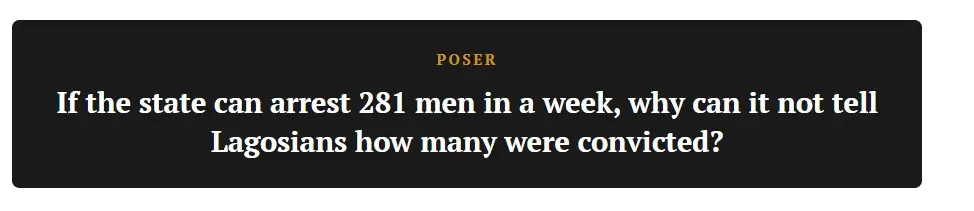
A state that can deploy a Taskforce to arrest 281 men in a week can prosecute them. It can publish the outcomes and stop the revolving door. It can put its emergency hotlines to work at the bridges and junctions where breakdowns turn into sieges. It can separate the management of motor parks from the machinery of party politics, so that the men who collect tickets are not the same men mobilised on election day.
- Prosecute, then publish. Release conviction figures for every Omotaku sweep, not just arrest counts.
- Man the black spots. Station responders at bridges and junctions where breakdowns become sieges: Ojuelegba, Ozumba Mbadiwe, Third Mainland.
- Separate parks from parties. The men who collect tickets should not be the men mobilised on election day.
- Secure vulnerable polling units. Commit publicly to protecting units in areas hit in 2019 and 2023.
- Finish the 2023 investigations. Close the files the police opened, and tell the public what they found.
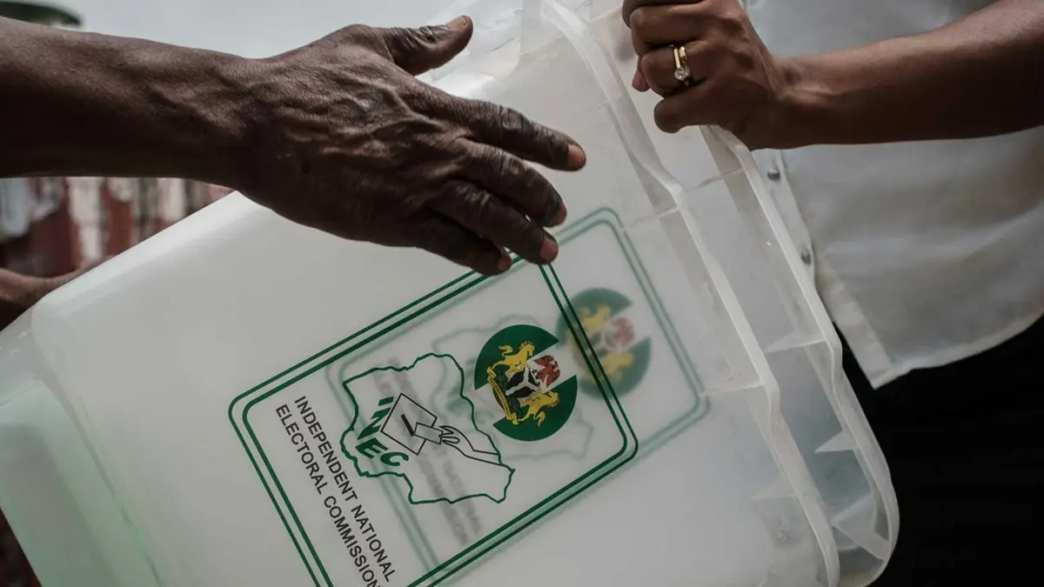
Before 2027, the police and INEC can make a public commitment to secure polling units in neighbourhoods where non-indigenes vote in large numbers. The 2019 and 2023 attacks clustered in exactly those places. And the Nigeria Police Force can finish the investigations it announced in 2023, which have gone silent since.
Back on the bridge
I still think about that afternoon on the Ojuelegba bridge: my son beside me, the engine dead, the water draining off the road below. A man I never saw decided on the phone what I would pay to go home.
I paid ₦7,000. It was cheap, as these things go. The real price is paid by the whole city, every time a trailer driver is held hostage on Ozumba Mbadiwe and every time a voter in Okota or Ejigbo decides it is safer to stay home. It is paid again whenever a government official describes the men responsible as brothers and cousins.
The boys on the bridge said they owned Lagos. In 2027, Lagosians will find out whether they were right.