Trending


Africa is moving away from old colonial-era air routes built to link intra-Africa flights to Europe, embracing free-route airspace to enable more direct and potentially cheaper flights.
Soon, flights between African cities could become more direct, with travellers less likely to route through Europe or the Middle East.
Only 19 per cent of intra-African routes currently have direct flights, according to the International Air Transport Association (IATA), forcing many passengers to take longer and more expensive journeys through hubs outside the continent.
In contrast, intra-European traffic accounts for up to 80 per cent of airline traffic, according to data from Eurocontrol, a pan-European civil-military organisation, while OAG scheduled flights data puts intra-regional traffic in Latin America at between 40 and 50 per cent.
The African Union officially launched the Single African Air Transport Market (SAATM) on January 28, 2018, during its 30th Ordinary Summit in Addis Ababa, Ethiopia, but implementation across member states remains slow due to national protectionism for national flag carriers.
The association says African airlines operate in one of the world’s toughest cost environments, with its data showing fuel prices 17 per cent higher and taxes and charges 12 per cent to 15 per cent higher than the global average.
IATA attributes the high costs to African governments treating aviation more as a revenue source than a catalyst for economic development, along with increased fuel costs driven by the US/Iran war.
Air navigation costs are 10 per cent higher, while maintenance, insurance, and capital costs are 6 to 10 per cent higher, further squeezing airline margins and pushing up the cost of flying.
The continent has begun resolving these challenges by re-drawing Africa’s skies using a new approach known as a Free Route Airspace system. This model allows airlines to plan user-preferred routes (UPRs) and fly more direct paths based on weather, winds and traffic conditions.
“Rather than being locked into a fixed network of airways, an airline can fly the most direct, efficient path between its entry and exit points,” African Airlines Association (AFRAA) Secretary General Abderahmane Berthé told delegates during the 10th Africa Aviation Summit in Nairobi in early September.
The free route system, Berthé said, relies on four key elements. First, airlines file user-preferred routes based on prevailing winds, weather and aircraft payload. Air navigation service providers on either side of a flight information region boundary coordinate to clear the route. During this time, aircraft remain continuously monitored and separated, just as they are on conventional routes. To achieve this, air navigation service providers need to approve changes faster.
“Same origin, same destination, fewer track miles, less fuel, less time. The difference is that the aircraft can take a more direct path,” Berthé explained.
Initial projections by the AFRAA-led initiative from its West and Central African implementation indicate that one launch airline could save 1,393 flight hours and US$15 million in operational costs annually, alongside 5,000 tonnes of fuel and 15,750 tonnes of carbon dioxide emissions.
The free-route approach is already operational across 24 states in West and Central Africa, where it has been under pilot since November 2023.
These regional airspaces became fully open to UPRs for any airlines by October 3oth 2025, when air navigation service providers initially committed to approving new user-preferred routes within 48 hours.
“From mid-year, approvals are streamlined further moving from that 48-hour turnaround to no pre-approval required,” said Berthe.
AFRAA is working with global, continental and national aviation bodies to deliver the new airspace arrangements.
The International Civil Aviation Organisation (ICAO) provides the regulatory framework, the International Air Transport Association (IATA) contributes industry data and standards, while the Civil Air Navigation Services Organisation (CANSO) coordinates air navigation providers and the African Export-Import Bank (Afreximbank) provides financial support.
National regulators and service providers, including the Agency for Aerial Navigation Safety in Africa and Madagascar (ASECNA), Ghana’s Civil Aviation Authority and Nigeria’s Nigerian Airspace Management Agency (NAMA), are implementing the changes on the ground.
Initial projections by the AFRAA-led initiative from its West and Central African implementation indicate that one launch airline could save 1,393 flight hours and US$15 million in operational costs annually, alongside 5,000 tonnes of fuel and 15,750 tonnes of carbon dioxide emissions.
After successful trials in the two regions, the team is looking to extend the experiment to Eastern and Southern Africa while simultaneously removing regulatory, infrastructure and market barriers that have kept cross-border air travel expensive.
748 Air Services Head of Flight Operations, Captain Ayub Gitau, who has flown across Africa over the last 16 years, expressed excitement about the upcoming shorter routes that will come with open skies for Africa.
“It will be easier for us; we will no longer have to think about avoiding some airspaces. Even our duty time and fly time will come down and we will have more experiences flying to different parts of Africa that is somehow now still restricted,” Gitau said.
For decades, aircraft have navigated a fixed network of routes designed around ground-based beacons, forcing them to fly circuitous routes because of fragmented airspace.
The fixed-airway systems tied to most commercial agreements for national flag carriers and international routes, which have since remained oriented toward former colonial powers, have been cited as key barriers to building a competitive and sustainable African aviation industry.
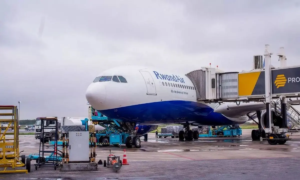
The slow and uneven implementation of the Yamoussoukro Declaration, adopted by 44 countries in 1999 to create open skies, lower airfares and seamless regional flights, is also partly blamed for the fragmentation of Africa’s aviation market.
Some countries continue to protect national carriers and maintain restrictive bilateral air service agreements, limiting competition and connectivity. With few direct routes, passengers visiting neighbouring African countries are often funnelled through European or Middle Eastern hubs like Paris, Dubai and Istanbul.
“These traditional routes have presented numerous challenges to flight operations. Sometimes you don’t have clearance to fly over certain countries and without the clearances, you will not fly straight, you will have to go around it, adding your duty time, burn more fuel and the flight ticket becomes more expensive,” said Gitau.
For instance, a passenger flying from Nairobi to Algiers may have to connect through Paris, turning what could be a roughly six-hour direct journey into a trip of about 15 hours because no direct service runs on the route. Fares can also reach as high as US $1,283 for a return ticket on carriers such as Turkish Airlines and EgyptAir.
This pattern dates back to when European capitals were the hubs for all African aviation.
The same challenge is evident on the Lagos-Kinshasa route, where no direct flights operate. Passengers typically connect through cities such as Nairobi, Addis Ababa or Lomé, with total journey times ranging from about eight hours to more than 22 hours, depending on the length of the layover.
According to 748 Air Services Head of Safety, Maurice Juma said some countries have yet to fully open their skies, while lengthy bureaucratic processes for obtaining operating approvals continue to make it difficult for airlines to launch services to some cities and markets.
“With new shift it is becoming a reality to fly from one African state to the other but still there remains challenges. Getting permits to overfly some of the states take ages,” said Juma.
“If an operator takes say two months to get an operating permit, basically you are not able to plan well and that is why operators will opt to take longer routes,” he said.
According to AFRAA, conflict-driven airspace closures across the Sahel, including a roughly 4,000km no-fly corridor spanning Niger, Mali, Sudan and Libya, are also forcing costly re-routings that add fuel burn and operating cost to already thin margins.
Latest data show Africa’s aviation market remains heavily dependent on connections outside the continent, with Europe accounting for more than half of its international scheduled air capacity.
Global travel intelligence firm OAG reported in August 2026 that European routes accounted for 10.8 million of Africa’s 21.5 million international seats, representing 50.35 per cent of total capacity. The Middle East was second with 4.93 million seats, or 22.9 per cent.
Europe and the Middle East trips accounted for more than 73 per cent of Africa’s international scheduled capacity. Intra-African capacity grew by 10 per cent year-on-year to 4.53 million seats, but it accounted for only 21.1 per cent of international capacity.
A Single African Air Travel Market
Government officials and aviation industry leaders are also pushing for more strategic collaborations and the full implementation of the Single African Air Travel Market (SAATM), one of the flagship initiatives under the African Union’s Agenda 2063 to help fully liberalise the aviation market.
Kenya Civil Aviation Authority chairman Brown Ondego said better connectivity between African cities and countries would create opportunities for trade, tourism, investment and the movement of people and goods.
His sentiments were echoed by Kenya’s Prime Cabinet Secretary Musalia Mudavadi, who affirmed the country’s commitment to implementation of SAATM.
“The moment is here for us to implement the vision of Single African Air Travel Market. A connected Africa will uplift the growth of the aviation sector, create jobs, accelerate industrialisation and unlock full potential of our continent,” said Mudavadi.
“We mostly need collaborations among states, African civil aviation authorities, association of airline operators, regional blocs and AU who are trying to do a lot on this front to make open skies a reality,” said Juma.
African Civil Aviation Commission Secretary General AdeSewa Adeyemi told delegates that African airlines can achieve financial sustainability through cooperation and collaboration.
“We are not here to compete and please remember that no one can stand alone… The largest airlines in the world still cooperate with one another,” said Adeyemi.
All the efforts need to ultimately trickle down to passengers, including the aspiring travellers, those who have never boarded a plane on the continent.
“People need to be able to afford to fly in Africa and it should not be the preserve of only the 15 percent who can do so today. What Africa must do now is deliver with discipline,” said Adeyemi.
Read More : Cameroon Authorises $391 Million World Bank Loan
Credit: Conrad Onyango, Bird Story Agency