Trending
Before dawn in the Namib Desert, a small darkling beetle climbs a dune, faces the fog-laden breeze and tilts its body. Droplets settle on its hardened outer wings and trickle towards its mouth.
For South African designer Shaakira Jassat, this survival strategy offered a different way of thinking about buildings: could their surfaces collect water, too?
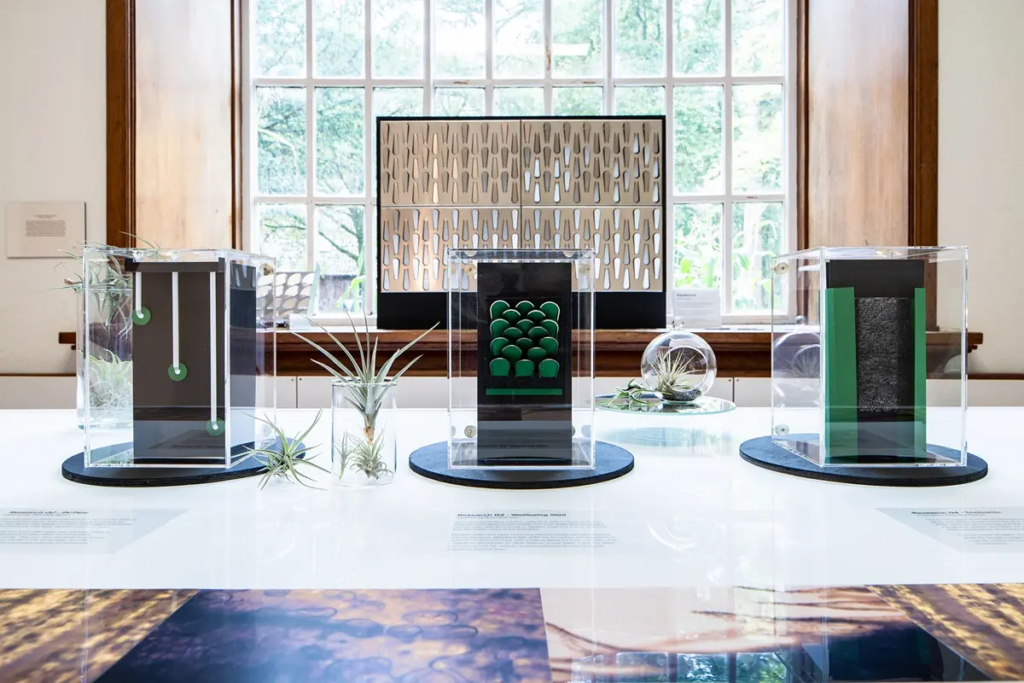
Her answer is Aquatecture Water harvesting system, a system of modular panels mounted on building facades to collect rainwater. The panels channel water through gutters towards storage, turning vertical surfaces into collection spaces.
Read More : AEW Showcases $16 Billion Investment Pipeline
The idea began as Jassat watched rain run down the bricks opposite her home.
“I was looking out the window, and there was rain falling. I just saw it on the bricks across my house. And I thought, there’s all this water gushing down,” she said.
She began considering how buildings could capture that water instead of directing it away.
Conventional rainwater harvesting generally relies on roofs and gutters. Aquatecture uses facades, which Jassat sees as an opportunity particularly for high-rise buildings and other structures with large vertical surfaces.
Water flows through the panels by gravity into a storage tank. Removable gutter sections allow cleaning. The longer-term aim is to supply water for non-potable uses, including toilet flushing and use in washing machines.
For Jassat, fitting the system into architecture matters as much as collecting water: “I wanted something that was really integrated in the language of architecture.”
The concept developed alongside Shaakira’s research into other forms of atmospheric water collection. She investigated fog harvesting and moisture-harvesting technologies, including work with the engineering department at Eindhoven University of Technology.
A semester-long student case study examined whether collecting water vapour on panels could work in South Africa. The research found that it was possible, but not at a level sufficient to support the entire concept.
Rainwater offered a more practical opportunity.
The project subsequently moved into pilot development. Engineers Without Borders became involved after an engineer working on the V&A project connected the organisation to Shaakira. The team visited the site regularly, took readings and participated in meetings as the system was developed.
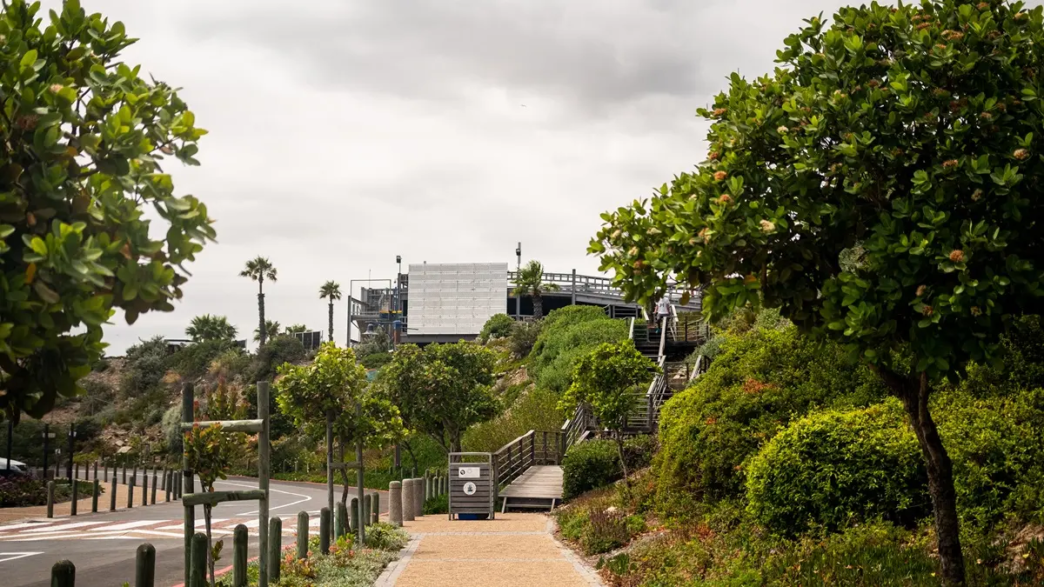
A pilot installation at Waterfront in Cape Town has remained in place, with collected water used to water plants. Shaakira says one of the things she appreciated about the installation was that people could use the space without necessarily noticing the water infrastructure.
The aim was to demonstrate that water infrastructure does not necessarily have to be visually separate from architecture.
But the journey from pilot to wider use has exposed a challenge faced by many locally developed technologies: proving that something can work is only the beginning.
Shaakira says the Aquatecture has attracted significant interest. It has been shown at Dutch Design Week and received media attention, but she wanted that attention to translate into practical use.
“I would have liked to have more impact than exposure on this project,” she said.
The difficulty, she says, emerges when interest has to become investment, manufacturing and construction.
“People love it, they want to publish it, they want to talk about it, but then when it comes to implementation, that’s where the clog really comes in.”
Manufacturing is now one of the central questions.
Shaakira wants the system to be produced as locally as possible. Interest in the technology has extended to Kenya through an architect working on a building there, but the Kenyan producers could not manufacture the system.
That has prompted further investigation into where the panels could be produced in South Africa and elsewhere on the continent, while Shaakira is also considering manufacturers in India and China.
The production process itself needs to reflect the principles behind the technology, she says, which means considering materials, durability and how the system can be maintained over time.
Someleze Mbele, who worked alongside Shaakira on the project through Engineers Without Borders and was involved in the development and refinement of the concept, said the feasibility and affordability of modular wall-mounted rainwater harvesting depend heavily on materials, manufacturing and local sourcing.
The engineering requirements are equally important. Panels need to withstand weathering, ultraviolet exposure, corrosion and physical damage. Collection and storage systems need to remain accessible for cleaning, while structural connections must be designed for safety and longevity.
“Materials must resist weathering, UV, corrosion and physical damage,” Mbele said, adding that collection and storage systems should be “easy to clean and maintain and reduce blockages”.
In lower-income or resource-constrained settings, access to replacement components and technical support can become another barrier.
That makes local capacity part of the innovation itself.
Building-scale systems can provide non-potable water and reduce pressure on centralised supplies, while potentially providing additional resilience during interruptions or droughts.
“Decentralised harvesting should complement, not necessarily replace, large-scale municipal infrastructure,” she said. “It adds resilience, reduces pressure on centralised supplies.”
She also stresses that communities need to be involved in how such technologies are designed and maintained.
“Community ownership is crucial,” Mbele said. “Technologies should be designed with participation, not imposed as finished products.”
For Dr Ferrial Adam, executive director of WaterCan, the broader challenge is designing buildings that use less water, alongside finding additional supplies.
Alternative sources can be presented as resilience, she argues, without addressing how much water a development consumes.
“We need to really look at how we save water, how we build into the future buildings that use less water,” she says, arguing that water resilience should be incorporated into development rather than added afterwards.
That could include reusing water within buildings, such as directing water from handwashing into toilet cisterns, alongside rainwater harvesting.
Adam argues that this approach should also reach poorer communities, where water tanks, tankers and communal or temporary sanitation often serve as responses to inadequate services.
She sees the same need in industry, mining and agriculture: water use and pollution must be considered when designing more resilient systems.
For Aquatecture, wider implementation requires developers willing to invest, manufacturers able to produce the panels and systems that users can maintain.
Funding remains an obstacle. Jassat has largely financed development herself, apart from support for pilot projects. A Johannesburg developer expressed interest but questioned whether clients would be willing to invest.
The project remains at an unfinished stage. Its pilots show that the concept can be built and tested, but Jassat says it is too early to claim measurable impact at full scale. She is still working through materials, manufacturing, funding and partnerships.
Read More : Africa’s Energy Leaders Convene in Cape Town
For her, success will be measured by what the system delivers.
“When it is collecting water and it is flushing those toilets, that’s when it’s successful for me.”
Credit: Someleze Ndede by Bird Story Agency.