Trending



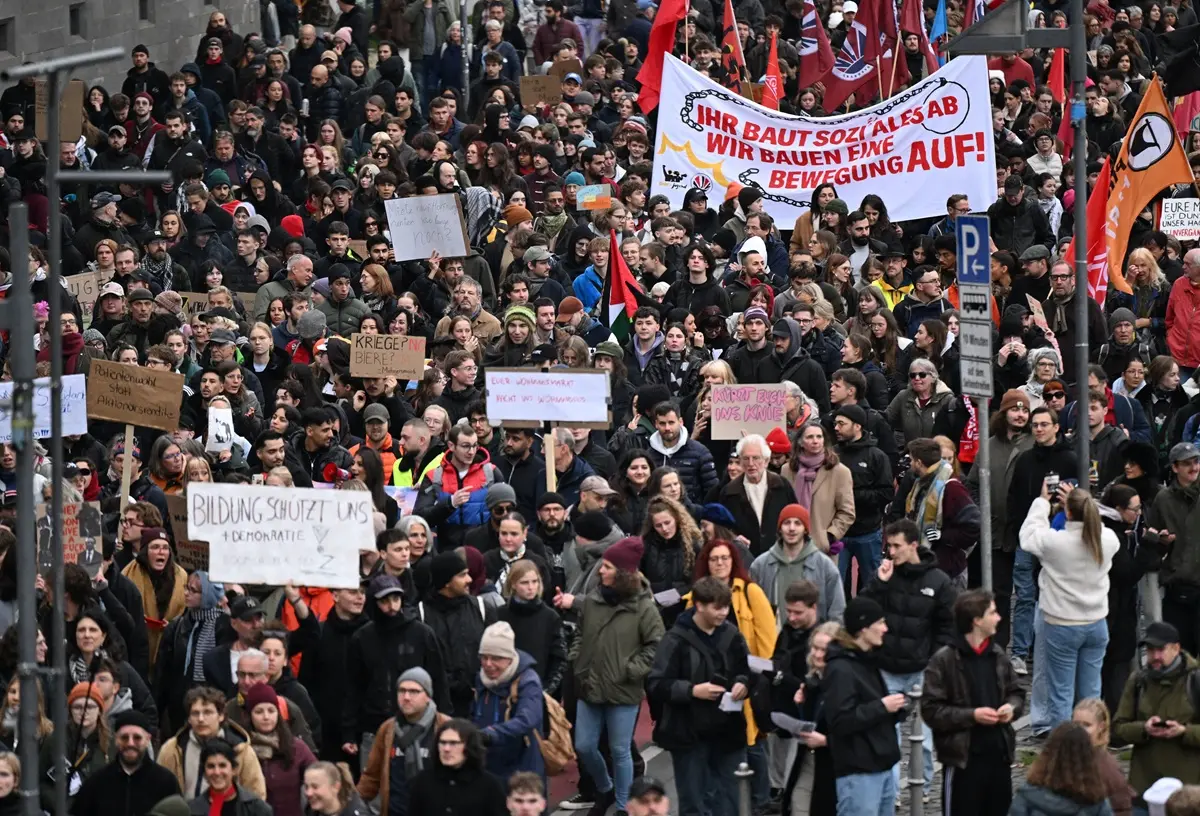
A wave of youth-led demonstrations has spread across Europe, with young people taking to the streets to protest rising living costs and what they see as a failure of traditional institutions to address their concerns.
Although local issues have shaped individual demonstrations, the protests that drew hundreds of thousands of people in France, Belgium, Spain, Italy and Germany over the weekend reflect common challenges across the continent, including soaring housing costs, low wages and the climate crisis.
Schools, Universities
Students from secondary schools and universities have played a prominent role in the demonstrations.
Read More : Zimbabwe Designer Blends Heritage With Fashion
The latest wave gained momentum in mid-September when French high school students protested over inadequate school facilities and called for greater transparency in the university admissions process.
Historian Sylvain Boulouque, who studies social movements, described the demonstrations as a European movement that gained its initial momentum in France.
After several weeks of rallies, at least 550,000 people took part in demonstrations across France on October 17. Although largely peaceful at first, the protests were later overshadowed by looting, arson and confrontations with police.
Four days later, more than 10,000 people demonstrated in several Greek cities. Some demonstrators carried placards bearing messages in both Greek and French.
Filippos Armen, a physics student at Aristotle University in Thessaloniki, said young people across different European countries were facing similar problems.

‘Uncertainty’
Belgian sociologist Geoffrey Pleyers said the demonstrations reflected growing frustration with an economic and social system that many young people believe no longer offers them a secure future.
He argued that the opportunities available to young people increasingly amounted to finding employment, often in insecure or poorly paid jobs.
Rising housing costs and the consequences of the climate crisis have further weakened young people’s expectations of achieving financial stability.
Rising Rents
Housing has become a major concern in demonstrations across countries such as Spain, Portugal and Greece, Pleyers said, linking the issue to declining purchasing power and growing wealth inequality.
However, political scientist Mariam Martinez-Bascunan argued that the protests were driven less by poverty than by uncertainty about the future.
Speaking to Spanish broadcaster RTVE, the professor at the Autonomous University of Madrid highlighted how images of demonstrations in France and housing rights activists’ tent camps in Portugal had helped inspire similar protests elsewhere.
‘Sacrificed’ Generation
Boulouque said young people were increasingly aware of the financial debt and environmental challenges inherited from previous generations, leaving many with a sense that their interests had been neglected.
The historian, who also teaches at a high school, pointed to an unexpected side effect of the ban on mobile phones in French classrooms: “Students began to socialise again and lifted their heads to see just how far their working conditions have worsened”.
In Germany, concerns over a possible return of compulsory military service, have also encouraged young people to join the demonstrations.
Inequalities
The protests have attracted support beyond the younger generation, with Europe preparing for major elections in Spain, France, Italy and Greece over the coming year.
In France, students received support from members of the yellow vest movement, which previously organised demonstrations against the cost of living in 2018 and 2019.
In Italy, drivers and farmers angered by high petrol prices also joined young protesters at Friday’s rallies.
Pleyers identified the feeling that ordinary people are being ignored by political leaders as another common source of frustration. He said this was widening the gap between citizens and the state.
Growing perceptions of social and economic unfairness have added to the discontent, with opportunities increasingly shaped by family background.
According to Pleyers, young people from financially comfortable households are better positioned to maintain their standard of living, while those from less secure backgrounds face increasingly difficult circumstances.
“Young people whose parents live comfortably have a more comfortable life and, conversely, those who come from more precarious backgrounds have a much harder life today,” Pleyers added.