Trending
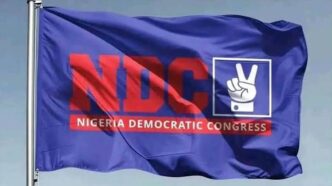
A High Court in Abuja has dismissed a suit filed by the National Democratic Congress (NDC) challenging provisions of the Electoral Act 2026 relating to the qualification and disqualification of candidates for elective offices.
Delivering judgment, Justice Muhammed Umar held that the suit lacked merit, ruling that the contested provisions of the Electoral Act were consistent with and complementary to the 1999 Constitution.
The NDC had sued the Attorney General of the Federation, the Clerk of the National Assembly, Senate President Godswill Akpabio and the Independent National Electoral Commission (INEC), arguing that Sections 138 and 77(5) of the Electoral Act 2026 were unconstitutional.
Read More : Tinubu Celebrates Oyedepo At 72
Addressing the court’s jurisdiction, Justice Umar noted that the case sought an interpretation of the Electoral Act alongside the Constitution.
“The plaintiff is invoking the interpretative jurisdiction of this honourable court in respect of the provisions of the Electoral Act 2026 on the one hand and the 1999 Constitution on the other hand,” he said.
He also dismissed arguments that the attachment of INEC’s election timetable brought the matter within the scope of Section 285 of the Constitution, noting that no evidence had been presented challenging the timetable.

On the preliminary objection raised by the Clerk of the National Assembly, the judge found that the NDC failed to comply with the statutory requirement of serving a pre-action notice before filing the suit.
He ruled that the omission rendered the case incompetent against the second defendant and struck out the action against the Clerk.
On the substantive issues, Justice Umar rejected the party’s contention that Section 138 of the Electoral Act conflicted with constitutional provisions on the qualification and disqualification of candidates.
He held that while the Constitution sets out the qualifications and disqualifications for elective offices, the Electoral Act merely establishes the procedure and timelines for resolving disputes arising from party primaries.
“Any aggrieved party who intends to challenge any candidate that emerged at the primary election of a political party on grounds of disqualification, must do so at the pre-election level,” the judge said.
Justice Umar further ruled that Section 138, when read alongside other provisions of the Electoral Act, did not contradict the Constitution.
Read More : Abia Arrests 86 Over Sanitation Violations
“The provision of Section 138 of the Electoral Act 2026 complements the provision of the Constitution, but is not in conflict with it. The contention of the plaintiff that Section 138 is inconsistent with the Constitution is of no merit,” he held.
The court also declined to strike down Section 77(5) of the Electoral Act, with Justice Umar noting that the issue had already been settled by the Court of Appeal.
He said lower courts were bound by established judicial precedent and could not depart from the appellate court’s decision.