Trending
Governors are crossing party lines for the President, the opposition is fighting itself, and the man running the show in the capital may be playing a longer game than anyone admits.
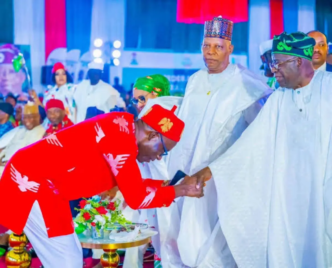
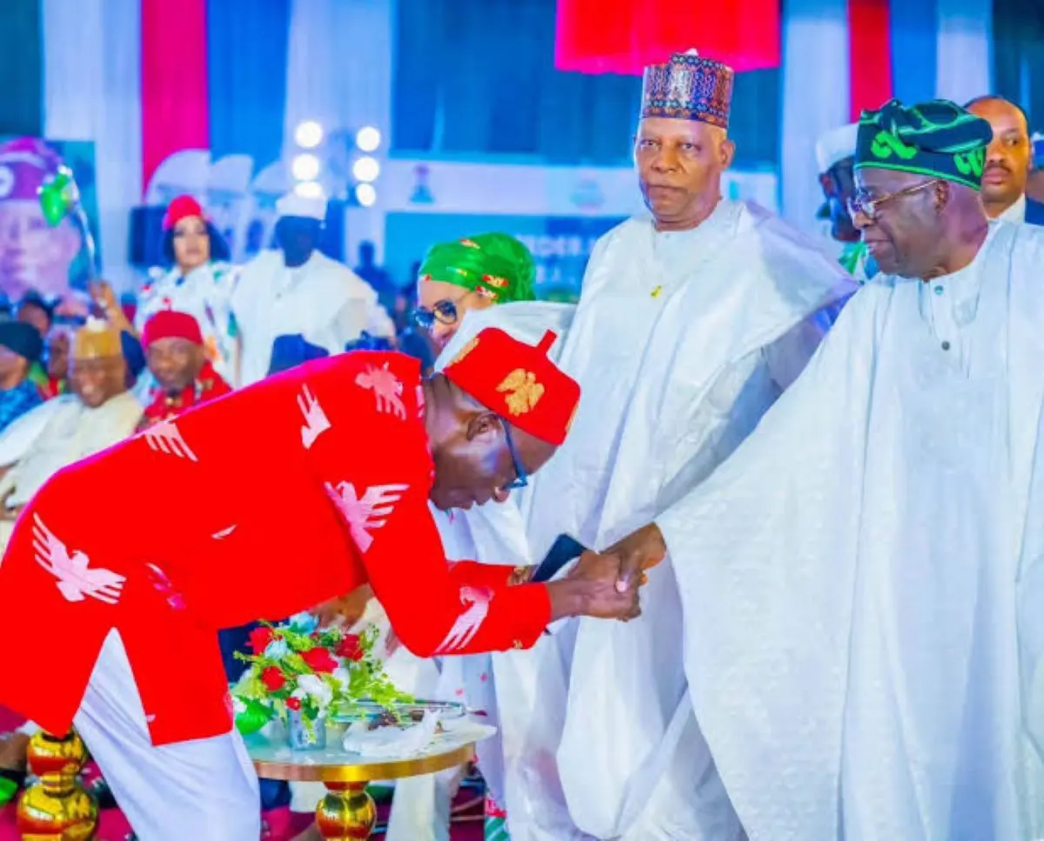
A governor elected on the APGA platform tells the South-East not to “waste” its votes on alternative candidates in 2027, urging the region to back Tinubu. In Osun, Governor Ademola Adeleke and Accord’s national leadership have adopted Tinubu as the party’s presidential candidate. And FCT Minister Nyesom Wike, still a PDP man on paper, declares that “there is no opposition now” and promises a “rainbow coalition” behind the President.
In a mature democracy, this would be a scandal. In Nigeria’s 2026, it is simply how politics is done.
Read More : Uyo Police Nab Two Suspects, Seize Drugs
The Party as a Rented Vehicle
The cross-carpeting should not be read as conversion. Nigerian parties have never really been ideological institutions. They are franchises, licences to contest, rented for a cycle and returned when the weather changes. That is how a PDP minister can lead the pro-Tinubu mobilisation, how a governor can leave one party and campaign for another’s candidate, and why nobody asks what the parties actually stand for.
The reasons are not mysterious. The centre controls federal allocations, security architecture, and appointments, and, in the perception of many governors, much of the fear around who gets investigated and who does not. A governor in a second term, or one eyeing a soft landing, has every reason to avoid the wrong side of Abuja.
Meanwhile, the PDP, once billed as Africa’s largest party, has become too fractured to offer shelter. When the opposition cannot protect its own, defection starts to look like prudence.
Wike: the Man Who Wants to be Counted
No figure embodies this convergence better than Nyesom Wike, and no figure is more misread. The surface reading is simple: a former governor who backed Tinubu in 2023 and was rewarded with a ministry is repaying a debt. But the reading gaining traction among political watchers is that this is not really about Tinubu at all.
Wike has been handed the coordinating brief for Rivers and the FCT. Reports say Tinubu moved to give him a defined role as campaign coordinator for both, even though Wike remains in the PDP, reportedly to keep the campaign’s top echelon from clashing.
At a Rainbow Coalition stakeholders’ meeting in Abuja, he declared himself the commander of field operations for the FCT election. He has been equally blunt about the council itself: he argued that membership of a campaign council does not deliver votes, pointing to Tambuwal losing Sokoto as Atiku’s director-general and Lalong failing to deliver Plateau as head of the APC council in 2023. He has said he does not need to be the DG or even a council member, and that he will ensure Tinubu wins with wide margins in Rivers and the FCT.
Read that carefully, and the logic is clear. Wike is not asking for a title; he is asking to be measured on a single metric: delivery. And that is precisely what an ambitious politician wants on his CV.
One analyst’s widely shared reading frames it as an audition. If Wike can show in 2027 that he controls structures, shapes elections and delivers states when it counts, he becomes valuable currency in the next cycle. Once the South completes its eight years, the argument goes, a Northern presidential candidate will need a strong Southern running mate, and a man who has demonstrated that he can deliver Rivers and flip the FCT would be an obvious name on the shortlist. Look further down the road, and the prize is bigger.
After another Northern cycle, power returns to the South, and Wike would present himself as a kingmaker who has helped determine presidential outcomes across multiple elections, much as Tinubu built his “Emi Lokan” case on a long record as the man behind other men’s victories. Under this theory, Wike is not only helping Tinubu win. He is building his own presidential case.
It is a theory, not a fact, and Wike would no doubt describe his motives as loyalty and delivery for the President. But it fits his behaviour. He has already inaugurated 345 coordinators across Rivers wards, local governments and senatorial districts, with the state’s House of Assembly Speaker publicly aligning behind him, and he has not hidden his rivalry with Rivers Governor Siminalayi Fubara in the process. A man investing this heavily in building a visible machine is not hedging.
The stakes for him are also unusually concrete. In 2023, Obi carried the FCT, which is Wike’s home turf as minister. Flipping it for Tinubu in a three-way race is a tougher assignment than defending a state, and a failure there would be difficult to explain away. Wike has framed the contest as one of delivery, so delivery is how he will be judged. Putting everything on the line, as one observer put it, cuts both ways: it maximises the reward, and it removes the excuses.
The Street Tells a Different Story
This is where elite calculation collides with the ordinary Nigerian’s reality. The subsidy removal and exchange-rate unification of 2023 may have been defensible on a ledger, but they landed on households as a brutal squeeze, with food inflation, transport costs and a salary that buys less every quarter. Insecurity persists across the North-West, the North-Central belt and parts of the South-East and every few months another corruption story surfaces, with predictable outrage and rare consequences.
The danger for the ruling party is not that governors are defecting. It is what defections signal to voters: that the political class has settled its differences and left them out. When every party looks the same, voters stop distinguishing between them, and apathy follows. In 2023, apathy was the real winner. Turnout fell to roughly a quarter of registered voters, and Tinubu won with about 36 per cent of the vote, around 8.8 million against Atiku’s 7 million and Obi’s 6.1 million.
An Opposition Split, Again
The coalition story, which looked so promising a year ago, has changed shape. The ADC was supposed to be the single umbrella for Atiku, Obi, Amaechi and the rest. Instead, Obi and Kwankwaso announced their defection to the NDC, citing internal crisis and court cases involving the ADC. Obi then accepted the NDC’s presidential ticket at a special convention in Abuja, and named former Kano governor Rabiu Kwankwaso as his running mate.
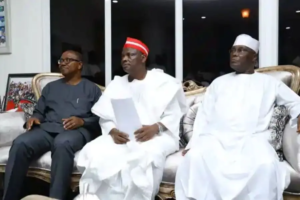
Meanwhile, Atiku has inaugurated the ADC’s presidential campaign council and charged members to present the party as a credible alternative.
That makes a structure Nigerians have seen before: an incumbent with the state behind him, a veteran northern challenger on one platform, and a Southern-led ticket with its own base on another. The Obi-Kwankwaso pairing is serious political engineering. Kwankwaso polled just under 1.5 million votes in 2023 as the NNPP candidate, but his real value is concentrated: a disciplined movement, the Kwankwasiyya, in Kano, one of the most vote-rich states in the country. Obi brings the urban, young, Southern and diaspora energy that made him the surprise of 2023. Kwankwaso has said the arrangement is for the South to hold the presidency for one term before it returns to the North, a zoning promise designed to calm northern nerves.
On paper, it is the strongest ticket the opposition has produced in years. In practice, it exists because the broader coalition failed, and every vote it wins from the ADC is a vote the combined opposition cannot count on in aggregate.
How 2027 is Likely to Play Out
The election is scheduled for January 16, 2027 under INEC’s revised timetable, and the campaign season is compressed accordingly. The APC has unveiled a 343-member council chaired by the President himself, with Shettima and party chairman Nentawe Yilwatda as vice chairmen, and plans to formally flag off the campaign in Kaduna on October 24. The incumbent starts with the state machinery, the money, and a political map already tilted in his favour.
Therefore, with about 12 weeks left to the polls, my base case is that Tinubu wins, and probably more comfortably than in 2023. The reason is structural, not romantic. In 2023, the combined opposition vote exceeded the winner’s but was split three ways. In 2027, it is likely to be split three ways again, only this time the incumbent has absorbed several governors who might have mattered, and the opposition’s two main platforms are competing for overlapping constituencies.
The rainbow coalition is as much a psychological project as a practical one. It persuades donors, voters and the electoral umpire that the contest is settled before anyone votes, and in Nigeria, expectation shapes outcomes.
The more interesting question is the North, and here the Wike audition thesis helps read the map. The incumbent’s weakest ground is the North-West and North-East, where insecurity and poverty bite hardest and where Atiku and Kwankwaso both have genuine roots. If Atiku holds ADC structures in the North-East while Kwankwaso pulls Kano and part of the North-West toward the NDC, the opposition vote there is not only divided but cancelled out in the states that matter. In the South, Obi is strong in the South-East and parts of the South-South, but he faces governors like Soludo working against him and a federal patronage system that makes the argument for alignment very persuasive. This is exactly the terrain where a man like Wike will try to prove his worth, since Rivers is a South-South swing state and the FCT is a symbolic prize.
The constitutional threshold is the opposition’s best hope. A winner must lead nationally and also clear the spread requirement across a majority of states and the FCT, so a candidate who wins narrowly but fails the spread can be pushed to a runoff. A scenario in which Obi sweeps the South-East and parts of the South-South, Kwankwaso delivers Kano and a slice of the North, Atiku holds the North-East and parts of the North-Central, and Tinubu’s South-West base is dented by cost-of-living anger is possible. But it needs several things at once: a vote split that denies Tinubu the spread, exceptional turnout among the young voters who backed Obi in 2023, and credible polling-unit protection. That is an unusually demanding combination.
Then there is the wildcard of trust. Nigerians were disappointed by the 2023 process, particularly how results were transmitted, and 2027 will be judged on whether INEC restores confidence. If voters conclude the outcome is fixed, many will stay home, which favours the incumbent. If a surprise emerges, the courts, not the ballot, will likely decide the final word, as they have in so many recent cycles.
Read More : NAFDAC Destroys Fake Products in Rivers
What happens after January may matter as much as the vote itself. If Tinubu wins and Wike delivers his two territories, the 2027 narrative will include a new kind of Nigerian power broker: a minister from an opposition party who showed he could move a state and a capital. That reputation is exactly what he is reported to be chasing, and it will shape who the next Northern candidate calls in 2031. If he fails, particularly in the FCT, it will be the first serious dent in the aura he has spent years building.
The Case for the Other Side
It would be unfair to treat the realignment as pure cynicism or Wike’s role as pure ambition. Supporters of the rainbow coalition argue that governors do what governors do in every federal system: align with the centre to deliver for their states, and that cross-party endorsements reflect a belief that the reforms are working and need time. They would say Wike’s loyalty is real and long-standing, that his 2023 record speaks for itself, and that reading a presidential audition into every move is the kind of speculation that politics invites but rarely proves. They also note that many opposition leaders are recycled from earlier governments, which undercuts any claim of a clean break.
Critics respond that democracy needs an opposition that can oppose, and that a system’s health is measured by whether citizens have a real choice, not by how smoothly elites reach agreement. Both camps would agree on one thing: whoever wins in January inherits a tired electorate. The ballot will tell us whether Nigerians read the convergence as stability or as a closing door.