Trending
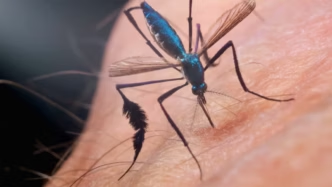
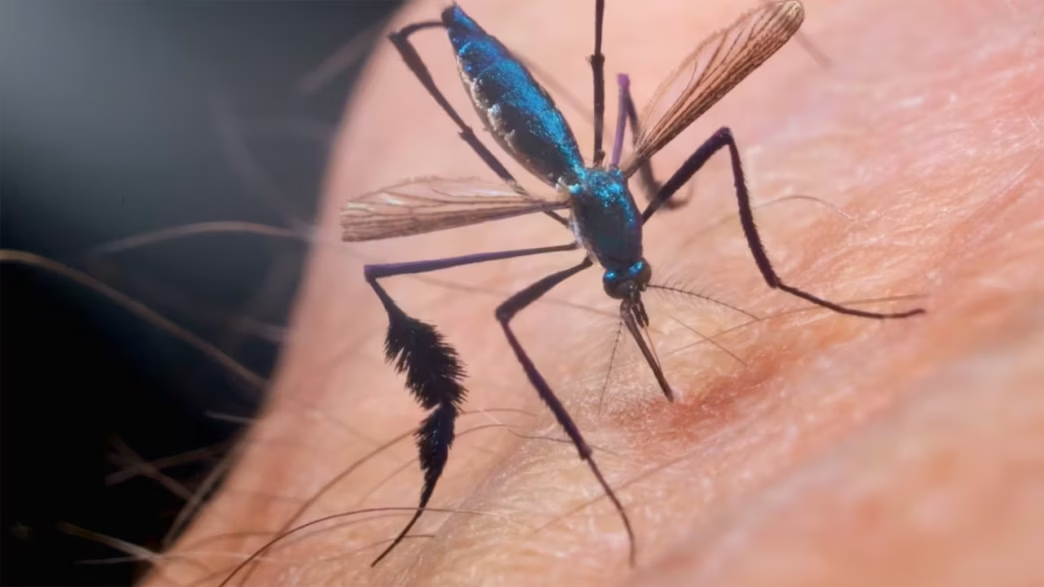
It does not have sharp teeth. It does not stalk its prey. It weighs less than a paperclip. Yet the tiny mosquito kills more humans every year than any other creature on Earth, by a staggering margin.
According to research site Our World in Data, mosquitoes are responsible for around 760,000 deaths annually. Humans come a distant second.
The reason mosquitoes are so deadly is that they do not just bite; they infect. They account for 17 percent of all infectious diseases globally, including malaria, dengue, yellow fever, chikungunya, and Zika.
And as the planet warms due to human-driven climate change, these insects are expanding their range. Longer summers are allowing them to roam into new territories, raising fears of future health crises.
So what can humanity do? Is there a safe way to wipe out these killer mosquitoes? And if we succeed, what happens to the environment?
Not All Mosquitoes Are Created Equal
The good news is that we would not need to eliminate every mosquito. Of the roughly 3,500 species, only about 100 bite humans. And just five species are responsible for roughly 95 percent of human infections, according to Hilary Ranson, a vector biologist at the Liverpool School of Tropical Medicine.
On balance, Ranson told AFP that losing those five species “could be tolerated given the huge devastation” they inflict on the world – from mass death to crippling economic fallout.
Dan Peach, a mosquito entomologist at the University of Georgia, broadly agreed but cautioned that more information is needed to compare eradication with alternative approaches.
Would Nature Even Notice They Were Gone?
The five disease-spreading mosquitoes “have evolved to be very closely associated with humans,” Ranson explained. They feed on us. They breed near us.
That means removing them would likely not shake the broader ecosystem. Other mosquito species that are genetically similar but far less dangerous would probably move in and “fill that ecological niche,” she said.
Peach is not so sure. He says we simply do not know enough “about the ecology of most mosquito species to be confident one way or the other.” Still, he added, “I also think that it is OK to acknowledge this and still proceed.”
Mosquitoes do play roles in nature. They carry nutrients from water to land. They are food for fish, insects, and other animals. Some species also pollinate plants, though scientists do not fully understand how or how much.
Ranson admits there is a real ethical question about humans deliberately wiping out a species – what some call “specicide.” But she notes that humans are already driving countless species to extinction by accident.
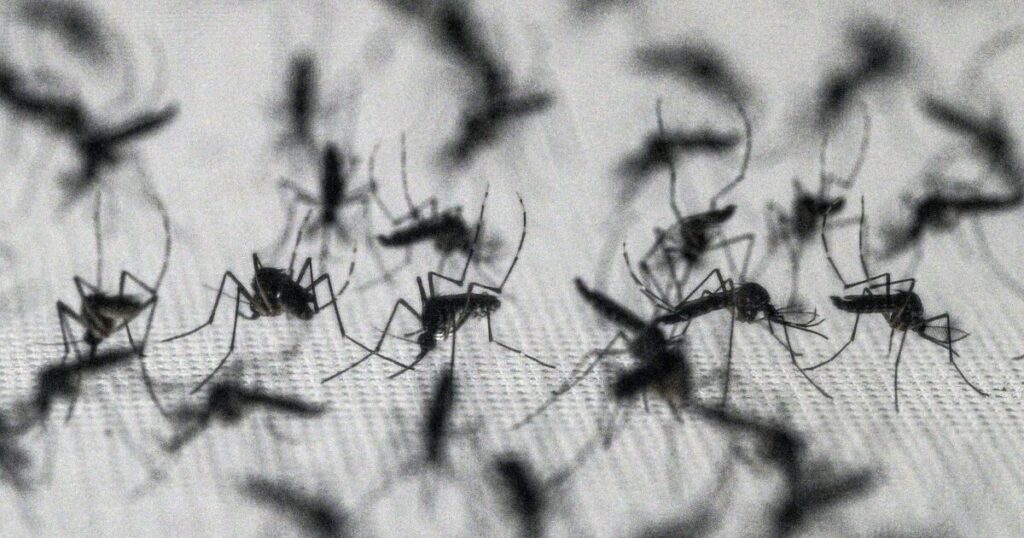
How Science Is Trying to Tip the Scales
One of the most exciting tools in the fight is called gene-drive. This technology allows scientists to genetically modify insects so they pass specific traits down to nearly all their offspring.
In lab experiments, researchers tweaked female Anopheles gambiae mosquitoes – the main carriers of malaria – to make them infertile. The population collapsed within just a few generations.
Target Malaria, a Gates Foundation-funded project, has tested this technology in several African countries. But last year, Burkina Faso’s military-led government pulled the plug on testing there. Civil society groups had criticised the project, and disinformation campaigns had targeted it.
Another approach uses a bacteria called Wolbachia. When scientists infect Aedes aegypti mosquitoes with it, the bacteria can crash their population – or simply reduce their ability to spread dengue.
In the Brazilian city of Niteroi, releasing Wolbachia-infected sterile mosquitoes led to an 89 percent drop in dengue cases, research showed last year.
Scott O’Neill, founder of the World Mosquito Program, told AFP that more than 16 million people across 15 countries have now been protected by these mosquitoes, with “no negative consequences.”
What If We Just Disarmed Them Instead?
A project called Transmission Zero is taking a different path. Researchers are using gene-drive technology to make Anopheles gambiae mosquitoes incapable of transmitting malaria at all.
Lab research published in Nature late last year showed promising progress. The team hopes to launch an in-country trial by 2030.
But the Burkina Faso setback sent a clear message. Dickson Wilson Lwetoijera of Tanzania’s Ifakara Health Institute told AFP that these projects must have “political support or buy-in” from the countries where they are tested.
No Single Solution Will Save Us
Ranson warns against relying on a technological “magic bullet” – usually funded by the Gates Foundation. She argues for a more “holistic solution” to mosquito-borne diseases.
That would mean giving people in affected countries better access to treatment, diagnosis, housing, and vaccines.
Read More : Traore at Four: Revolution or Repression?
But there is another problem. Humanitarian organisations have warned that sweeping foreign aid cuts by Western countries have already slowed progress against most mosquito-borne diseases over the past year.
The battle against the world’s deadliest animal is far from over. But for the first time, humans may have more than just nets and repellents on their side.