Trending


Three years into Nigeria’s President Bola Ahmed Tinubu’s administration, the economy has continued to face major pressure despite several economic reforms introduced by the government.
Since the removal of the fuel subsidy and the floating of the naira in 2023, Nigerians have struggled with rising fuel prices, high transportation costs, food inflation, and a rising cost of living. While government officials speak of improvements in macroeconomic indicators and foreign exchange reforms, many citizens say daily life has become more difficult.
Speaking on Friday, in an interview with NewsCentral TV , Dr Samson Simon, Chief Economist at Arkk Economies & Data Limited, said the hardship experienced by Nigerians has worsened because of the way the subsidy removal policy was handled.
“There’s nothing wrong about subsidising, if it’s done the right way. We failed to tackle the corruption, which would have been a better way of tackling the problem instead of punishing everybody with higher prices,” Simon said.
Chief economist Dr. Samson Simon says removing the fuel subsidy, though intended to fix systemic inefficiencies, has caused severe short-term effects for Nigerians, especially rising transport and food costs. pic.twitter.com/0XtstCUfzW
— News Central TV (@NewsCentralTV) May 29, 2026
According to him, the immediate increase in fuel prices after subsidy removal triggered sharp rises in transportation and food prices, as well as other living expenses.
“Certainly, a subsidy was removed, if you look at it from the standpoint of the masses. Prices climbed, cost of living got out of hand. We’re living in a crisis situation now, because people struggle to afford a lot of things,” he stated.
The economist added that although government reforms may have improved some economic indicators, the common Nigerian are still facing poverty, unemployment and high living costs.
“But if you look at the quality of life, in terms of poverty, employment and cost of living, the reforms, particularly the subsidy removal, would have compounded problems for the masses,” he said.
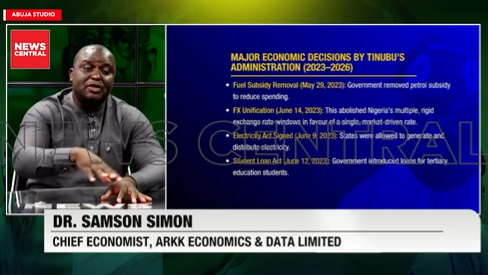
Simon also questioned claims that inflation has significantly declined in Nigeria, saying the lower figures are mainly due to changes in how the National Bureau of Statistics measures inflation.
“The reason why inflation today is lower than what we had in 2024 is not because prices actually came down; it’s because there was this statistical change in the way we measure our inflation,” he said.
He went further to explain that lower inflation figures do not mean prices are dropping.
Read More : Zamfara Police Arrest Youth Over Video Threat
“When you say inflation was 34 percent in 2024 and it’s 16 percent now, that doesn’t mean prices are coming down. It only means that prices are accelerating, but not as fast as before,” Simon said.
He stressed that Nigerians are still struggling with rising market prices despite official data showing inflation slowing down.
“It’s not like if you go to the market, the prices are better,” he added.