Trending


The United States has warned its citizens against travelling to the Spanish enclave of Ceuta after thousands of migrants crossed from Morocco into the territory within 24 hours, prompting Spain to deploy troops and security forces to contain the situation.
In a travel advisory issued on Friday, the US Embassy in Spain and Andorra said the sudden arrival of migrants in Ceuta, along with hundreds more in the Spanish enclave of Melilla, could create “unpredictable and dangerous situations.”
It added that Spain has deployed the military to contain the developing situation, along with the Spanish National Police and Guardia Civil.
Read More : North Korea Fires Ballistic Missiles
The embassy noted that ferry services between Ceuta and mainland Spain remained operational but urged travellers to monitor official updates.
The advisory urged Americans to avoid travelling to the affected areas, stay away from demonstrations, comply with instructions from Spanish authorities, follow local media and government updates, and inform family and friends of their safety.
Ceuta and Melilla are Spain’s two autonomous cities on the northern coast of Africa.
Although geographically located on the African continent and bordering Morocco, they are part of Spain and, by extension, the European Union’s external border.
Credit: France 24
The enclaves have long been focal points for irregular migration into Europe.
Migrants from across sub-Saharan Africa, North Africa and, increasingly, conflict-affected regions often seek to enter the territories in hopes of eventually reaching mainland Spain and other parts of Europe.
Ceuta has witnessed repeated mass migration episodes over the years.
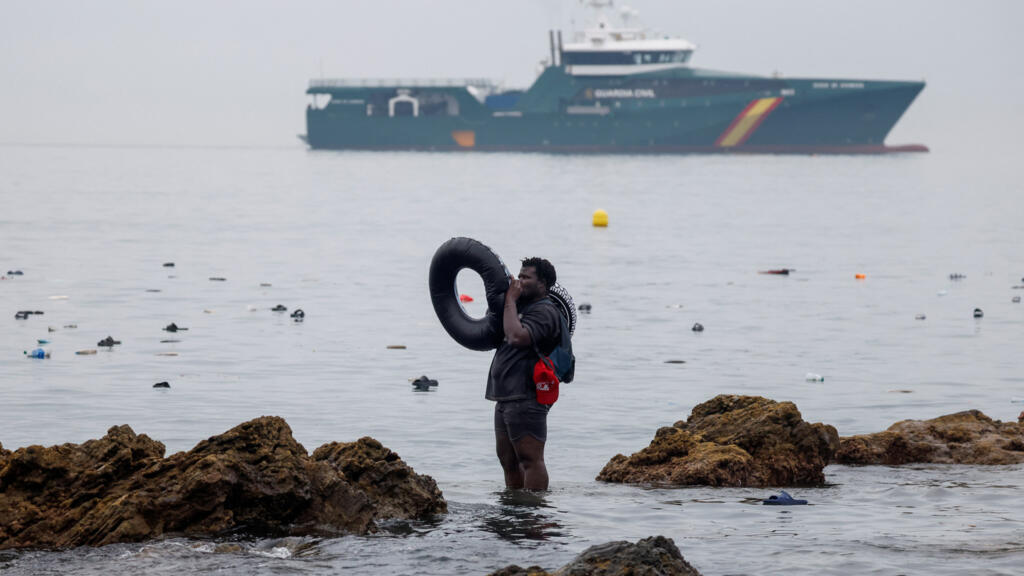
Because the city is separated from Morocco by land fences and border controls, some migrants attempt to bypass the frontier by swimming around coastal breakwaters or using inflatable boats to reach Spanish territory.
One of the most significant incidents occurred in May 2021, when around 10,000 migrants, including many minors, entered Ceuta within two days after Moroccan border controls were abruptly relaxed during a diplomatic dispute between Madrid and Rabat.
Many reached the enclave by swimming around border barriers or wading through shallow waters at low tide.
Read More : Trump: Planned Arch Will Serve as Military Base
The route is highly dangerous. Strong currents, rough seas and cold water have resulted in numerous drownings over the years.
Spanish and Moroccan rescue services regularly conduct search-and-rescue operations for migrants attempting the crossing, while Spanish authorities have reinforced surveillance along the coastline to discourage the hazardous journeys.
The latest influx comes as European authorities continue to grapple with migration pressures across several Mediterranean and Atlantic routes, with Spain remaining one of the principal entry points for migrants seeking access to the European Union.