Trending
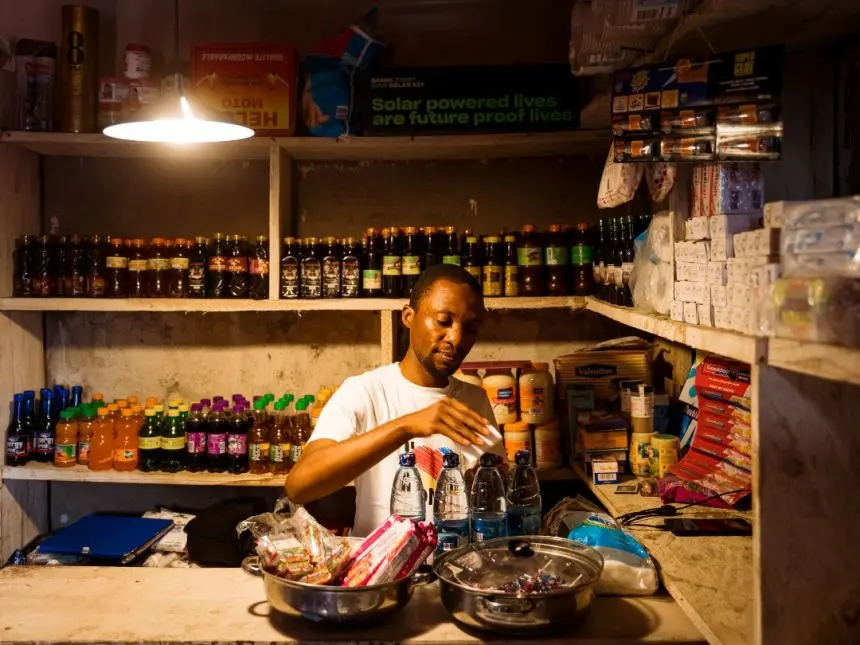
Blackouts are rare these days at United Aryan’s garment factory in Nairobi, Kenya, where thousands of solar panels cover much of the roof above the production floor.
The 1.8 MW solar plant was installed in 2021 to supply electricity to the factory, which makes woven and knitted garments for export to the United States and Europe. It has 3,334 panels and can produce about 2.3 GWh of electricity a year, according to the company and Solarise Africa, which financed the project.
United Aryan is not disconnected from Kenya’s power grid. The solar plant works alongside the wider electricity system, giving the factory another source of power and reducing the amount it needs to buy from the grid.
Read More : ANC Faces Voter Backlash Over Municipal Failures
The approach is becoming more common among large power users in Africa, as manufacturers and mines look for ways to keep production running when the public supply is costly or unreliable.
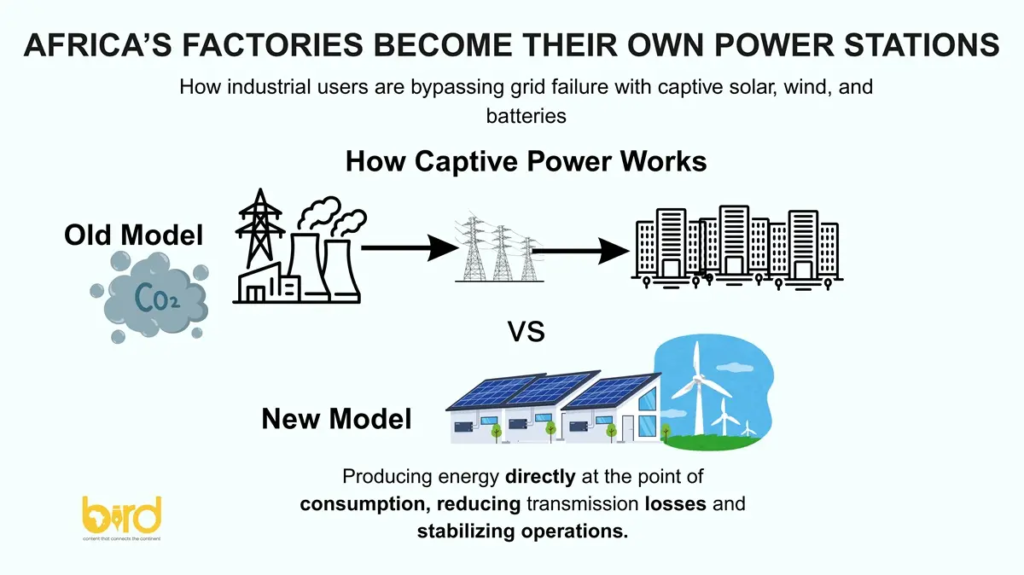
On‑site generation, also called distributed generation, means producing electricity at or near the point of use. Instead of relying fully on power from the central grid, businesses run their own equipment to cover part or all of their energy needs.
Centralised generation depends on long‑distance transmission, which adds costs through line losses and congestion and exposes users to system‑wide risks. On‑site generation cuts those risks by producing energy at the facility, reducing losses and giving businesses the flexibility to work with or apart from the grid.
Experts now expect captive generation to gain more ground as factories and mines try to hedge against rising tariffs and unstable grids.
Marco Rahner, director of Smart Infrastructure at Siemens in Africa, said investment was needed across the power system, from generation to transmission and distribution.
“Capital is there,” Rahner said at the online Enlit Africa discussion last week. “The investment has to be now in all directions, transmission, distribution and generation as well.”
He noted that investors are ready to deploy funds, but the system needs to open up more projects and push money through the pipeline.
Rahner added that industrial demand is already forcing utilities to spread risk and balance their books differently.
For companies running large factories, the decision is as much about securing the source of electricity as it is about managing the losses when that supply breaks down.
A textile plant can lose production when machines stop, just like a food processor can lose stock when refrigeration fails or a mine can also face heavy costs when equipment is forced to stand idle.
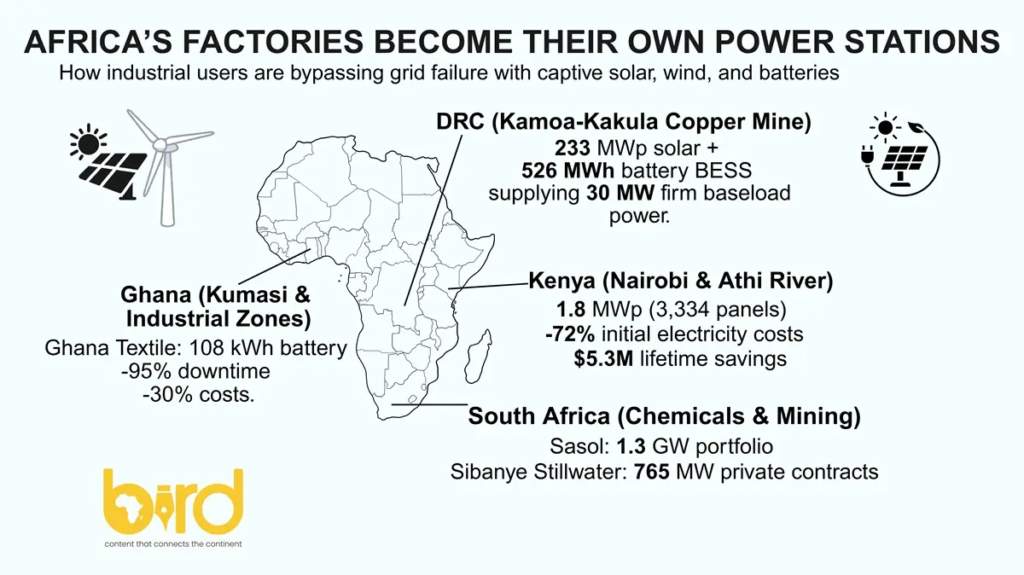
When United Aryan’s project was announced, Solarise Africa projected that United Aryan’s 1.8 MWp rooftop solar plant would cut its electricity costs by about 72% in its first month and save approximately US$5.3 million over its lifetime.
The Kenyan energy regulator lists the United Aryan plant as a 1.8 MW captive solar installation, meaning the electricity is produced for use by the facility itself. Other manufacturers are using a similar approach, although the systems differ.
At Kenya’s Athi River export processing zone, JP Garments began production in 2025. The Kenya Export Processing Zones Authority says this apparel factory is fully reliant on solar power and has shipped more than 42 million pieces to export markets. The Kenya Investment Authority has also described the plant as 100% solar powered.
The project is part of a newer generation of factories where electricity supply is considered as part of the design of the plant rather than something left entirely to the public grid.
Nonetheless, private generation does not remove the need for the grid according to industry players.
Tsolane Mokoena, head of energy at GLS Consulting in South Africa, said that generation planning needed to take account of the networks required to move electricity to users.
According to the National Transmission Company South Africa’s (NTCSA) Transmission Development Plan, South Africa requires an estimated R440 billion ($25 billion) in grid infrastructure over the next decade.
This massive investment aims to construct 14,500 km of new transmission lines to unlock over 50 GW of new generation capacity, primarily integrating wind and solar projects into the national grid.
The pressure on networks is rising as private generation expands, making grid investment critical to balance supply.
Solar can often meet part of a factory’s daytime demand, but production does not always follow the sun. Batteries can store some of the electricity produced during the day, while the grid or another source can supply power when solar output falls.
The need to balance these flows is growing as firms sink capital into captive plants.
Ghana Textile Industries in Kumasi has installed a 108 kWh battery system alongside solar generation to stabilise the electricity supply to its production facilities. According to supplier CTECHi Ghana, the system has reduced production downtime by 95% and energy costs by 30%, although these company-reported figures have not been independently verified.
Mining operations are also turning to much larger systems. At the Kamoa-Kakula copper complex in the Democratic Republic of Congo, a solar-and-battery facility developed by CrossBoundary Energy began commercial operation on 12 August 2026.
The system combines 233 MWp of solar capacity with a 123 MVA/526 MWh battery energy storage system and supplies the mine with 30 MW of firm baseload power, according to the developer.
A similar shift is underway in South Africa, where mining companies are investing in renewable energy to reduce their reliance on Eskom. The transition extends beyond individual businesses: Ghana is also developing solar power for its industrial zones.
The International Finance Corporation is providing financing for a 150 MW solar project in LMI Holdings’ Tema and Dawa special industrial zones. The project is expected to supply more than 100 businesses, including companies in textiles, food processing, cement and steel.
For the businesses using these zones, power is becoming part of the infrastructure they rely on to operate.
That matters because Africa still has a large gap between the electricity it needs and the power system it has built. The 2026 Africa Sustainable Development Report estimates that the continent will need more than 160 GW of new generation capacity by 2030, most of it from renewable sources.
But solar is not the only source of private power for African industry. In South Africa, large industrial users are also turning to wind as they seek to secure electricity outside the national grid.
Sasol, the South African chemicals and energy group, has built up a renewable energy portfolio of more than 1.3GW, including the 330MW Impofu wind cluster, which began commercial operations in June.
The company says about 508MW of its renewable capacity is now operational and that the power will support its operations in South Africa.
Mining companies are following a similar path. South Africa’s Sibanye Stillwater has secured renewable power through long-term agreements, including electricity from the 89MW Castle wind farm in the Northern Cape.
The company says its renewable energy programme now covers 765MW of private sector projects, with wind and solar supplied through power purchase agreements, with the economics as part of the appeal.
Large industrial plants need a steady supply of electricity and remain exposed to the cost and reliability of the national grid.
Private renewable contracts allow them to lock in part of their power supply while reducing their exposure to fossil fuel-based electricity.
The model is spreading beyond South Africa as companies in other energy-intensive industries look for ways to reduce both electricity costs and emissions.
Read More : Kenyan Artist Revives Lamu Woodcarving Tradition
Despite the growth of captive power projects, experts say private generation cannot close the gap on its own. Factories still depend on transmission lines, distribution networks and reliable national grids.
But examples from manufacturing and mining show that some of Africa’s biggest electricity users are no longer waiting for the wider system. They are building part of it themselves.
Seth Onyango, Bird Story Agency.