Trending


Twenty-five-year-old Zambian entrepreneur Brian Hamubotu has grown a small bag business into a 14-person operation.
Hamubotu founded Hillight Manufacturers Limited in 2025 with just one worker.
Today, the company makes customised travel, toiletry and laptop bags at its workshop in Lusaka City Market. It supplies businesses, schools and individual customers across Zambia. Depending on the size and design, the company can produce up to 600 bags a day, Hamubotu said. Now, he wants to expand the business and train at least 5,000 young Zambians.
Read More : Man City Charges: Judgment Day Approaches
Hamubotu’s journey into manufacturing followed several failed business attempts. He first bought fish in Mongu to sell at Kasumbalesa, but lost most of his money. He later travelled to Eswatini in search of opportunities, but those plans also failed.
When he returned to Zambia, his mother’s house had burnt down. He had no permanent home and faced serious financial difficulties.
Counsellors at Lusaka’s University Teaching Hospital helped him rebuild his life. He began making and selling bracelets. A friend who sold printed bags later introduced him to bag manufacturing.
“I continued making bracelets and selling them to people until I had raised enough for the heat press.”
“I started with one stand. When the bags were finished, I would go into the streets, sell them and return,” Hamubotu said.
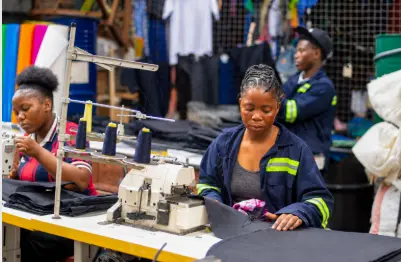
The business later bought a manual sewing machine and hired more workers. However, growth has not always been easy. At one point, Hamubotu could not pay three employees, forcing them to leave. He eventually rebuilt the team and expanded it to 14 workers.
“Business is not easy. It demands passion, commitment and sacrifice,” he said.
Hamubotu now faces another challenge: expanding the workshop. The current space is too small for large industrial machines. He also says larger premises are expensive.
“Where we are now is not a good space. We can hardly bring in big machinery, and other places are very expensive.”
“We are asking the government or well-wishers to help us with better machinery or a place where we can work,” he said.
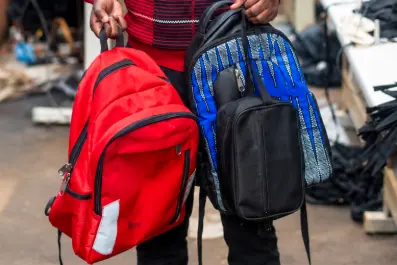
Modern sewing machines would help the company increase production. They would also let it take larger orders and train more young people. The company currently uses some locally sourced cotton. However, it imports most of its fabrics and accessories from China.
For Hamubotu, the business is about more than making money. He wants to create opportunities for young people who lack education or employment.
“Looking at my background, I had nobody to fully support me. I wanted to become a father figure, someone who would raise and support young people and help orphans and those in need,” he said.
He describes the workshop as a place where young people can learn practical skills.
“It is not just a workplace. It is a place of love, harmony and unity. We share ideas and move together as a family,” he said.
Esther Banda joined the company in August 2025. She said the job has helped her learn practical skills despite having no formal education.
“I find it useful to work here because I never went to school. I have learned how to use the heat press and the cutter,” she added.
Another worker, John Banda, said Hamubotu gave him an opportunity when he had no job.
“I didn’t have anything to do, but now I have something to do. My boss taught me how to do this. This is my job now, and I am very grateful to have it,” he said.
Hamubotu’s business has also gained wider attention. The company was selected to exhibit at the Ministry of Small and Medium Enterprise Development pavilion during the 98th Zambia Agricultural and Commercial Show. The six-day event attracted about 1,400 exhibitors from more than 20 countries.
Hamubotu used the event to showcase locally made bags and promote his manufacturing business. His ambition also comes as Zambia pushes domestic manufacturing and local value addition.
The country’s Eighth National Development Plan for 2022–2026 identifies local production and value addition as national priorities. A Zambia Development Agency report recorded US$19.07 billion in actualised investments between 2021 and June 2026.
Manufacturing attracted US$7.33 billion, representing 38.5 per cent of the total. The sector generated 46,759 jobs, according to a statement by the Zambia Association of Manufacturers. The association also said manufacturing grew by 7.1 per cent in 2025. It reported 5.4 per cent year-on-year growth in the first quarter of 2026.
Manufacturing contributes nearly 10 per cent of Zambia’s gross domestic product, the association said. However, Zambia’s cotton industry faces serious challenges. Cotton Board of Zambia Executive Director Derrick Sichilima said production has fallen sharply.
Fewer farmers are growing cotton, while some companies have reduced input loan programmes. Sichilima said cotton could create jobs and support local manufacturing if its value chain is developed.
“Cotton is a zero-waste crop. From the seed to the stalk and even the leaves, every part can be used,” he said.
However, low prices and limited transparency have pushed some farmers towards more profitable crops. About 99 percent of Zambia’s cotton is exported, leaving local producers exposed to international price changes.
The government is now working on a new Cotton Act. The proposed law would create a price consultation forum involving farmers, companies and regulators. The government also plans to reopen textile facilities and increase local cotton processing. Sichilima said stronger local processing could create demand for cotton and support more stable prices.
Hamubotu says better equipment, more space and access to finance would help Hillight Manufacturers expand. He also wants the company to train thousands of young people in cutting, tailoring, branding and machine operation. His immediate goal is to move beyond the crowded City Market workshop. His long-term goal is to build a larger manufacturing operation that creates jobs and practical skills.
“My desire is to have no fewer than 5,000 young people trained. That is the vision I have,” Hamubotu said.
Credit: Lydia Makina, Bird Story Agency.