Trending
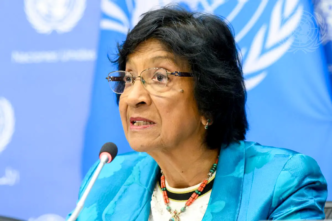
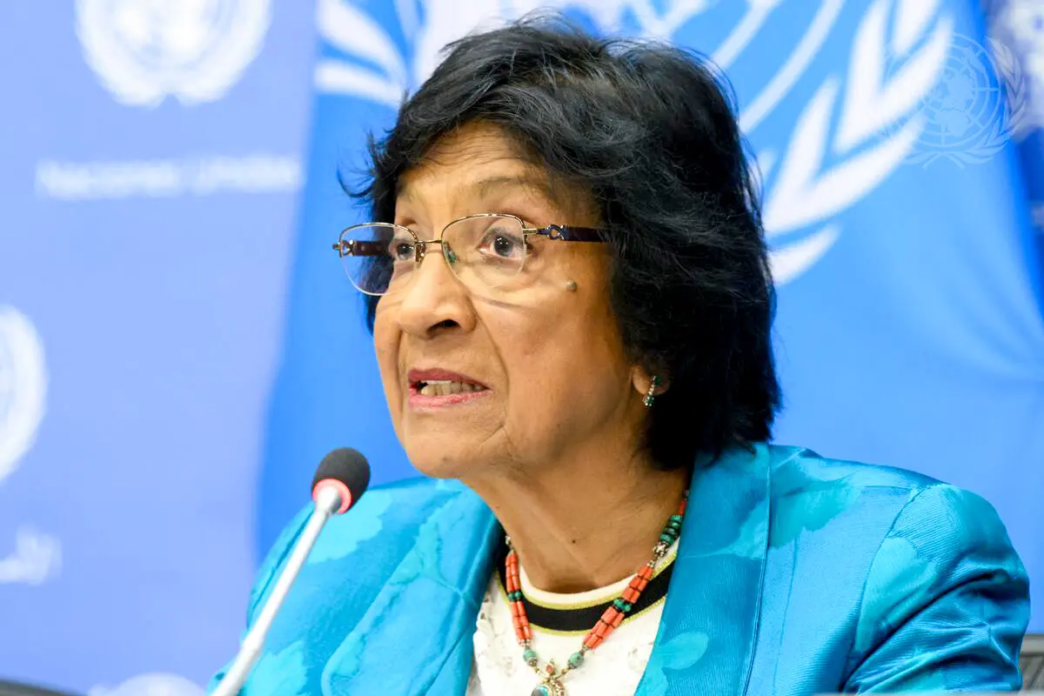
Recognised by the Norwegian Nobel Committee for her efforts to promote peace and international law, Navi Pillay is being celebrated by African media, legal and civil society voices for a career advancing justice, accountability and human rights — including the right to report freely and safely.
Navanethem ‘Navi’ Pillay’s Nobel Peace Prize, announced on Friday, 9 October, highlights her support for media freedom and a career spanning some of the most consequential developments in international human rights law.
The South African jurist has backed initiatives to strengthen legal protections for free expression and promote a free and pluralistic information space.
Read More : UN: Four Million Displaced in Central Sahel
Pillay is the fifth South African to receive the Nobel Peace Prize, following Albert Luthuli, Desmond Tutu, Nelson Mandela and F. W. de Klerk.
Announcing the Nobel, Norwegian Nobel Committee chair Jørgen Watne Frydnes linked Pillay’s early legal work under apartheid to her later role in international justice, from defending Nelson Mandela and others who opposed apartheid to serving as a judge in major international cases.
The committee said she had helped strengthen the international legal order and institutions responsible for holding perpetrators of serious crimes accountable. It also highlighted the uneven application of international law and the ability of powerful states and leaders to evade responsibility.
“Whenever might overtakes right, it undermines stability, trust and peaceful co-existence,” the committee said.
Pillay’s win is being celebrated by the media fraternity in Africa, most of whom are citing her efforts to defend media freedom.
Reacting to the announcement, Moky Makura, Executive Director of Africa No Filter, said Pillay “embodies African agency”.
“For decades, she has worked tirelessly to create the change she wants to see in the world. This Nobel Prize shines a well-deserved spotlight on her extraordinary contribution. It is a reminder that African progress is not always about what is happening, but also about what the world is failing to see,” Makura said.
Churchill Otieno, president of The African Editors Forum (TAEF), also said Pillay’s record held particular significance for journalists because of its emphasis on accountability and the right to report freely.
“From her struggle against apartheid to her work in international human rights and law, she has shown that peace cannot endure without accountability,” Otieno said.
“For us journalists and media workers, her record also speaks directly to the right to report freely and safely. As UN High Commissioner, she called for journalists to be protected from political interference and physical threats. Her recognition affirms that defending human dignity, press freedom and the rule of law takes courage, especially when powerful interests resist scrutiny.”
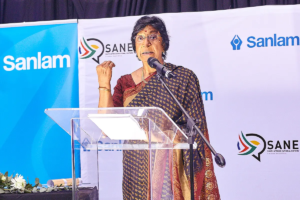
In February 2025, Pillay delivered the keynote address at the launch of South Africa’s Free Expression Legal Network in Johannesburg. Developed by the South African National Editors’ Forum (SANEF), the Press Council, the Campaign for Free Expression and other organisations and legal experts, the network connects journalists and others facing legal threats over their expression with support, including legal representation.
Information and digital rights activist Izak Minnaar notes that Pillay had actively supported the network and advanced media freedom initiatives internationally.
“As the only South African on the global Information and Democracy Commission, she has been spearheading initiatives to support media freedom in South Africa and beyond,” Minnaar explained.
Anton Harber, Director of the Henry Nxumalo Foundation, said Pillay had been particularly consistent in defending independent journalism.
“Navi Pillay has stood firm on many human rights issues, but has had particularly clear, strong and consistent views in defence of media freedom and the importance of independent journalism.”
“Whenever called upon to defend the media, she has been quick to stand up and be counted, even when it was not an easy thing to do. Her prize will be celebrated by journalists,” Harber added.
At the network’s launch, Pillay stressed the value of collective action. “If you clap with a single hand, nobody yells for you. But if a lot of people form a network clap, they will be heard,” she said, according to SANEF.
In its statement congratulating her, SANEF recalled Pillay’s call for governments to promote a free press that can “combat disinformation, build public trust and advance the promotion and protection of human rights.”
She also emphasised the need to protect those who help journalists expose wrongdoing. “I would say that such action must also protect media sources and whistle-blowers,” she said, according to SANEF.
Pillay served on the International Commission on Information and Democracy, convened by Reporters Without Borders in 2018. The 25-member commission developed principles for protecting freedom of expression and democratic debate in the global information space. Its declaration described information and communication as a common good and called for freedom, pluralism and reliable information.
President Cyril Ramaphosa said the award recognised Pillay’s contributions to peace and human dignity in South Africa and internationally.
“She has served humanity with principle and the belief that the world can and should be a better place,” Ramaphosa said.
Mameltwe Sebei, president of the General Industries Workers Union of South Africa (Giwusa) and an attorney at Lawyers for Human Rights, described the Nobel as recognition of Pillay’s legal career serving oppressed and marginalised people.
Her work defending anti-apartheid activists and involvement in international cases concerning atrocities, including the Rwanda genocide and the occupied Palestinian territory, made the award a source of pride for South Africans, he said.
“Most importantly, this should affirm our commitment to the principles of justice that underpin the work of any lawyer who stands on the side of the oppressed,” Sebei said. “She represents that type of jurist, that type of lawyer, and this Nobel Peace Prize is a well-deserved recognition of that.”
South Africa’s parliamentary Portfolio Committee on International Relations and Cooperation also described the award as a source of national pride, citing Pillay’s contribution to international justice and accountability for war crimes, crimes against humanity and genocide.
Na’eem Jeenah, Senior Researcher at Mapungubwe Institute for Strategic Reflection (MISTRA) and political analyst, said the award carries significance beyond South Africa.
“This then is an honour not only for South Africa but for the whole of Africa, a continent that is battling with its own conflicts and violations of international law,” Jeenah said.
While he believes the Nobel Prize would not change conditions for Palestinians nor stop the violence in Gaza, it “adds to the body of moral and legal evidence against Israel, including several UN reports (including on genocide), and the ICJ genocide case”.
Born on 23 September 1941 in Clairwood, Durban, to a family of Indian Tamil descent, Pillay grew up under apartheid. She graduated from the University of Natal with a bachelor’s degree in 1963 and an LLB in 1965.
In 1967, she became the first Black woman to open her own law practice in Natal, now KwaZulu-Natal. She represented political detainees and exposed abuses including torture and solitary confinement. In 1973, she successfully challenged restrictions preventing political prisoners from accessing legal counsel, according to South African History Online.
After earning postgraduate law degrees at Harvard University, she became the first Black woman appointed to South Africa’s High Court in Natal in 1995. She also participated in the Women’s National Coalition during the country’s constitutional transition and co-founded Equality Now, an organisation campaigning for the rights of women and girls.
In 1995, Pillay joined the International Criminal Tribunal for Rwanda, established to prosecute those responsible for the 1994 genocide against the Tutsi. She became its president in 1999 and served until 2003.
A landmark case during her time on the tribunal was the trial of Jean-Paul Akayesu, a former local official convicted of genocide and crimes against humanity. The tribunal’s 1998 judgment established that rape and other forms of sexual violence could constitute acts of genocide when committed with the intent to destroy a protected group, in whole or in part.
Pillay later served in the International Criminal Court’s Appeals Division from 2003 to 2008. She became United Nations High Commissioner for Human Rights in 2008, serving until 2014, a period that included the Arab Spring uprisings and the Syrian civil war.
Her later work included international proceedings and investigations into alleged serious crimes. In December 2019, she was appointed an ad hoc judge at the International Court of Justice in the case brought by The Gambia against Myanmar over alleged genocide against the Rohingya minority. The court confirmed its jurisdiction and ruled the application admissible.
From 2021 to 2025, Pillay chaired the United Nations Independent International Commission of Inquiry on the Occupied Palestinian Territory, including East Jerusalem, and Israel.
In September 2025, the commission concluded that Israel had committed genocide in Gaza. Israel rejected the conclusion. A UN commission of inquiry made the finding, not a final judgment by an international court.
The commission’s work highlighted a central challenge for international law: translating findings of serious violations into consequences for those responsible, particularly when powerful states are involved.
The Stockholm International Peace Research Institute (SIPRI) said the award underscored the importance of international law at a time when its institutions face growing pressure.
“Throughout her long career, Navi Pillay has set a high moral example, speaking out and standing up for justice, accountability and the rule of law,” said SIPRI director Karim Haggag.
Haggag said the award also recognised the institutions Pillay had served, warning that powerful states were increasingly resorting to power politics and transactionalism while international law and its institutions faced attack.
South African investigative organisation Open Secrets also welcomed the award, saying it affirmed the importance of international law and its promise of holding human rights abusers to account.
Read More : Kenyan Women Take Soapstone Craft Global
Pillay was a panellist at the first People’s Tribunal on Economic Crime in the arms trade, convened by Open Secrets and civil society partners in 2018. The tribunal sought accountability for arms companies and politicians in the aftermath of apartheid and State Capture.
Credit: Bonface Orucho, Bird Story Agency