Trending
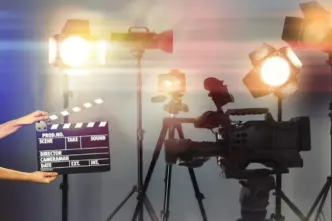
Across Africa, filmmakers are testing the waters of the craft with artificial intelligence to find ways to make filmmaking financially sustainable and profitable.
In a coming-of-age film, titled Makemation, 17-year-old Zara Sodangi’s world shifted from survival in a neighbourhood in Nigeria’s commercial capital, Lagos, to the universe of artificial intelligence, product design, and data analytics, when she gained admission into one of the most prestigious fictional tech academies in the country, Makemation.
The film follows Sodangi, a brilliant but financially struggling teenager, as she navigates elite technology education, class barriers, and self-doubt while trying to transform her family’s fortunes through innovation.
Read More : Kenyan Artist Revives Lamu Woodcarving Tradition
According to the film’s producers, Makemation is Africa’s first AI-themed feature film, which frames artificial intelligence not only as a storytelling subject but also as part of the production workflow itself, combining generative AI systems with live-action filmmaking.
Filmmakers gathered at the 2026 Cannes Film Festival to debate whether generative artificial intelligence threatens the future of cinema, while some African producers are already experimenting with AI as a practical production tool, using it to reduce costs, expand creative possibilities, and work around long-standing financing and infrastructure constraints.
Makemation’s production employed high-end systems, including Arri Alexa LF camera packages, CGI, holograms, and advanced visual effects integration, reflecting a growing push among African filmmakers to bridge technology and storytelling at a level traditionally associated with much larger production markets.
At a time when African film industries continue to face structural bottlenecks ranging from limited financing and expensive equipment costs to weak studio ecosystems and fragmented continental distribution systems, filmmakers across the continent are now testing AI-assisted workflows in editing, subtitling, dubbing, sound enhancement, animation, storyboarding, and visual effects production as pressure mounts to lower the cost of producing high-quality content.
Africa’s film and audiovisual sector already supports more than five million jobs and generates roughly US$5 billion annually across the continent, according to UNESCO, but much of the industry still operates under severe resource constraints.
Visual effects capacity remains expensive and limited in many African markets, forcing some productions to outsource advanced post-production work abroad or significantly reduce creative ambition altogether.
An analyst, Kenim Oba, said the imbalance reflects a much deeper structural problem that has shaped African cinema for decades.
“Hollywood did not become Hollywood simply because America had better stories. It became Hollywood because it built and protected an entire production system,” Oba explains.
“The West built the machinery of global storytelling and then controlled access to it,” she added.
According to her, Africa is not only excluded from capital flows but also from what she describes as “production intelligence,” the technical infrastructure, post-production systems, distribution pipelines, and industrial knowledge that transform storytelling into scalable commercial media.
Nollywood emerged as one of the world’s largest film industries by output despite these constraints.
Nigeria’s Federal Ministry of Art, Culture, Tourism, and the Creative Economy says the country produces thousands of films annually through a rapid, low-cost production model that has built one of Africa’s most influential cultural industries.
For Oba, that evolution matters because it disproved a long-standing assumption in global media markets.
“African storytelling was never too small. The problem was whether African creators could convert demand into sustainable economics,” she explained.
African filmmakers are increasingly experimenting with AI-generated visual worlds, futuristic African cities, folklore-inspired fantasy universes, and animated historical reconstructions that would previously have required budgets far beyond the reach of most independent creators.
Some projects remain rough and experimental, while others are beginning to attract substantial online engagement precisely because they attempt something historically difficult for African productions: visually ambitious world-building at relatively low cost.
“This is not a small shift. It is the beginning of a new production model,” Oba notes.
According to Oba, AI dramatically lowers the cost of visual development by allowing filmmakers to generate concept art, mood boards, storyboards, character studies, and prototype worlds long before major financing arrives.
That matters in African film industries where creators have historically struggled to convince investors to finance large-scale productions without expensive proof-of-concept material.
“Instead of asking investors to imagine the vision, creators can show it,” Oba notes.
“Instead of waiting for a studio to approve an African fantasy universe, a filmmaker can prototype it.”
The implications extend beyond filmmaking itself.
AI-assisted subtitling and dubbing technologies could help African productions travel more easily across the continent’s fragmented linguistic markets spanning English, French, Arabic, Portuguese, Swahili, Hausa, and dozens of other widely spoken African languages.
That possibility is becoming increasingly important as streaming platforms and digital distribution networks expand demand for localised African content.
The continent’s rapidly growing gaming, advertising, and animation sectors are also closely watching the transition.
In Nigeria, the emergence of AI-focused creative communities is already formalising experimentation with the technology.
The Naija Artificial Intelligence Film Festival, launched in 2025, attracted hundreds of submissions from multiple countries, signalling growing interest in AI-generated storytelling, hybrid animation, and experimental production techniques.
The development suggests Africa’s relationship with artificial intelligence may be evolving beyond passive consumption toward active experimentation inside creative industries.
That narrative sharply contrasts with much of the current global AI debate.
In Hollywood and parts of Europe, discussions around artificial intelligence have largely centred on ethical concerns surrounding authorship, labour displacement, copyright protection, and the replacement of human creativity.
Those tensions have intensified at Cannes this year, currently ongoing between May 12 and May 23, where filmmakers and studios remain divided over how deeply generative AI should enter cinema production.

“AI is here. And so to fight it is to, in a sense, fight something that is a battle we will lose. So finding ways in which we can work with it is a more valuable path to take,” according to Demi Moore, an American actress and producer, who was speaking during the opening of the 2026 Cannes Film Festival.
But African filmmakers are approaching the technology from a fundamentally different economic position.
For many producers on the continent, the immediate challenge is not preserving highly capitalised studio systems but finding ways to scale production quality under persistent financial and technical limitations.
That distinction may ultimately shape how aggressively African creators adopt AI-assisted filmmaking tools compared to wealthier film industries.
At the same time, African film entrepreneurs are beginning to experiment with AI far beyond content generation itself.
Grace Olubiyo, founder of the Africa-focused film marketing intelligence platform CR8US AI, argues that one of African cinema’s biggest problems has not been creativity but weak audience intelligence and poor market targeting.
“The reason most African films underperform has nothing to do with the script,” Olubiyo wrote recently on a LinkedIn post.
“It is because filmmakers go to market blind.”
Her company is building AI systems designed to help filmmakers identify audience behaviour, release timing, and marketing opportunities before films are launched.
“CR8US AI is not touching your script. It is not generating your film,” she wrote.
“Your creativity is yours. CR8US AI just makes sure the right people see it.”
That shift suggests artificial intelligence may increasingly reshape not only how African films are produced but also how they are marketed, distributed, and monetised.
Still, the transition carries significant risks.
Oba warns that African creators could face a new era of cultural extraction if African aesthetics, mythology, and storytelling traditions are absorbed into global AI systems without African ownership of the platforms, intellectual property, and distribution infrastructure that capture the value.
“The fight is not simply to be seen,” she explained.
Read More : Africa’s Energy Shock Tests Economic Reforms
“The fight is to own the systems through which we are seen.”
Bonface Orucho, Bird Story Agency.