Trending
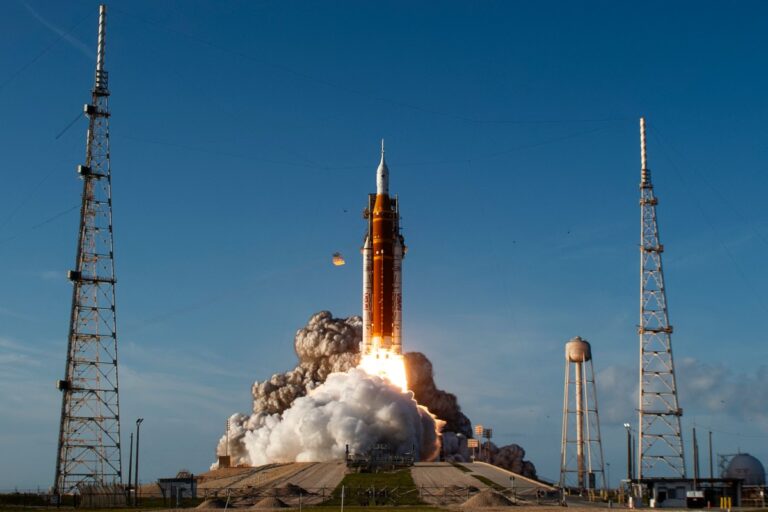
The four astronauts aboard Artemis II began their fifth day en route to the Moon on Sunday, already witnessing parts of the lunar surface never before seen by human eyes.
According to NASA, the Orion spacecraft was about 215,000 miles (346,000 kilometres) from Earth and roughly 65,000 miles from the Moon.

The crew received a ceremonial wake-up call from Charlie Duke, who walked on the Moon in 1972 during Apollo 16.
Read More : SpaceX Starship Reaches Orbit For First Time
“Below you on the Moon is a photo of my family. I pray it reminds you that we in America and all of the world are cheering you on. Thanks to you and the whole team on the ground for building on our Apollo legacy with Artemis,” he said.
Earlier, NASA released an image captured by the crew showing the Moon’s Orientale Basin—a massive crater formation described as resembling a bullseye.
“This mission marks the first time the entire basin has been seen with human eyes,” NASA noted, adding that it had previously only been photographed by orbiting spacecraft.
Astronaut Christina Koch, speaking to children via the Canadian Space Agency, described the sight as one of the mission’s highlights.
“It’s very distinctive, and no human eyes had previously seen this crater until today, really, when we were privileged enough to see it,” she said.
Record-setting journey
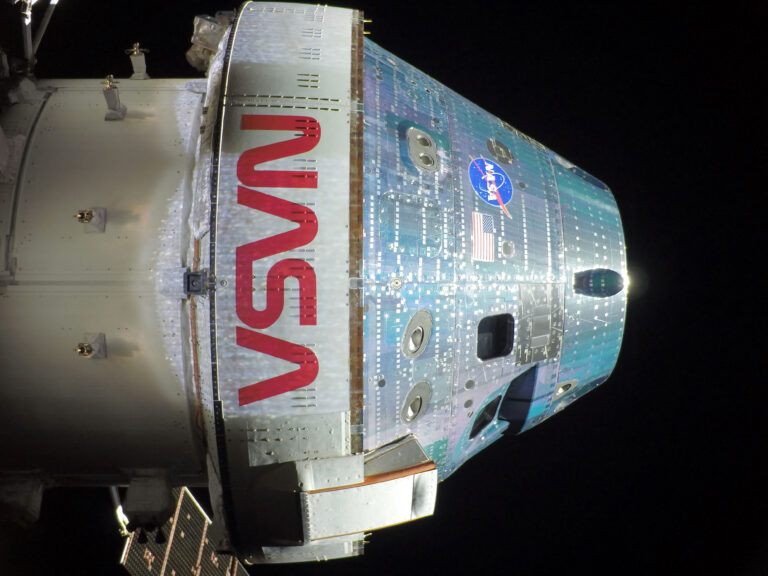
The next key milestone is expected as the spacecraft enters the Moon’s gravitational sphere of influence, where lunar gravity begins to outweigh Earth’s pull.
If successful, the astronauts—Koch, Reid Wiseman, Victor Glover, and Jeremy Hansen—are set to travel farther from Earth than any humans in history.
Systems tests underway
NASA said the crew has already conducted manual piloting demonstrations and reviewed plans for their lunar flyby, including identifying and photographing surface features.
NASA chief Jared Isaacman said the mission is focused on testing the spacecraft’s systems, particularly its life support capabilities.
Read More : Historic French Wildfire Fully Extinguished
“This is the first time astronauts have ever flown on this spacecraft before. That’s what we’re most interested in getting data from,” he said.
As part of day five activities, the astronauts are testing their “survival” suits—used during launch, re-entry, and emergencies such as cabin depressurisation—by running full operational checks.
Although the crew will not land on the Moon, the mission is expected to provide crucial data for future missions, including Artemis III, which aims for a lunar landing in 2027, and Artemis IV, planned for 2028.