Trending
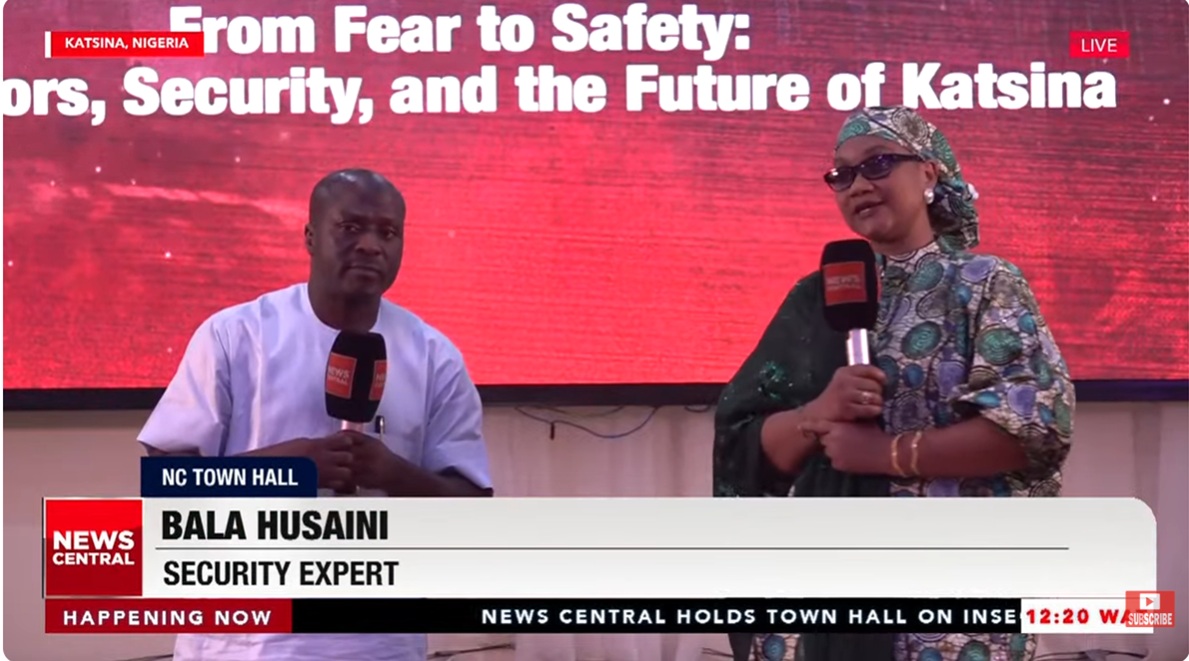
A security expert, Bala Husaini, has called for a stronger community-based approach to tackling insecurity in Nigeria, arguing that the country’s security challenges are sustained by complex financial and political interests that require coordinated action beyond military operations.
Husaini made the remarks during the News Central Town Hall in Katsina, where he spoke on the financial implications of insecurity and recommended policy measures to address the crisis.
According to him, insecurity in Nigeria has evolved into a multi-layered problem involving different actors with varying interests.
Read More : Ronaldo Hails Messi After Argentina Retirement
“I don’t know where to start, but it has three stages,” he said, adding that “the government has every possibility to stop whatever is happening because we have the power.”
He, however, argued that while progress had been made in some areas, other aspects of the crisis remain unresolved.
“The government has been able to stop two but can’t stop the other one,” he said, noting that “people are already used to things happening around now.”
Husaini identified what he described as “conflict entrepreneurs” as the first category of actors driving insecurity.
“We have conflict entrepreneurs, those people that intervene and benefit more in insecurity,” he said.
According to him, such individuals profit financially from criminal activities, making them reluctant to see insecurity end.
“Whenever kidnapping goes down, they go down too,” he said, alleging that “they benefit more because there are certain countries that benefit from the mining and money they get, and because the government is involved, they do not want to stop it because it brings more financial profit to them,” he added.
The security expert also pointed to what he described as the role of the international community in conflict dynamics.
“The second intervention is international communities’ intervention,” he said, arguing that external financial and political interests can complicate efforts to resolve insecurity.
He referenced historical examples to support his argument, citing allegations of foreign involvement during Nigeria’s civil war and recalling an aircraft allegedly intercepted in Kano carrying arms.
“If you could remember previous administrations, we have had the case of a plane landed in Kano full of armoury,” he said. “Up till today there has been no details on where the plane was coming from, what were the consignment, who were involved, nobody can say.”
Husaini further argued that global arms production and conflict financing contribute to prolonged insecurity in resource-rich countries.
“We have what we call disaster capitalism,” he said, describing it as “a system where the developed world decides to establish… the more they establish weapons and armoury they stock, the more they also finance crisis in countries like Nigeria.”
He also claimed that criminality had expanded beyond organised bandit groups.
“This issue of banditry has been hijacked by armed robbers, pickpockets and whosoever,” he said, adding that they now “follow the same processes in order to lay claim to it.”
Husaini stressed that tackling insecurity requires cooperation among government, communities and international partners.
“One thing I want us to understand and believe in is that we have a community that has three forces, our government, community and international communities,” he said.
He argued that security policies should focus on identifying and neutralising threats before they escalate.
Husaini also expressed concern about what he described as political disillusionment among some citizens, warning that unresolved grievances could continue to fuel insecurity.
Read More : Police Arrest Suspected Quack Doctor in Oyo
According to him, “we have what we call political disorientation among individuals,” adding that political actors often determine “when to subside” and “when to up rise.”
He concluded by alleging that criminal networks sometimes extend beyond bandit groups alone.
“One thing that we know is that the miners, some of them are also part of the bandits group, some of our politicians, some security agencies are also part of it,” he claimed.