


 Trending

The Transmission Company of Nigeria (TCN) has disputed Ikeja Electric’s explanation that recent electricity supply interruptions were caused by instability on the national grid, attributing the shortfall instead to inadequate power generation.
TCN said constraints in gas supply to thermal power plants and reduced output from hydroelectric stations had lowered the amount of electricity available for distribution companies, resulting in shorter supply hours and increased load shedding.
In a statement signed by its management on Friday, the transmission company faulted a public notice issued by Ikeja Electric on November 5, which blamed grid instability for outages recorded on some Band A feeders on November 3 and 4.
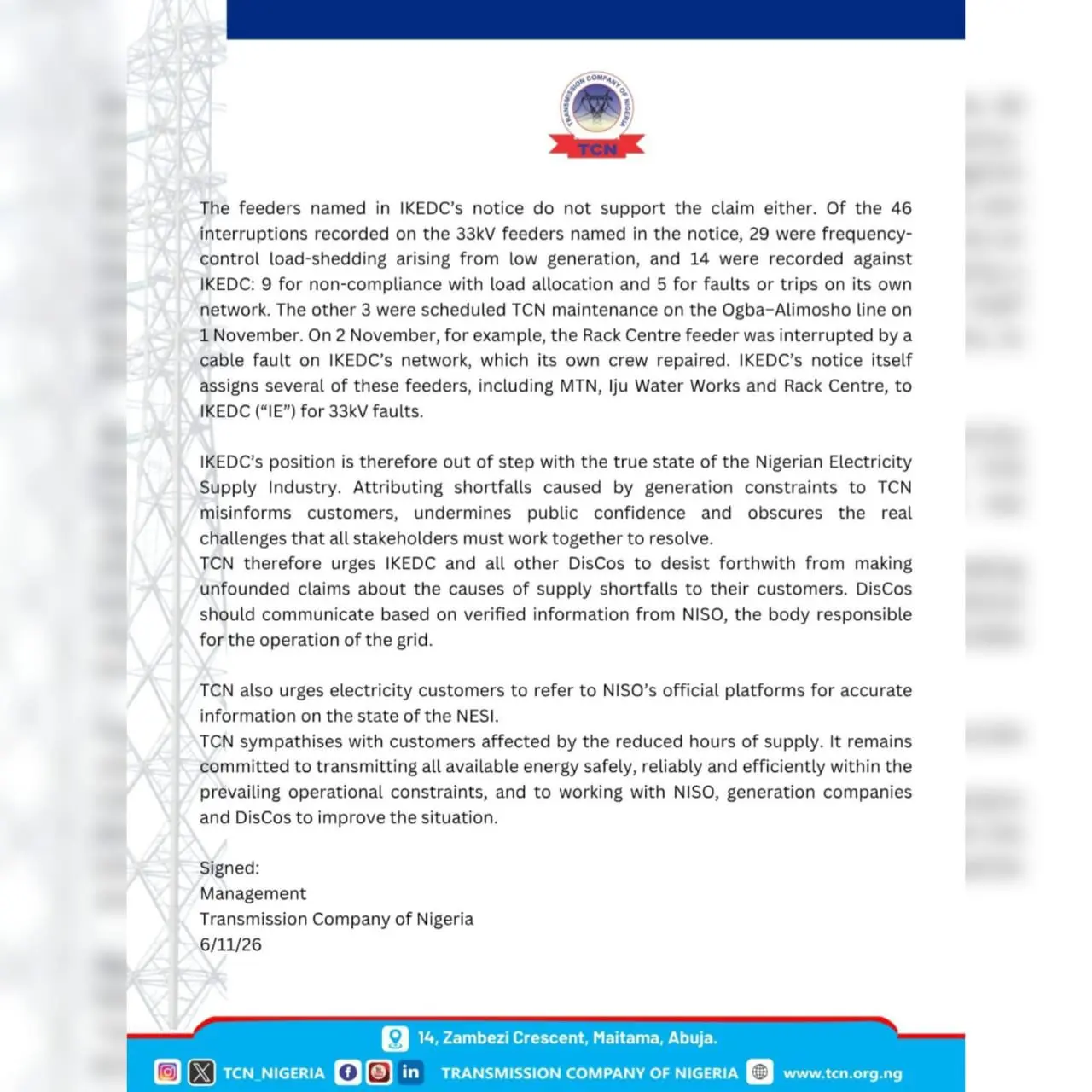
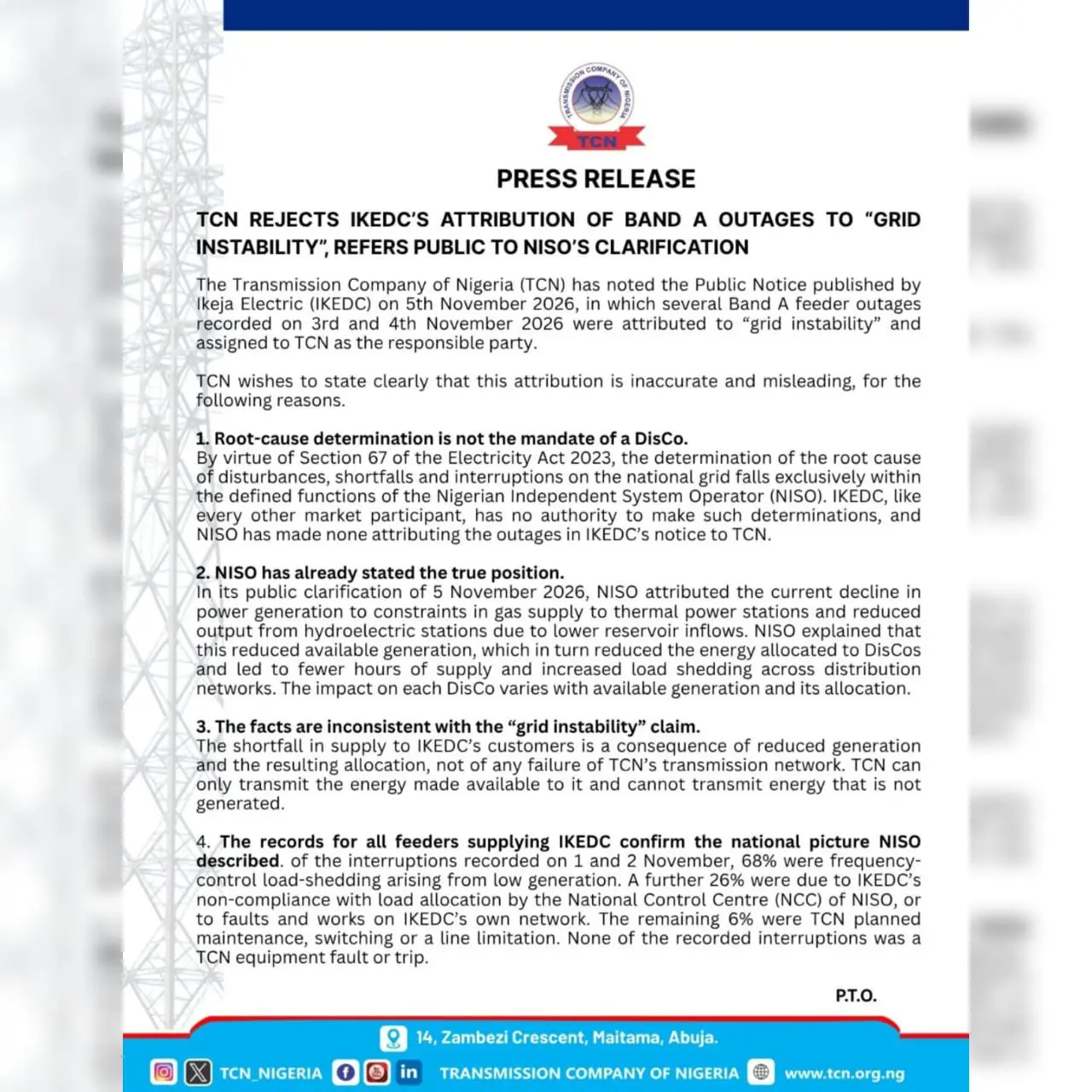
TCN REJECTS IKEDC’S ATTRIBUTION OF BAND A OUTAGES TO “GRID INSTABILITY”, REFERS PUBLIC TO NISO’S CLARIFICATION
The Transmission Company of Nigeria (TCN) has noted the Public Notice published by Ikeja Electric (IKEDC) on 5th November 2026, in which several Band A feeder outages recorded on 3rd and 4th November 2026 were attributed to “grid instability” and assigned to TCN as the responsible party.
TCN wishes to state clearly that this attribution is inaccurate and misleading, for the following reasons.
1. Root-cause determination is not the mandate of a DisCo.
By virtue of Section 67 of the Electricity Act 2023, the determination of the root cause of disturbances, shortfalls and interruptions on the national grid falls exclusively within the defined functions of the Nigerian Independent System Operator (NISO). IKEDC, like every other market participant, has no authority to make such determinations, and NISO has made none attributing the outages in IKEDC’s notice to TCN.2. NISO has already stated the true position.
In its public clarification of 5 November 2026, NISO attributed the current decline in power generation to constraints in gas supply to thermal power stations and reduced output from hydroelectric stations due to lower reservoir inflows. NISO explained that this reduced available generation, which in turn reduced the energy allocated to DisCos and led to fewer hours of supply and increased load shedding across distribution networks. The impact on each DisCo varies with available generation and its allocation.3. The facts are inconsistent with the “grid instability” claim.
The shortfall in supply to IKEDC’s customers is a consequence of reduced generation and the resulting allocation, not of any failure of TCN’s transmission network. TCN can only transmit the energy made available to it and cannot transmit energy that is not generated.4. The records for all feeders supplying IKEDC confirm the national picture NISO described. Of the interruptions recorded on 1 and 2 November, 68% were frequency-control load-shedding arising from low generation. A further 26% were due to IKEDC’s non-compliance with load allocation by the National Control Centre (NCC) of NISO, or to faults and works on IKEDC’s own network. The remaining 6% were TCN planned maintenance, switching or a line limitation. None of the recorded interruptions was a TCN equipment fault or trip.
The feeders named in IKEDC’s notice do not support the claim either. Of the 46 interruptions recorded on the 33kV feeders named in the notice, 29 were frequency-control load-shedding arising from low generation, and 14 were recorded against IKEDC: 9 for non-compliance with load allocation and 5 for faults or trips on its own network. The other 3 were scheduled TCN maintenance on the Ogba–Alimosho line on 1 November. On 2 November, for example, the Rack Centre feeder was interrupted by a cable fault on IKEDC’s network, which its own crew repaired. IKEDC’s notice itself assigns several of these feeders, including MTN, Iju Water Works and Rack Centre, to IKEDC (“IE”) for 33kV faults.
IKEDC’s position is therefore out of step with the true state of the Nigerian Electricity Supply Industry. Attributing shortfalls caused by generation constraints to TCN misinforms customers, undermines public confidence and obscures the real challenges that all stakeholders must work together to resolve.
TCN therefore urges IKEDC and all other DisCos to desist forthwith from making unfounded claims about the causes of supply shortfalls to their customers. DisCos should communicate based on verified information from NISO, the body responsible for the operation of the grid.— TCNNIGERIA (@TCN_NIGERIA) November 6, 2026
It described the distribution company’s explanation as misleading, arguing that Ikeja Electric was not authorised to determine the causes of disturbances on the national grid.
TCN cited Section 67 of the Electricity Act 2023, which it said assigns responsibility for determining such causes to the Nigerian Independent System Operator (NISO).
The company said NISO had not linked the reported outages to any failure of TCN’s transmission network.
The statement read, “The Transmission Company of Nigeria has noted the Public Notice published by Ikeja Electric on 5th November 2026, in which several Band A feeder outages recorded on 3rd and 4th November 2026 were attributed to ‘grid instability’ and assigned to TCN as the responsible party.”
Instead, it pointed to a clarification issued on November 5, which identified gas supply constraints to thermal power stations and lower reservoir inflows affecting hydroelectric generation as the reasons for the decline in electricity output.
According to TCN, the reduced generation had limited the power available for allocation to distribution companies, affecting supply to customers across their networks.
It maintained that its role was to transmit the electricity generated and made available to it.
“TCN can only transmit the energy made available to it and cannot transmit energy that is not generated.”
The transmission company also presented a breakdown of interruptions on feeders supplying Ikeja Electric, stating that 68 per cent were caused by frequency-control load shedding due to low generation.
It attributed another 26 per cent to Ikeja Electric’s alleged failure to comply with load allocations issued by NISO’s National Control Centre, as well as faults and maintenance activities on the distribution company’s network.
The remaining six per cent, TCN said, resulted from its planned maintenance, switching operations and line limitations. It insisted that none of the recorded interruptions was caused by equipment failure or a trip on its transmission network.
For the 33-kilovolt feeders listed in Ikeja Electric’s notice, TCN said 29 of the 46 interruptions resulted from frequency-control load shedding linked to low generation.
It attributed 14 others to Ikeja Electric, comprising nine instances of non-compliance with load allocations and five faults or trips on the company’s distribution network.
The remaining three were linked to scheduled maintenance by TCN on the Ogba-Alimosho line.
TCN also referred to an interruption on the Rack Centre feeder on November 2, which it said resulted from a cable fault on Ikeja Electric’s network and was subsequently repaired by the distribution company.
It added that Ikeja Electric had acknowledged faults on some feeders, including MTN, Iju Water Works and Rack Centre, in its own notice.
However, TCN’s breakdown covers interruptions recorded on November 1 and 2, while the Ikeja Electric notice it criticised concerned outages on November 3 and 4.
The transmission company accused Ikeja Electric of wrongly attributing generation-related supply shortfalls to the national grid, warning that such claims could mislead customers and weaken public confidence in the electricity supply industry.
It urged distribution companies to stop making claims about the causes of supply interruptions without verifying the information with NISO, which is responsible for grid operations.
Read More : How MTN Users Can Access Nigeria’s ₦50,000 Grant
“IKEDC’s position is therefore out of step with the true state of the Nigerian Electricity Supply Industry. Attributing shortfalls caused by generation constraints to TCN misinforms customers, undermines public confidence and obscures the real challenges that all stakeholders must work together to resolve.
“TCN therefore urges IKEDC and all other DisCos to desist forthwith from making unfounded claims about the causes of supply shortfalls to their customers. DisCos should communicate based on verified information from NISO, the body responsible for the operation of the grid,” the report added.
TCN also expressed sympathy for customers experiencing reduced electricity supply, saying it remained committed to safely transmitting all available power and working with NISO, generation companies and distribution companies to improve supply.