Trending


French lawmakers are expected to give final approval on Tuesday to legislation banning children under the age of 15 from accessing social media, a move that would make France the first European Union country to introduce a minimum age requirement for online platforms.
The bill advanced after members of both chambers of parliament reached a compromise on its wording on Monday, clearing the way for a final vote that is widely expected to pass despite opposition from left-wing parties.
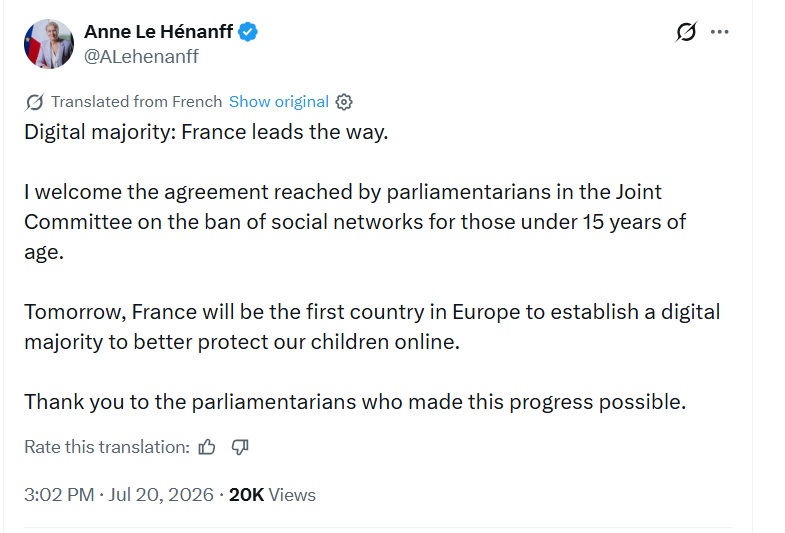
Digital Minister Anne Le Henanff said the legislation would position France at the forefront of efforts to better protect children online.
Read More : Mauritania Students Protest Transport Fare Hike
“Tomorrow, France will become the first country in Europe to introduce a digital age limit to better protect our children online,” Anne Le Henanff said on X (formerly Twitter)
The measure, championed by President Emmanuel Macron as a key domestic reform of his final term in office, is expected to take effect in stages.
Under the proposal, children under 15 will be prevented from opening new social media accounts from September 1, while existing accounts held by users below that age will be suspended from January 2027.
The legislation also includes a ban on mobile phone use in secondary schools, which Macron has pledged to implement before the start of the new academic year.

French lawmakers agreed that stronger safeguards were needed as concerns grow over the impact of social media on children’s mental health.
France’s public health authority warned last year that platforms such as TikTok, Snapchat and Instagram could negatively affect adolescents, particularly girls, although it noted that social media was only one of several factors behind declining mental wellbeing.
The Senate had initially proposed allowing parental consent for access to some platforms while blacklisting those considered harmful to children’s development.
However, lawmakers ultimately adopted the National Assembly’s broader proposal requiring social media companies to block all new users under 15 and suspend existing accounts belonging to children below that age.
The restrictions will not apply to educational platforms and online encyclopaedias.
Senator Catherine Morin-Desailly, who oversaw the bill in the upper chamber, said the broader approach avoided lengthy consultations with the European Commission and reduced the risk of conflicting with EU law.
The European Union is also considering similar restrictions after France, Greece and Spain urged the bloc to introduce limits on children’s access to social media.
European Commission President Ursula von der Leyen recently said children should be granted gradual and age-appropriate access to social media platforms.
Read More : Brazil’s Lula Turns 81, Vows 24-Hour Workday
The legislation will require platforms to adopt reliable age verification systems, with lawmakers saying companies will be free to use approved technologies, including an age-verification application being developed by the European Commission.
If enacted, France will join more than 20 countries that have introduced or proposed restrictions on children’s use of social media.
Australia became the first country to require major platforms, including TikTok, YouTube and Snapchat, to remove accounts belonging to users under 16 or face substantial financial penalties.