Trending


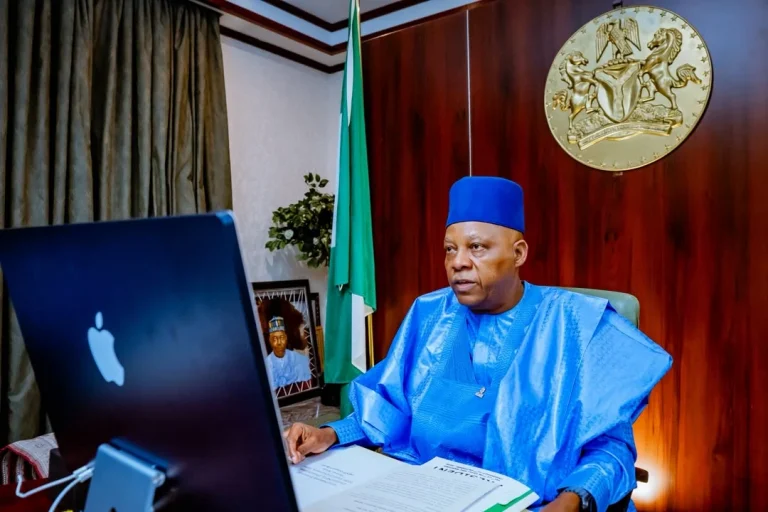
Vice President Kashim Shettima has criticised calls to restore petrol subsidy in Nigeria, warning against reversing economic reforms introduced by President Bola Tinubu.
Shettima, who represented Tinubu at the 32nd Nigerian Economic Summit in Abuja on Monday, questioned the economic judgment of a leading presidential aspirant advocating the restoration of the subsidy.
Speaking at the summit, themed “Growth that Works: Delivering Jobs, Productivity and Shared Prosperity,” the Vice President said Nigeria needed consistent economic policies rather than politically attractive promises that could undermine fiscal stability.
Read More : Drone Strike Kills 21 in Sudan’s Darfur Region
“One of the leading presidential candidates is advocating a return to the subsidy scheme,” he said.
Shettima accused the unnamed aspirant of promoting the proposal for political convenience and questioned whether the individual possessed the skills required to manage a modern economy.
He argued that Nigeria could not afford to abandon difficult reforms simply because their immediate consequences were unpopular.
“Nigerians will have to decide,” he said, urging citizens to consider the long-term implications of competing economic proposals.
Shettima Defends Subsidy Removal
Defending Tinubu’s decision to remove petrol subsidy in May 2023, Shettima said the President inherited an economy facing severe difficulties, with foreign reserves standing at $33.9 billion.
“Our economy was teetering on the verge of collapse,” he said.
The Vice President maintained that the previous subsidy arrangement had encouraged abuses and diverted public resources from productive economic activities.
“We have created a subsidy scam, a subsidy industry that we are taking part in at the agony of our people,” he stated.
According to Shettima, Tinubu recognised the political risks associated with removing the subsidy but proceeded because postponing the decision would worsen the country’s economic challenges.
“But Mr President understood that postponing difficult decisions would multiply the eventual cost. He accepted the burden of acting while others calculated the comfort of delay,” he said.
Shettima also compared petrol prices in Nigeria with those in neighbouring countries, arguing that historically cheap Nigerian petrol encouraged cross-border smuggling.
He said the previous pricing arrangement had effectively turned Nigeria into a supplier of subsidised fuel to other African countries, including the Central African Republic.
The Vice President called for informed economic decisions and policies capable of surviving changes in political leadership.
“Administrations can go and go. I am the 17th Vice President of Nigeria, and there will be 17 more Vice Presidents of Nigeria after my lecture. But the Nigerian nation has to be sustained.
“And that sustainability must be anchored on stable policy frameworks, not on political experience,” he added.
Shettima Highlights Economic Growth
Speaking on the economy, Shettima said Nigeria’s real Gross Domestic Product grew by 3.89 per cent in the first quarter of 2026, compared with 3.18 per cent in the corresponding period of 2025.
He also said capital importation reached $10.37 billion during the quarter, representing an 83.83 per cent increase year-on-year, which he presented as evidence of improving investor confidence.
According to the Vice President, the administration is pursuing reforms in taxation, electricity, agriculture, solid minerals and petroleum production to attract investment and expand employment opportunities.
Read More : Troops Kill 16 Suspected ISWAP Fighters in Chad
He disclosed that crude oil and condensate production reached 1.735 million barrels per day in June 2026, while stressing the need to expand domestic refining, manufacturing and non-oil exports.
Shettima maintained that economic growth must ultimately translate into improved livelihoods, productive employment and greater opportunities for Nigerians.
He urged government officials, businesses and other stakeholders to sustain policy reforms and strengthen cooperation to achieve long-term economic development.