Trending
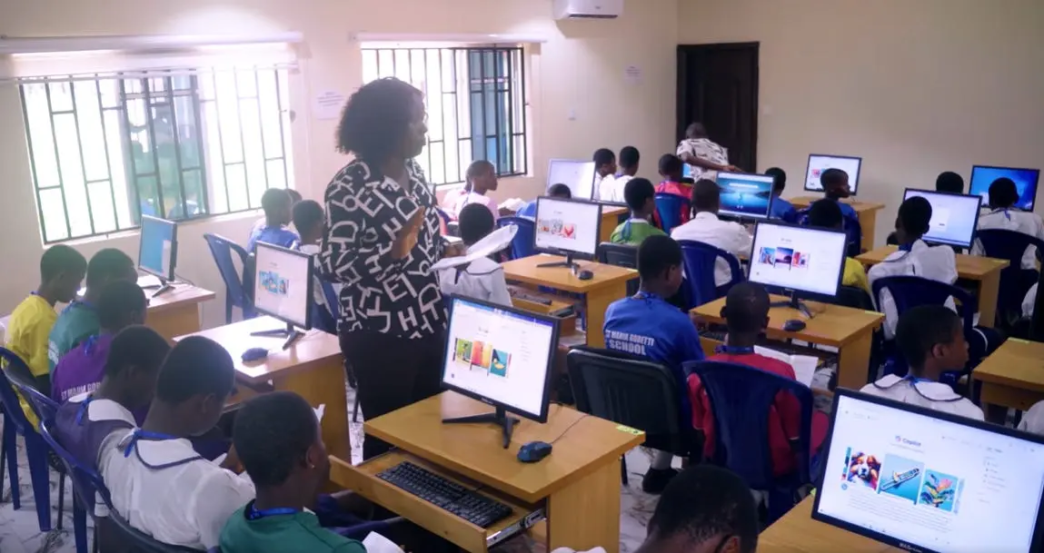
Artificial intelligence (AI) has begun transforming education in Nigeria by helping lecturers create courses, materials and assessments faster.
Across Africa, rising teaching demands and the need to reach learners beyond classrooms are driving educators towards AI.
Nigeria is emerging as an early adopter of educational technology. At Santuval Academy in Abuja, students once attended finance, accounting and investment classes in rented classrooms. Lecturers also spent days preparing lesson plans and learning materials.
Read More : Google Fined €403 Million Over Location Data
For Idris Abba, a chartered accountant and lecturer, the system became difficult to sustain.
“We were having challenges at our center because we rent classrooms, and we discovered that the generation of students we are teaching don’t like sitting in one place for a very long time,” he said.
The academy later moved its classes online. Abba said the shift became easier after he discovered Distinction AI in 2025.
Distinction Labs, a subsidiary of Nigerian education technology company FlexiSAF Edusoft Limited, developed the platform.
Distinction AI uses artificial intelligence to help educators create online courses and teaching materials. Users can generate lecture slides, videos, assignments and exams. They can also deliver courses online and sell them to learners.
For Abba, one major benefit has been the time saved when preparing course materials.
“Lecture slides used to take a minimum of three days to generate, but with Distinction, in a couple of minutes you’ll be able to generate that,” he said.
Abba now creates courses on the platform and tracks student assignments. He said its AI assistant can also mark coursework and provide students with scores and feedback. The experience reflects a wider challenge facing lecturers. They must balance teaching with course preparation, assessments, research, mentorship and student engagement.
Umar Adam Ibrahim, a computer scientist, AI researcher and lecturer at Nigeria’s Nile University, said AI could reduce some of that workload.
“The lecturer does not really have time for research, for student engagement, for mentorship and even community services,” he said.
Ibrahim said AI could also help lecturers create teaching materials and monetise courses.
“The ability for you to create a slide using AI, the ability for you to upload your course content that you can further monetize is a plus from the side of the lecturer,” he added.
He also highlighted the potential for more personalised learning.
“From the side of the student, the ability for you to get a personalized learning structure based on your learning speed, based on your learning ability, it’s also a plus to the student on the other hand,” Ibrahim said.

Distinction AI began with an internal challenge at FlexiSAF. Employees were spending significant time creating courses and training materials for new staff. The company later explored how the technology could support teachers, lecturers and students.
Hamid Bashir, a petroleum chemist and engineer, leads Distinction AI’s product development. Bashir began his career in the oil and gas sector before moving into education technology.
“I started my journey in the oil and gas sector, but as time went on, I realized that to make much impact, we need to be in the educational sector,” he said.
His interest in education was also shaped by his experience as a student. He recalled struggling to follow lessons in crowded classrooms and having to find additional learning materials.
“When I was in school, you are too many, you are crowded, you can’t understand, or you are not able to follow,” Bashir said. He added that students often had to seek tutorials and other resources to support their learning.
Bashir said the problem was not necessarily the quality of lecturers but the number of students they had to teach.
Distinction AI was established in 2024 and now supports teachers, lecturers, coaches and other educators. The platform lets users create courses with slides, videos, and other learning materials.
Course creators can also sell their content to learners. The platform has helped more than 10,000 instructors produce 20,000 courses.
It now has more than 160,000 learners who have spent over two million hours learning on the site. However, the growing use of AI in education also comes with risks.
Bashir said the platform found cases where AI generated incorrect answers, particularly in practice questions.
“So when we’re doing the practice questions, we were having a lot of flags so we added a way for students to flag this kind of thing,” he said.
The company responded by introducing a quality assurance process. AI-generated questions are reviewed before being made available to students.
“We had to have a QA team, a quality assurance team that went through each and every question after AI generated them to make sure it passes, you know, the benchmark that we wanted,” Bashir said.

Ibrahim said universities must also protect students’ personal information and academic records.
“We need to safeguard the student identity, the student grade, the lecturer questions, so there is a need for guardrails,” he said.
He also called for clearer policies on AI use in Nigerian universities.
“For policy, of course, there is a need for NUC (National Universities Commission), Ministry of Education, and all tertiary institution related body to come up with a policy that has to do with AI and tertiary institution,” Ibrahim said.
Evidence from Nigeria also suggests that AI can improve learning when used alongside teachers. A 2025 World Bank study in Edo State found significant learning gains among students who received AI tutoring with instructor support. The students used the system for six weeks.
They achieved learning gains equivalent to 1.5 to two years of traditional schooling. The findings point to a growing role for AI in education.
However, educators and experts say human oversight remains important to ensure accuracy, protect student data and maintain quality.
Credit: Ibrahim Ismail by Bird Story Agency.