Trending


Eight Arab and Islamic countries have welcomed the United Kingdom’s decision to ban goods imported from Israeli settlements in the occupied Palestinian territory, calling for similar international action against activities that support the settlements.
In a joint statement issued in Doha on Wednesday, the foreign ministers of Qatar, Türkiye, Egypt, Indonesia, Jordan, Pakistan, Saudi Arabia and the United Arab Emirates said they welcomed Britain’s decision to ban settlement goods and restrict services linked to settlements.
The ministers said they hoped the move would help “mobilise the international community to take similar actions in line with international law” and hold accountable “settlement organizations and individuals engaged in illegal settlement activities.”
The statement comes after Britain announced sweeping restrictions on trade with Israeli settlements in the occupied West Bank, alongside targeted measures against those facilitating or profiting from settlement activity.
Britain’s decision followed a coordinated move by the United Kingdom, France and Canada, whose leaders said settlements were illegal under international law and that their governments would take steps to ban importing goods from settlements.
The three countries said “systematic settlement expansion in the West Bank” and rising settler violence posed “a direct and urgent threat” to the prospect of peace and a two-state solution.
A separate joint statement issued by the foreign ministers of Canada, Denmark, Finland, France, Iceland, Ireland, Norway, Poland, Portugal, Spain, Sweden and the United Kingdom also confirmed their intention to introduce national restrictions or support European restrictions on trade in goods from settlements considered illegal under international law.
The European and North American ministers said the situation in the West Bank was “rapidly deteriorating amid unprecedented levels of settler violence and settlement expansion,” warning that Israel’s actions were undermining the possibility of a two-state solution.
They said the countries were “resolute” that the two-state solution “must be protected,” adding that they would take action to pursue a just and lasting peace.
The eight Arab and Islamic countries urged the wider international community to build on the latest measures and take concrete measures to bring an end to activities that support or sustain illegal Israeli settlements in the Occupied Palestinian Territory.
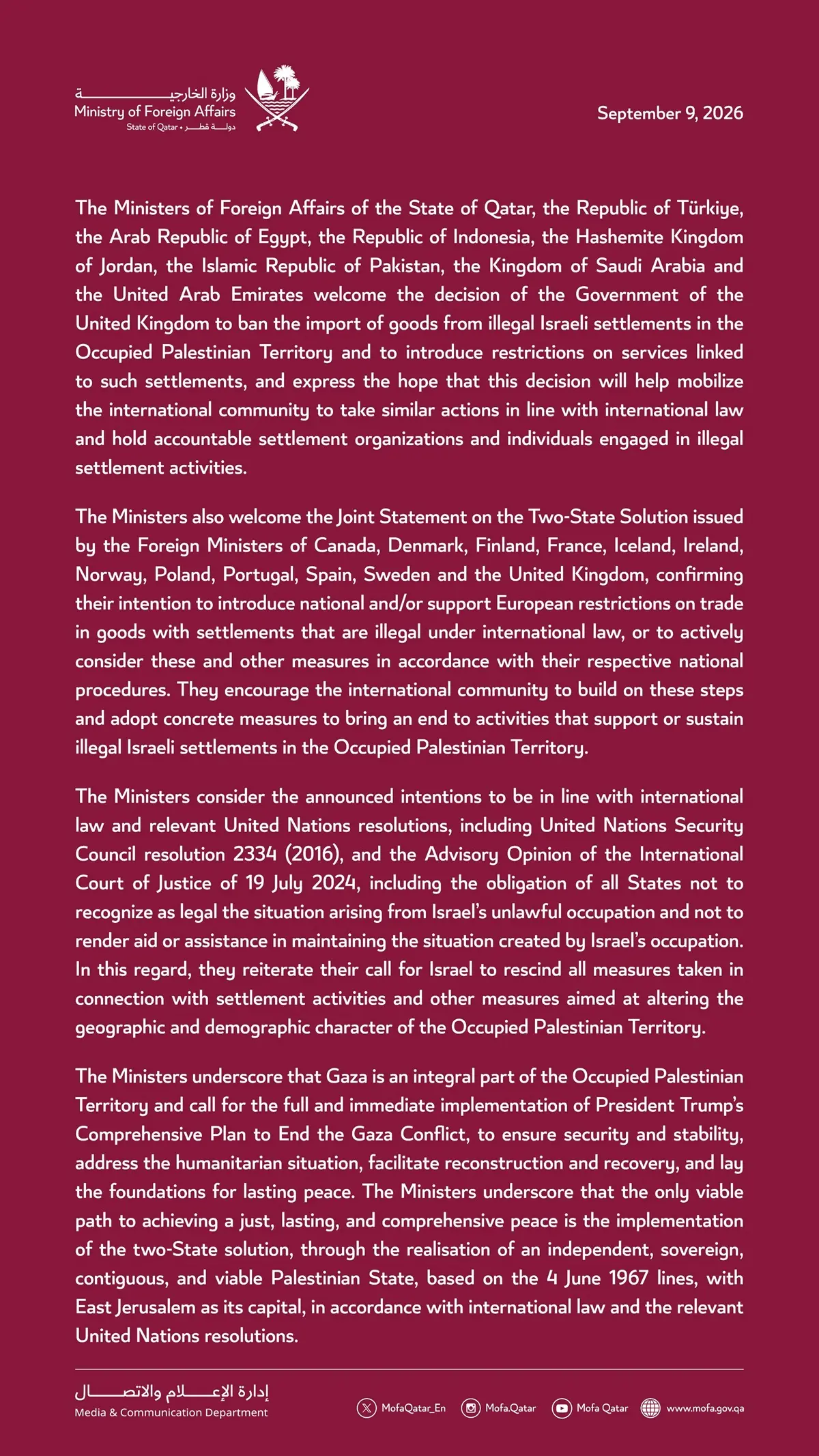
They said the restrictions were consistent with international law and cited United Nations Security Council Resolution 2334, adopted in 2016, as well as the International Court of Justice’s July 19, 2024 advisory opinion.
Resolution 2334 states that Israeli settlements in territory occupied since 1967 have “no legal validity” and constitute a major obstacle to the achievement of a two-state solution.
The ICJ, in its 2024 advisory opinion, said Israel’s continued presence in the occupied Palestinian territory was unlawful and said states had obligations not to recognise as legal the situation arising from the occupation or provide aid or assistance in maintaining it.
The ministers said Israel should “rescind all measures taken in connection with settlement activities and other measures aimed at altering the geographic and demographic character of the Occupied Palestinian Territory.”
They also stressed that Gaza was “an integral part of the Occupied Palestinian Territory” and called for the “full and immediate implementation” of President Donald Trump’s Comprehensive Plan to End the Gaza Conflict.
The White House has described the 20-point plan as a roadmap to advance peace, stability, reconstruction, and long-term governance in Gaza.
The plan remains active, although disagreements over implementation, including the disarmament of Hamas and the withdrawal of Israeli forces, have complicated its progress.
The eight ministers maintained that a two-state solution remained “the only viable path” towards a just, lasting and comprehensive peace.
They called for the establishment of “an independent, sovereign, contiguous, and viable Palestinian State, based on the 4 June 1967 lines, with East Jerusalem as its capital,” in line with international law and relevant United Nations resolutions.
The statement adds to growing international pressure over Israeli settlement expansion, with a widening group of Western, Arab and Islamic governments now calling for concrete measures to protect the prospect of an independent Palestinian state and a negotiated two-state solution.
8 Arab and Islamic countries welcome the decision of the Government of the United Kingdom to ban the import of goods from illegal Israeli settlements in the Occupied Palestinian
Doha | September 9, 2026
The Ministers of Foreign Affairs of the State of Qatar, the Republic of… pic.twitter.com/7w4eaY5Csu
— Ministry of Foreign Affairs – Qatar (@MofaQatar_EN) September 9, 2026