Trending
Khadija Sambe, a Senegalese surf coach who began surfing at 13, has become a role model for young female surfers.
Sambe said she felt immense joy when she stood on a surfboard for the first time.
“I screamed with joy,” she recalled. “It was something extraordinary.”
Read More : AI Governance Diverges Among Global Powers
That moment, she explained, marked the beginning of a journey that would take her beyond her imagination but also deeper into the questions she had already begun to ask as a teenager: why did she not see girls in the water? And why had she never seen a Black Senegalese woman surfer?
“I had never seen a black woman surfing before,” she said. “I kept asking myself: where are the girls? Where are the Senegalese?”
Those questions stayed with her. Surfing existed all around her, but always as something performed by others.
Sambe said growing up, surfing was not seen as an appropriate activity for girls.
“At the beginning, it was very difficult. My parents didn’t want me to surf. Neighbours and relatives were coming to my house to tell them that a girl should stay at home, cooking, cleaning, or looking for a husband, not surfing,” she added.
The pressure reflected a wider set of norms that shaped how girls were expected to move through public and private life in many communities. The beach was not exempt from those expectations. But Sambe continued anyway.
But Sambe remained determined, even without peers and a visible path. There was also no reference point for what a Black female surfer from Senegal could become. That isolation eventually led her to build something different.
“I grew up surfing alone and without female references, which is why I created Black Girls Surf Academy in Ngor, to show the girls that it is possible and to make them know they are not alone,” she said.
Many years later, Sambe sees her role as Senegal’s first professional female surfer less as a personal milestone and more as a responsibility she carries for the girls coming after her. She works with an academy that is part of a wider initiative founded by Rhonda Harper in 2014, which now operates in Senegal, Sierra Leone, Nigeria and the United States.
While its focus is surfing, its structure is built around something broader: access and representation in a sport where Black girls have historically been excluded. Harper emphasised the importance of representation in shaping what young people believe is possible.
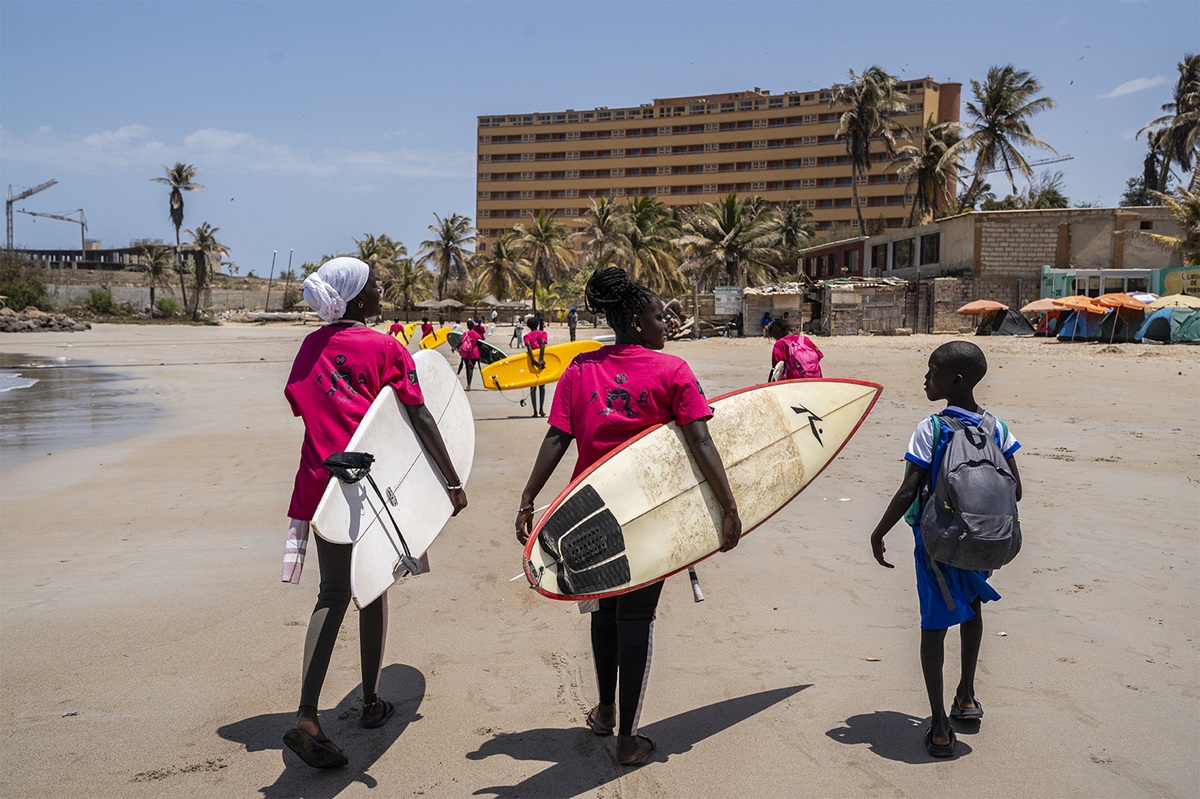
“The importance of having role models in sports is what I always say: if you can see it, you can be it,” she explains. “If you don’t see somebody doing it, you don’t think you can.”
“So when these girls go out in the world and other girls see them, more girls are going to want to be like them,” she continued. “There’s a culture here that tells women that they need to be this, that or the other, and it’s very linear. It isn’t a broad look on life.”
She leads the programme in the Senegalese capital, Dakar, directly, working with girls aged seven to seventeen. But the academy is not only about surfing technique. It is built around education and mentorship, responding to the reality that many girls in coastal communities face interruptions in schooling due to economic or social pressures.
In Ngor, a small fishing and surfing community on the western edge of Dakar, Senegal’s capital, where the city meets the Atlantic Ocean, Sambe saw this pattern repeatedly.
Ngor is a place shaped by the sea in every sense—where fishing boats are launched through the surf at dawn, where waves dictate movement and livelihood, and where surfing has long been part of youth culture.
Yet even amongst the youth, surf culture has historically belonged almost entirely to boys and men, leaving girls at the margins of the water they grew up beside.
“ I saw many girls who were not in school. Sometimes because of lack of means, sometimes because of necessity. That’s why I wanted Black Girls Surf to be more than a surf academy, it’s also a way to fight school dropout. Education is a very important part of the programme,” said Sambe.
According to UNICEF, only 37% of girls in Senegal complete a full cycle of basic education, with dropout rates rising sharply during adolescence due to financial pressure, household responsibility, and early marriage expectations.
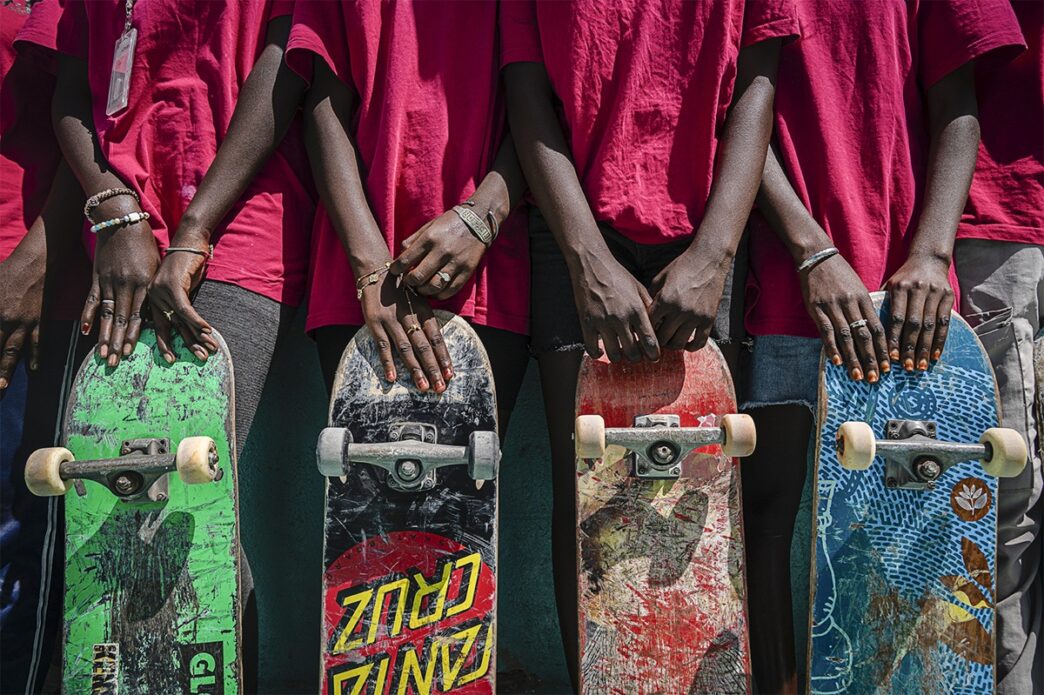
The academy responds by combining surf training with structured learning spaces and mentorship sessions designed to build confidence, discipline and belonging. Alongside surfing, girls are also introduced to activities like skateboarding as part of a wider approach to physical and emotional empowerment.
The academy responds by combining surf training with structured learning spaces and mentorship sessions designed to build confidence, discipline and belonging. Alongside surfing, girls are also introduced to activities like skateboarding as part of a wider approach to physical and emotional empowerment.
For many participants, the shift is immediate and practical.
“Before joining Black Girls Surf, I used to help my mother prepare fatayas and sell food on the beach,” says Rabiatou Ba, 20. “I had to leave school a long time ago.”
Her path reflects a common reality in which girls leave education not by choice but by circumstance. After time spent in Guinea caring for her grandmother, she returned to Senegal and joined the academy, finding a structure that allowed her to rebuild both routine and aspiration.
For younger participants, ambition often takes a different shape.
“My dream is to become an African surfing champion,” says 17-year-old Khardiata Mbengue. “I want to succeed to help my family, and I know surfing will take me there.”
The presence of the academy has not erased resistance. Social expectations remain strong, and Sambe continues to operate within a space that still questions women’s presence in the water.
“I know there are people who don’t want me here,” she said.
But she does not retreat.
“I will not give up.”
She encourages the girls to focus inward rather than on external pressure.
“I always tell them not to listen to what people say,” she added. “They should focus on their studies and on surfing. If you educate one girl, you educate the entire village,” she says.
The transformation in Ngor is gradual rather than dramatic. It is measured in repetition: more girls entering the water, more parents allowing participation, more visibility on the shoreline.
“Surfing is transforming the girls,” Sambe says. “They have gained confidence and self-esteem. It strengthens both their physical and mental well-being.”
Back in the water, another wave approaches. One of the younger girls hesitates briefly, then commits. She paddles, stands, and rides—still unsteady, but no longer uncertain.
Marta Moreiras, Bird Story Agency