Trending
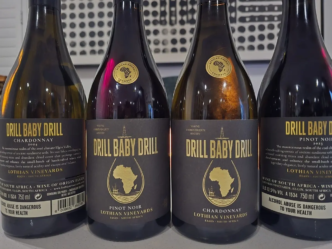
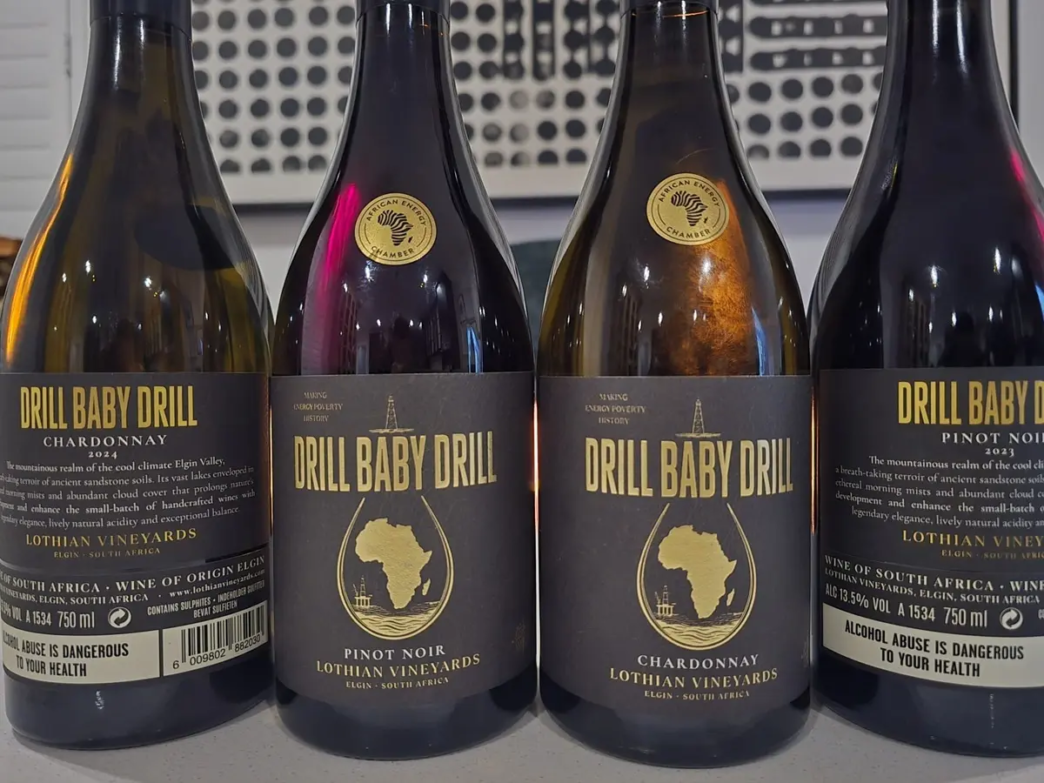
“Drill Baby Drill” is more than an audacious label. By putting Africa’s energy-access argument on bottles of Pinot Noir and Chardonnay, the African Energy Chamber is inserting a development challenge into one of the world’s most contentious political debates.
A bottle of wine is an unlikely place to encounter the politics of the global energy transition.
Yet that is precisely what makes “Drill Baby Drill” difficult to ignore.
Read More : Is Nigeria Becoming a Fake Country?
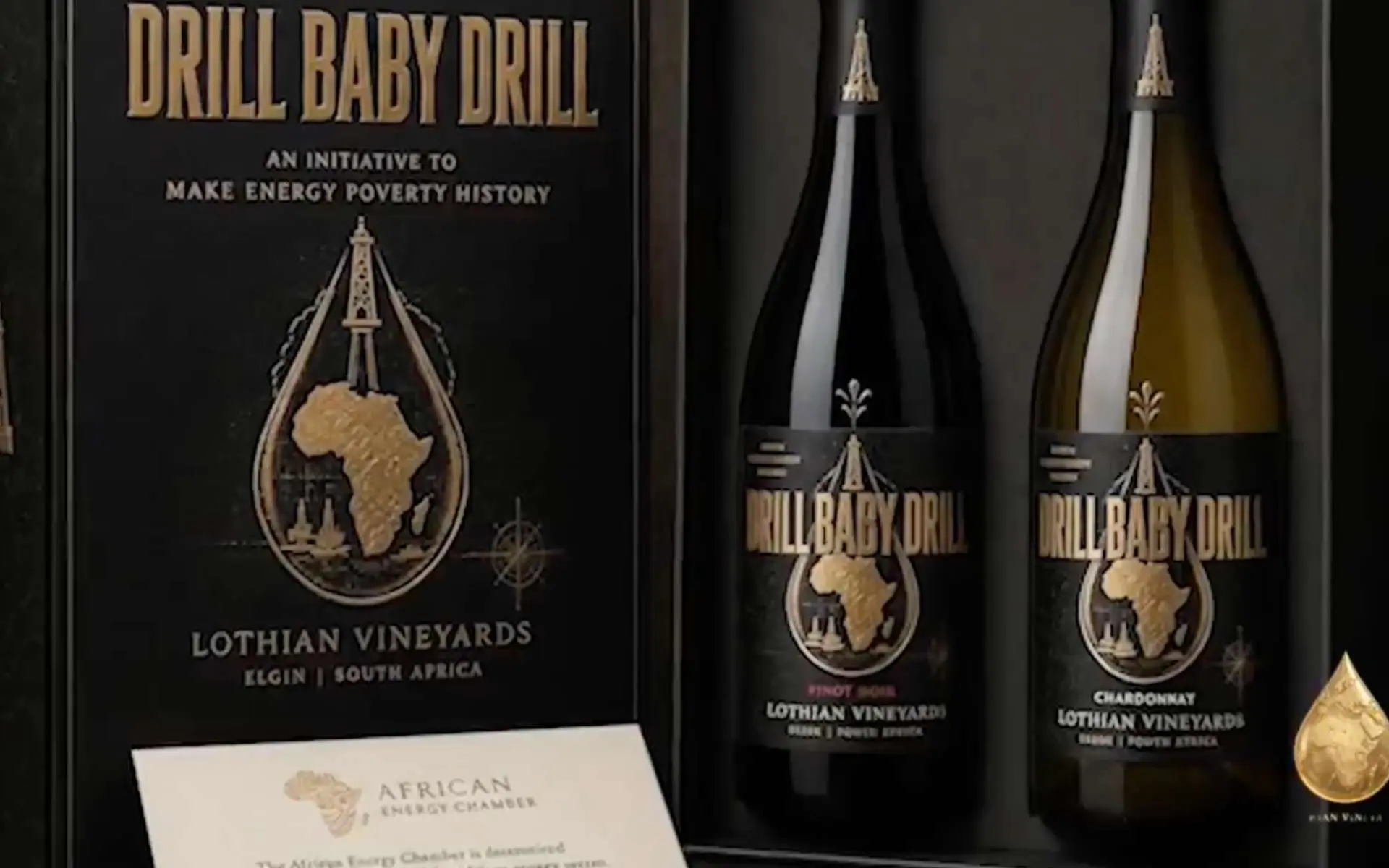
Created through a collaboration between the African Energy Chamber and Lothian Vineyards in South Africa’s Elgin Valley, the new wine brand arrives as Pinot Noir and Chardonnay wrapped in black-and-gold labels, drilling imagery and a message that reaches far beyond the vineyard: “An initiative to make energy poverty history.”
The African Energy Chamber says the wine will be unveiled at African Energy Week 2026 and describes it as a brand celebrating the energy industry and the community that invests in, builds and supports it. The collaboration brings together Lothian’s cool-climate Chardonnay and Pinot Noir with a Chamber that has become one of the continent’s most forceful advocates for increased investment in African energy.
But the wine is interesting precisely because it refuses to behave like a conventional wine.
Its name is political.
Its label is argumentative.
And behind the polished imagery of corks flying, wine pouring and bottles positioned against elegant backdrops sits a much harder question:
Who gets to decide what Africa’s energy transition should look like?
A slogan enters a global argument
“Drill Baby Drill” comes with political baggage.
The phrase is internationally associated with demands for increased oil and gas production. In much of the developed world, it sits almost directly opposite the vocabulary of decarbonisation, net zero, electrification and the rapid expansion of renewable energy.
Put those words on an African wine bottle and the meaning changes.
Or, at the very least, becomes more complicated.
The African Energy Chamber’s position has long been that the continent cannot approach the energy transition from the same starting point as Europe or North America.
For much of the developed world, the transition debate is fundamentally about replacing an existing energy system.
For millions of Africans, the more immediate challenge remains getting an adequate energy system in the first place.
That distinction is central to understanding the politics behind the bottle.
The latest international data underline the scale of the problem. More than 560 million people in sub-Saharan Africa still live without electricity, according to the 2026 Tracking SDG 7 assessment, while nearly one billion lack access to clean cooking. The report warns that electrification in the region must accelerate dramatically if universal access is to be achieved.
That is not merely an energy statistic.
It is an industrial statistic, a healthcare statistic, an education statistic and ultimately a development statistic.
Factories need electricity. Hospitals need it. Data centres need it. Irrigation systems, cold storage facilities, mines, schools, telecommunications networks and growing cities all depend on reliable power.
The International Energy Agency has similarly warned that Africa’s energy deficit constrains economic growth and industrial potential even though the continent possesses enormous fossil, solar, wind, hydro and geothermal resources.
This is the terrain on which “Drill Baby Drill” is attempting to make its argument.
The transition looks different from Africa
There is no serious dispute that the global energy system is changing.
Renewable-energy deployment is accelerating. Solar and wind have become increasingly competitive. Battery storage is expanding. Electric vehicles are reshaping transport markets. Governments are under pressure to reduce emissions.
Africa is part of that transition.
Indeed, some of the continent’s most compelling energy opportunities are renewable.
But the argument advanced by many African governments and energy advocates is that transition cannot mean simply transferring policy assumptions developed in mature energy economies onto countries where electricity access remains radically inadequate.
Africa therefore confronts two energy imperatives simultaneously.
It must build the energy system it does not yet have while preparing for the lower-carbon system the world is attempting to create.
That is considerably more difficult than replacing one mature system with another.
The debate consequently becomes less useful when reduced to a binary choice between hydrocarbons and renewables.
The more difficult question is what combination of gas, oil, hydro, solar, wind, geothermal, nuclear, grids, mini-grids and storage can deliver energy quickly enough, affordably enough and at sufficient scale to support development.
That is where the politics begin.
When climate policy meets development reality
The global transition has never been only about technology.
It is also about capital, influence and power.
Who receives investment?
Which projects qualify for finance?
Which fuels are considered acceptable?
Whose development pathway is regarded as legitimate?
These questions are particularly sensitive for African economies with substantial hydrocarbon resources but limited domestic electricity supply.
Some countries are being asked to contemplate leaving fossil resources underground while simultaneously struggling to finance power generation, transport infrastructure and industrialisation.
That tension has created growing resistance to what some African policymakers regard as a transition agenda shaped disproportionately by countries that became wealthy through centuries of intensive energy consumption.
The counterargument is equally important.
Climate change is already imposing severe costs on African economies, even though the continent has contributed relatively little to historical emissions. Expanding fossil infrastructure creates the risk of locking countries into carbon-intensive systems at precisely the moment clean technologies are becoming cheaper.
That is why the strongest African energy argument cannot simply be “drill everything.”
It must be more sophisticated:
Develop what is necessary, invest aggressively in cleaner energy, expand electricity access and allow African development priorities to determine the sequencing.
The danger with “Drill Baby Drill” is that the slogan can flatten that nuance.
Its advantage is that it forces the conversation to happen.
Why put the argument on wine?
This is where the initiative becomes particularly interesting as a communications strategy.
Energy policy is rarely culturally attractive.
It arrives in thick reports, technical presentations, communiqués, investment memoranda and conference speeches.
Wine operates differently.
Wine travels through restaurants, private dinners, receptions, hotels, business gatherings and celebrations.
It belongs to conversation.
By placing a contentious energy message onto a premium consumer product, the African Energy Chamber is effectively moving its argument from the conference podium to the dining table.
The bottle becomes media.
Its label becomes an editorial statement.
Its name becomes a provocation.
A person encountering “Drill Baby Drill” for the first time is almost compelled to ask what it means.
That curiosity is the communications opportunity.
The product therefore represents more than merchandise. It is an experiment in whether policy advocacy can migrate successfully into consumer culture.
Elgin gives the politics an unexpected elegance
There is also something striking about where the product comes from.
Lothian Vineyards sits in South Africa’s Elgin Valley, a region associated with cool-climate wine production rather than political agitation.
The Chamber says the launch brings together two industries central to Africa’s economic story: energy development and South African winemaking.
That juxtaposition matters.
A slogan usually associated with drilling rigs has been placed on Chardonnay and Pinot Noir.
Heavy industry meets terroir.
Energy politics meets hospitality.
The apparent contradiction is what gives the product much of its visual power.
The wine does not look like protest material. It looks premium.
That aesthetic allows the campaign to enter places where an explicitly political poster or advocacy pamphlet would feel intrusive.
Beyond hydrocarbons
The campaign will nevertheless have to resist one obvious weakness.
If the entire argument becomes “Africa needs more drilling,” it will fail to capture the actual scale of Africa’s energy challenge.
The electricity-access gap cannot be solved by oil and gas alone.
The IEA says universal access requires a combination of grid expansion, mini-grids and stand-alone systems, while financing remains one of the largest obstacles. Its analysis estimated that less than $2.5 billion annually was being committed to electricity access in sub-Saharan Africa even though investment needs are far higher.
That means solar matters.
Transmission matters.
Gas matters in some markets.
Hydropower matters.
Storage matters.
Private capital matters.
Regulatory reform matters.
So does the ability of households to afford the electricity once it arrives.
The World Bank and African Development Bank’s Mission 300 initiative, which aims to connect 300 million Africans to electricity by 2030, similarly treats the challenge as one requiring large-scale reform, investment and a broad range of technologies rather than a single fuel solution.
That complexity should strengthen rather than weaken the Chamber’s case.
The most persuasive argument for African energy sovereignty is not that fossil fuels should defeat renewables.
It is that Africans should be able to deploy every realistic energy option necessary to eliminate energy poverty and industrialise their economies.
A bottle cannot solve energy poverty
There is, of course, an important distinction between branding a cause and solving it.
No wine, however cleverly conceived, will build transmission lines, finance power plants or connect unelectrified communities.
The significance of “Drill Baby Drill” will therefore depend partly on what follows the launch.
The product’s packaging links it to making energy poverty history. The stronger that connection becomes in practical terms — through measurable programmes, fundraising, investment mobilisation or identifiable energy-access initiatives — the more difficult it will be to dismiss the project as provocative branding alone.
Without that bridge, critics could reasonably ask whether energy poverty has simply been turned into a marketing device.
That is the challenge the campaign must ultimately answer.
The politics inside the bottle
Yet even before a cork is pulled, “Drill Baby Drill” has already achieved something unusual.
It has compressed a vast geopolitical disagreement into a consumer object.
On one side sits the urgency of climate change and the global effort to move away from carbon-intensive energy.
On the other sits a continent where hundreds of millions still lack electricity and governments are desperate for the investment, infrastructure and energy required for industrial growth.
Between them sits the unresolved question of fairness.
Should countries that have barely begun to consume modern energy be expected to transition on the same timetable as those that have enjoyed it for generations?
Should Africa develop gas while simultaneously expanding renewables?
Who should finance the transition?
And when climate objectives and development priorities collide, which should come first?
These questions will not be settled by Pinot Noir or Chardonnay.
But perhaps that is not what the wine is trying to do.
Its purpose may simply be to put a neglected contradiction in front of people who might otherwise never encounter it.
The global energy transition is frequently presented as a journey with an agreed destination.
Africa keeps reminding the world that countries are starting that journey from profoundly different places.
“Drill Baby Drill,” for all its provocation, puts that argument in unusually simple form.
The wine may come from Elgin.
But the debate inside the bottle belongs to an entire continent.