Trending
The headline is not an exaggeration. It is just an observation drawn from the daily evidence of a nation where the counterfeit has become the norm. Consider what it means to live in a country where the medicine that could save your child might be ordinary chalk, where the agency that claims to represent you in foreign capitals does not legally exist, and where the certificate that qualifies a minister to govern was never actually earned.
I ask a genuine question: Is this not a portrait of a nation in decline? Because I truly believe this is an anatomy of a nation becoming fake, not in the sense of ceasing to exist, but in losing the essential qualities that make a country real: trust, legitimacy, and a shared commitment to truth.
In September 2026, NAFDAC said something that should scare every Nigerian. Chinese people who make fake products are no longer just shipping them into Nigeria. They have come inside the country, and they are building factories here and setting up their warehouses here.
“Before, to fake a product, you needed to go to China to bring it. Now, they are here with us,” said Martins Iluyomade, NAFDAC director of investigation and enforcement.
NAFDAC has destroyed fake products worth more than ₦1.5 trillion. Between June 2025 and June 2026, the agency got 64 people convicted. That is the highest number ever. One man who was running an illegal drinks factory got five years in prison.
But these big numbers also show how bad the problem is. In February 2026, NAFDAC found what it called “death warehouses” in Lagos. Inside were more than 10 million doses of fake and banned drugs worth ₦3 billion. The fake malaria injections alone could have killed more than three million people.
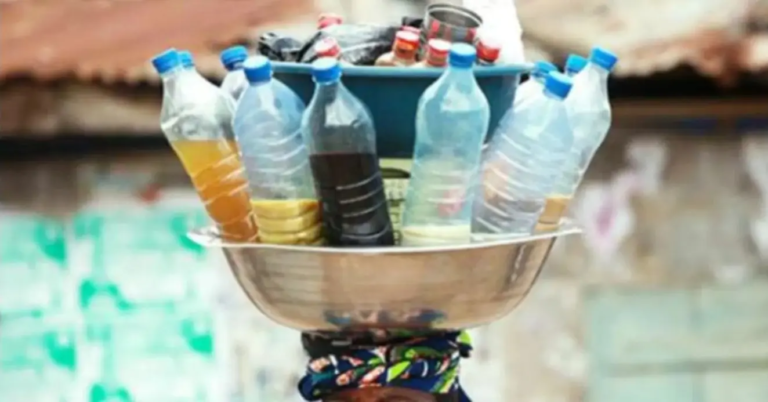
This is not merely a consumer protection issue. When adulterated toothpaste, contaminated bottled water, and fake cosmetics circulate freely, the state has failed in its most fundamental duty: to protect its citizens. The counterfeiters are not hiding; they are operating logistics companies and establishing production facilities. They have, in effect, built a parallel economy of the fake.
The problem extends far beyond counterfeit goods. In August 2026, Nigerians learnt that a purported government agency, the Presidential Foreign Intervention Promotion Council (PFIPC), had operated for nearly two years from an office inside the Federal Secretariat in Abuja. It had a website, a social media presence, and even approval to hire over 300 staff. Its “Director-General” met with cabinet ministers and foreign diplomats. The agency was allocated ₦1.3 billion in the national budget. There was only one problem: it did not officially exist. A second fake agency, the National Brands Development and Made in Nigeria Special Project Office, is now also under investigation.
When fake government agencies can operate undetected within the heart of the federal bureaucracy, the distinction between the real and the counterfeit has collapsed. The machinery of state has become so opaque, so riddled with forged signatures and falsified seals, that even the government cannot reliably distinguish its own institutions from those manufactured by fraudsters.
The rot reaches into the highest levels of public service. Allegations of certificate forgery have dogged ministers, security officials, and even a former finance minister who resigned in 2018 over a forged NYSC exemption certificate. The Federal University of Education in Pankshin recently uncovered a syndicate specialising in forging academic certificates bearing its name, leading to convictions and prison sentences. When the credentials of those who govern us are themselves counterfeit, what legitimacy can the system claim?
Even the outside world now struggles to see Nigeria clearly. At the 2026 AIDS Conference in Rio de Janeiro, the US State Department presented a map of Africa on which Nigeria was depicted as a landlocked nation in the Sahara Desert. The map, which bore the watermark of an AI image generator, placed Mozambique at the Horn of Africa and moved Côte d’Ivoire to the wrong side of the continent. The US government apologised, blaming a rushed slide change but the incident resonated because it captured something true: Nigeria has become a place so associated with fabrication that even AI-generated fictions are more legible to the outside world than the actual country.
This is the danger of becoming a fake country. It is not that Nigeria will literally cease to exist on any map. It is that the country will lose the essential qualities that make a nation real: a functioning social contract, institutions that command trust, and a shared commitment to truth.
When counterfeiters operate with impunity, when fake agencies drain public resources, when forged certificates secure positions of power, and when the state cannot distinguish between what is real and what is fabricated, the nation becomes a shell, a geographical expression held together by little more than inertia and the coercive power of the state.
The task of rebuilding is monumental, as it requires not just stronger enforcement, though that is essential. It requires a fundamental reckoning with the culture of impunity that allows the counterfeit to flourish. It requires leaders who understand that legitimacy cannot be forged and that a nation, like a product, cannot be re-branded if its contents are poisonous.
Nigeria is not yet a fake country, but the warning signs are everywhere. The question is whether we will listen to them before the distinction between the real and the counterfeit becomes impossible to recover.
Read More : From Ojuelegba Bridge to the Ballot Box