Trending


Nepal’s Prime Minister Balendra Shah has described the catastrophic flooding that hit the country last month as a warning to the world about the growing dangers of climate change.
Addressing the United Nations General Assembly on Thursday, Shah said rising temperatures were destabilising the Himalayan ecosystem, contributing to glacier melt, permafrost thaw and increasingly dangerous weather events.
Nepal suffered one of the worst disasters in its history last month after a tsunami-like flood, triggered by the collapse of a high-altitude glacier mountain along the Nepal-China border, caused widespread destruction.
Read More : Iraq’s Najaf Airport Halts Iranian Flights
More than 1,400 people were killed, while about 6,000 others remain missing. The economic damage is estimated to run into billions of dollars.
Scientists from World Weather Attribution have described the disaster as a compound crisis in which geological instability was worsened by long-term warming, glacier retreat and thawing permafrost.
Shah said Nepal contributed less than 0.1 per cent of global greenhouse gas emissions but was bearing the consequences of a crisis it did not create.
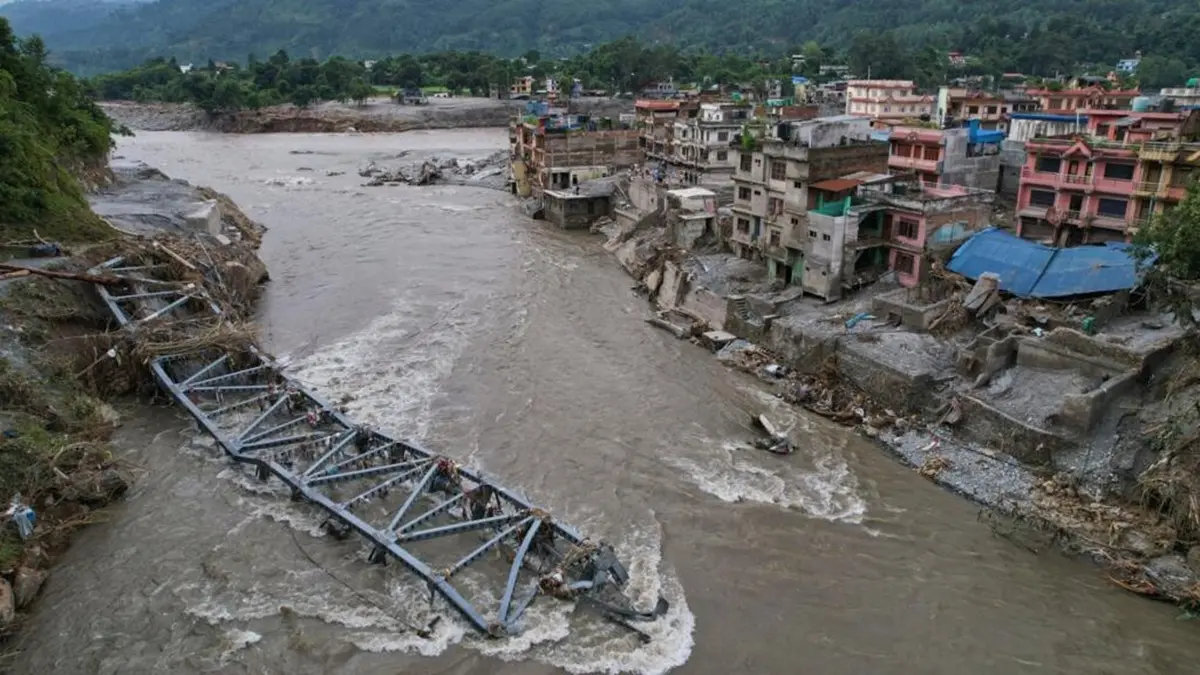
A drone view of a bridge damaged by flash flooding along the Tadi River in the Devighat area of Nuwakot district, Nepal, on August 29, 2026. Credit: France 24.
“Nepal contributes less than 0.1 percent of global greenhouse gas emission. We did not create this crisis, yet we are paying for it,” he said.
He called on the international community to share the cost of helping Nepal adapt, saying the country could not build resilience on its own against a crisis intensified by failures in global governance.
Shah proposed a “Himalaya Climate Resilience Mechanism” involving Nepal, India and China to facilitate sharing satellite data and expertise, monitoring glacial lakes and strengthening joint early-warning systems.
The 36-year-old former rapper came to power six months ago after a wave of youth-led anti-corruption protests and had campaigned on hopes of political change.
The scale of the disaster, however, has pushed climate diplomacy to the centre of his administration, overshadowing its anti-corruption agenda.
Nepal has requested $20 million from the UN’s Loss and Damage Fund, the maximum amount it can seek, although that represents only a fraction of the estimated needs.
A preliminary government assessment puts the total cost of the disaster at about $5 billion.
Read More : Iran Proposes Reopening Hormuz Within Seven Days
The Loss and Damage Fund was established in 2022 following catastrophic floods in Pakistan but has yet to make its first disbursement, making Nepal an important test of the fund’s effectiveness.
The United States pledged an additional $31 million in flood recovery assistance earlier this week.
Nepal’s Foreign Minister Shisir Khanal also told AFP that G7 countries had informally pledged support at a meeting on Wednesday, while Britain had separately promised assistance.