Trending
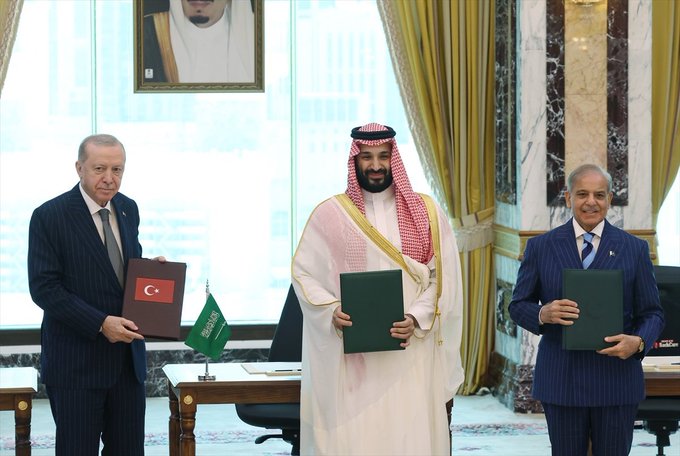
Pakistan, Saudi Arabia and Türkiye have signed a trilateral defence agreement committing them to collective security and mutual defence, as the three countries seek closer strategic cooperation following heightened tensions across the region.
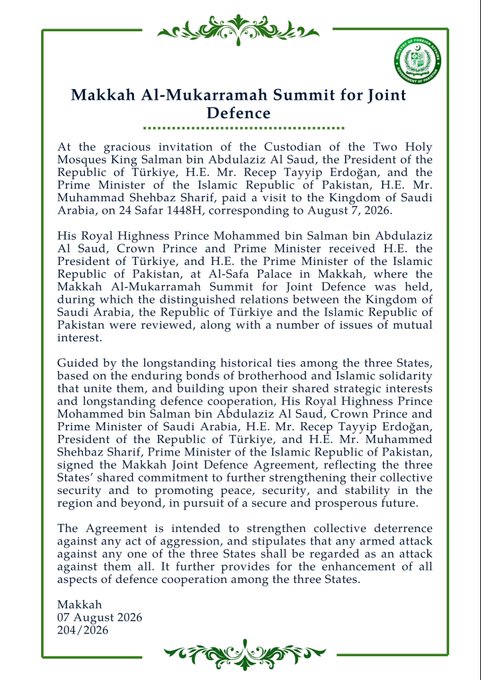
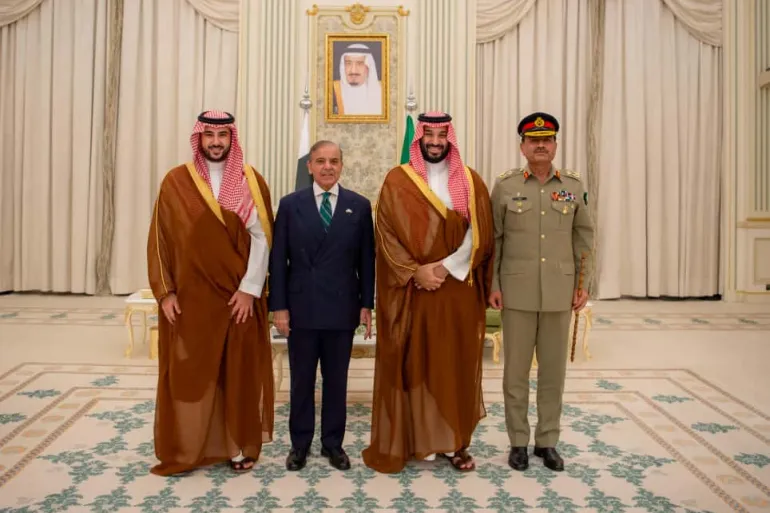
The Makkah Joint Defence Agreement, also referred to as the Makkah Accord, was signed in Makkah, Saudi Arabia, on Friday, August 7, 2026, by Saudi Crown Prince Mohammed bin Salman, Pakistani Prime Minister Shehbaz Sharif and Turkish President Recep Tayyip Erdoğan.
Pakistan’s Foreign Minister Ishaq Dar subsequently described the pact as “purely defensive in nature” and said it was not directed against any country.
Read More : UNGA: Lavrov Offers Help in Gulf, Slams Europe
Here is what the agreement means:
What is the Makkah Accord?
The agreement is a new trilateral security framework between Pakistan, Saudi Arabia and Türkiye.
According to Pakistan’s Foreign Ministry, it is the culmination of years of discussions and coordination aimed at strengthening strategic cooperation on peace and security challenges.
The agreement is intended to deepen cooperation among the three countries while supporting what they describe as regional peace, stability and prosperity.
What is its key provision?
The most significant provision is a collective-defence commitment.
Under the agreement, an armed attack on any one of the three countries will be considered an attack on all three.
Pakistan said this provision is consistent with the inherent right of individual and collective self-defence under Article 51 of the United Nations Charter.
Article 51 recognises the right of UN member states to defend themselves individually or collectively if an armed attack occurs.
The provision is therefore similar in principle to collective-defence arrangements found in other military alliances, although analysts caution against automatically equating the Makkah Accord with NATO.
Is the agreement directed against another country?
Pakistan says no.
Following the signing, Dar stressed that the agreement is “purely defensive in nature” and “not targeted against any country.”
He said its purpose is to strengthen efforts towards peace, stability and prosperity in the wider region.
This clarification is significant because the agreement was signed following heightened regional tensions, including the ongoing confrontation involving the United States and Iran. Turkish Foreign Minister Hakan Fidan also said the pact was not aimed at Iran or any other country.
Does it replace existing defence agreements?
No.
The Makkah Accord does not cancel or replace existing bilateral or multilateral agreements involving the three countries.
Pakistan specifically said the agreement “does not abrogate or replace any existing bilateral or multilateral agreements” between the signatories or their agreements with other countries and organisations.
This is important because the three countries already have extensive defence relationships.
Pakistan and Saudi Arabia, for example, signed a separate Strategic Mutual Defence Agreement in September 2025, under which aggression against one country was to be treated as aggression against both.
Pakistan and Türkiye have also maintained expanding defence-industrial and military cooperation.
Who can join the agreement?
The accord is open to other countries in the region, according to Pakistan.
However, prospective participants would have to uphold the agreement’s fundamental principles and commit to resolving differences through mutual respect, cooperation and peaceful means.
This means the agreement is being presented as potentially expandable rather than a closed three-country military bloc.
Why is the agreement significant?
The three countries bring different strategic capabilities and influence to the arrangement.
Pakistan has one of the region’s most experienced militaries and is the only nuclear-armed Muslim-majority country.
Saudi Arabia has substantial economic resources, energy influence and considerable political weight in the Arab and Muslim worlds.
Türkiye, a NATO member, has a large military and a growing domestic defence industry, including capabilities in drones and other military technologies.
The combination gives the agreement significance beyond the immediate military commitments.
However, analysts caution that the pact should not be treated as equivalent to NATO simply because it contains a collective-defence clause. The exact operational mechanisms for responding to an attack, including how military assistance would be coordinated, remain important questions.
What is the regional context?
The agreement comes at a time of heightened insecurity in the Middle East and surrounding regions.
It also builds on increasingly close Pakistan-Saudi defence ties.
The two countries’ 2025 Strategic Mutual Defence Agreement had already established a commitment to regard an attack on either as aggression against both.
Saudi Arabia later confirmed the arrival of Pakistani military personnel and fighter aircraft in the kingdom in 2026 under their defence cooperation framework.
The new agreement brings Türkiye into a trilateral framework, potentially broadening the security cooperation between three influential Muslim-majority states.
Pakistan has nevertheless emphasised that the agreement is intended to support regional stability rather than confrontation.
Read More : Trump Rejects Iran Proposal To Reopen Hormuz
What does Pakistan say about its broader objective?
Pakistan has described the accord as consistent with its foreign-policy principles and said it intends to continue working with countries across the region.
Dar said Pakistan remained committed to “peaceful resolution of all conflicts” and to building a “more secure, stable and prosperous future” for its people.
The agreement therefore represents both a security commitment and a diplomatic message: the three signatories want deeper strategic coordination while presenting the arrangement as defensive and open to wider regional cooperation.